London, United Kingdom№ 000060318
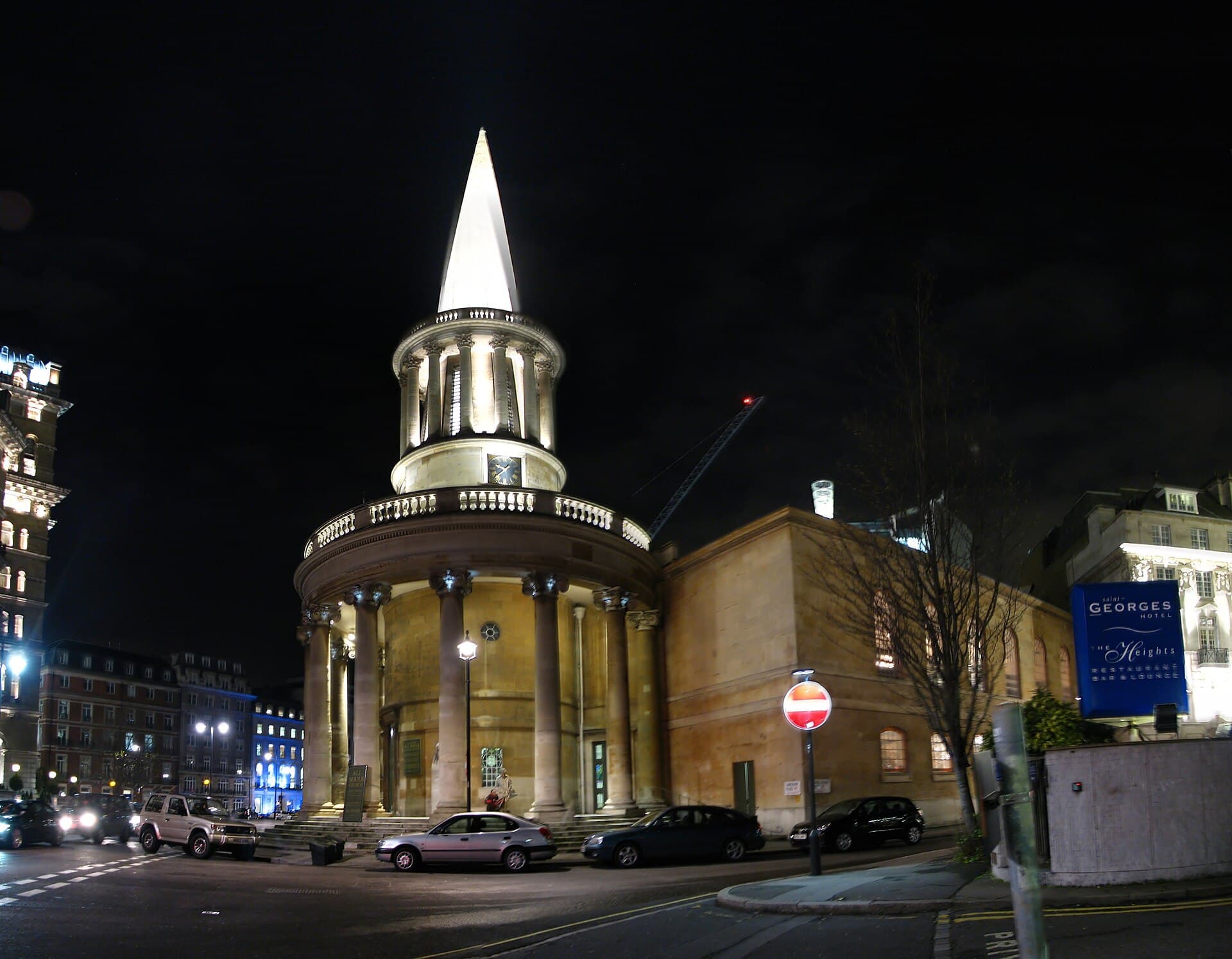
All Souls Church, Langham Place
- Founded
- 1824
- Tradition
- Anglican / Episcopal
- Architect
- John Nash
- Style
- Regency
About this place
History & significance.
All Souls Church, Langham Place, is one of the most familiar landmarks of central London — a distinctive Regency church with a circular, spired portico standing at the north end of Regent Street, directly opposite the BBC's Broadcasting House in Marylebone. Designed by John Nash, the favourite architect of King George IV, and consecrated in 1824, it is the last surviving church by that great designer of Regency London. Today it is a thriving conservative evangelical Anglican church, drawing some two and a half thousand people through its doors each Sunday and known across the world for its preaching ministry and its music.
The church was conceived as part of one of the grandest pieces of town planning in London's history. Nash laid out Regent Street to link Carlton House and Piccadilly with his new Regent's Park, and at Langham Place the street had to take an awkward, abrupt bend westward to align with the existing Portland Place. Nash's solution was a stroke of genius: he placed at the bend a church whose prominent circular vestibule and needle-like spire would act as an eye-catching monument closing the view up Regent Street, masking the change of direction. The result is the building's most idiosyncratic feature — a spire of seventeen concave sides encircled by a ring of Corinthian columns, rising above a circular colonnaded porch.
All Souls was a Commissioners' church, built with the help of a grant of £12,819 from the Church Building Commission, which had been established under the Church Building Act of 1818 to provide new churches for London's growing population. Nash, as one of the architects to the Board of Works, was asked to supply specimen designs, but All Souls was one of only two Commissioners' churches actually built to his plans, the other being the now-different St Mary, Haggerston. Built of Bath stone, the church was completed in December 1823 at a final cost of £18,323, and consecrated "with solemn grandeur" on 25 November 1824 by William Howley, Bishop of London and later Archbishop of Canterbury. Nash's design was not universally admired — one waspish reviewer in 1828 thought the body of the church "one of the most miserable structures in the metropolis" — but the building has long since become a cherished part of the London scene. Its links with the Crown, dating from the time of George IV when the Crown acquired the surrounding land, endure to this day, and the rector is still appointed by the Crown, the royal coat of arms adorning the west gallery.
The church has been altered more than once in its history. On 8 December 1940, during the Blitz, a Luftwaffe parachute mine exploded nearby, damaging the ceiling and forcing the church to close for some ten years, during which the congregation worshipped at St Peter's, Vere Street; the restoration was carried out by the architect Harry Stuart Goodhart-Rendel. Then, in 1975–76, under the rector Michael Baughen, the interior underwent an unusually invasive transformation for a Grade I listed building: a large basement was excavated beneath the church to create the Waldegrave Hall and other meeting spaces, the floor was raised, and the interior was reordered for the modern evangelical styles of worship. Little of the original furnishing now remains apart from the organ case and the reredos, and the body of the church is today carpeted and fitted with stackable chairs, allowing the flexible use of the space that is central to the church's life.
All Souls is celebrated for its musical tradition. Its organ, originally by Hunter and housed in a Spanish mahogany case designed by Nash himself, has been rebuilt several times, most recently by Harrison & Harrison. In 1972 the former director of music Noël Tredinnick founded the All Souls Orchestra, which has accompanied artists such as Sir Cliff Richard and performs an annual "Prom Praise" concert at the Royal Albert Hall, touring across the United Kingdom and internationally. Musical worship at the church blends contemporary and traditional styles, with a worship band, orchestra, singing group or choir featuring at the main Sunday services.
Above all, All Souls is known for its preaching and its place in the modern evangelical movement, a reputation owed in great measure to John Stott. One of the most influential theologians and evangelical leaders of the twentieth century and the author of more than fifty books, Stott was associated with All Souls for virtually his entire life — as curate from 1945, as rector from 1950 to 1975, and thereafter as Rector Emeritus until his death in 2011. His obituary in Christianity Today described him as "an architect of twentieth-century evangelicalism who shaped the faith of a generation". His successors have continued the church's prominent ministry, among them Richard Bewes and Hugh Palmer, while Rico Tice, who developed the widely used Christianity Explored course, also served here. The present rector, the Reverend Charlie Skrine, was installed in 2021.
Standing in the conservative evangelical tradition of the Church of England, All Souls does not ordain women to its leadership and receives alternative episcopal oversight from the Bishop of Ebbsfleet. It holds four services each Sunday, from an early Holy Communion to an evening service, together with a midweek service, and makes its sermons freely available online, where an archive of more than three thousand now exists. Its position opposite Broadcasting House has long made it a favourite venue for BBC broadcasts, carrying its worship and music far beyond Langham Place.
The church stands at the junction of Regent Street and Portland Place, in the heart of London's West End. Broadcasting House, Oxford Circus and the shops of Regent Street and Oxford Street are immediately at hand, with the Langham Hotel, the medical institutions of Harley Street, the Wallace Collection, Regent's Park and the wider attractions of the West End all within easy reach.
From its building in 1824 as the eye-catching climax of Nash's Regent Street, through its survival of wartime bombing and its bold twentieth-century reordering, to its renown as the church of John Stott and a powerhouse of modern evangelicalism, All Souls Church, Langham Place, gathers two centuries of London's architectural and religious history into one building. The last surviving church by John Nash and a Grade I listed landmark beside the BBC, it remains one of the most active and influential churches in the capital.
Plan a visit
Visiting hours & services.
Visitor information
All Souls is a busy and welcoming conservative evangelical Anglican church at Langham Place, opposite BBC Broadcasting House. It holds four services each Sunday (8:00 am Holy Communion, 9:30 am, 11:30 am and 5:30 pm), plus a midweek service on Thursdays during term time, with worship blending contemporary and traditional music. Visitors are warmly welcomed; sermons are streamed and archived online. The church is a short walk from Oxford Circus. Visitors should check current service times on the church website before attending.
Where to find it
Location & contact.
In the neighbourhood
Nearby attractions.
Gallery
Sources
Where this record comes from.
This entry is reconciled from open data. Follow the sources to verify the details or suggest a correction.
Nearby