Brighton, United Kingdom№ 000079732
Brighton and Hove National Spiritualist Church
- Founded
- 1902
- Architect
- Overton & Partners
- Style
- Brutalist
About this place
History & significance.
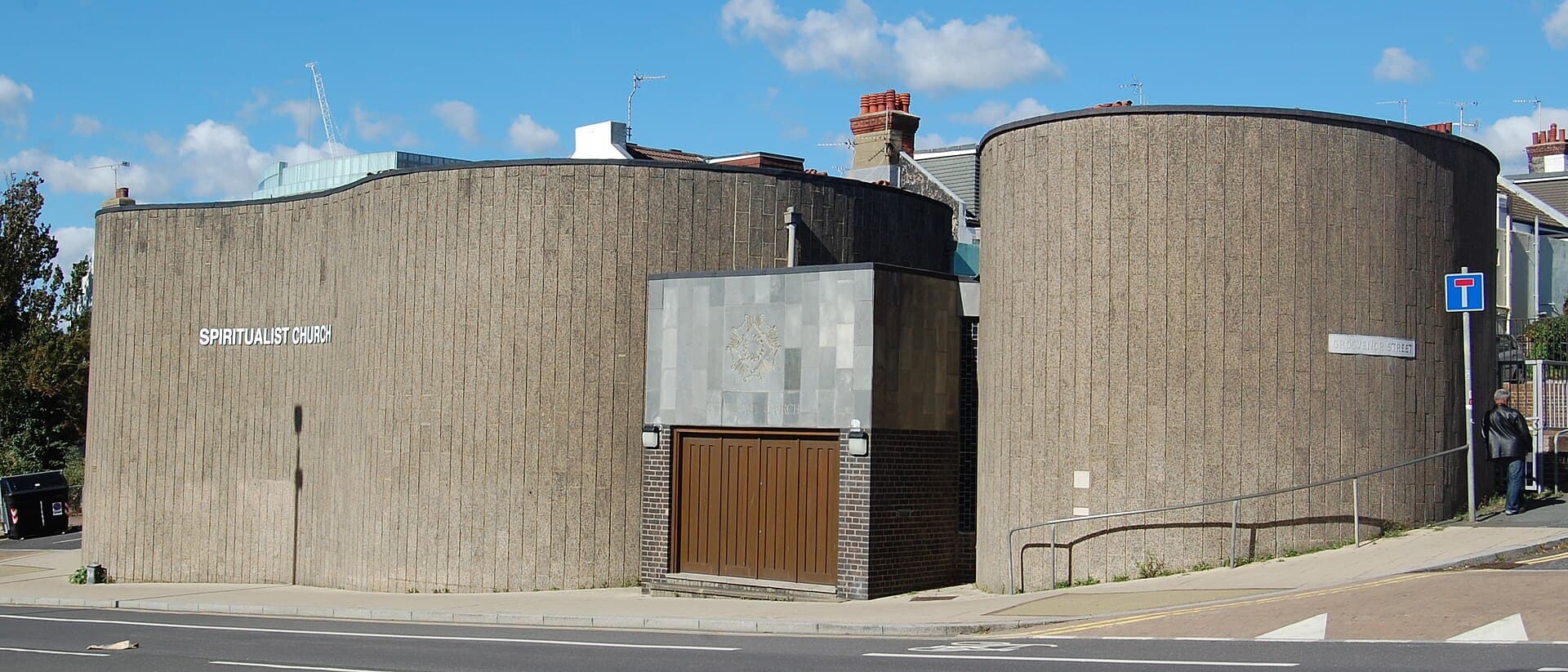
Brighton and Hove National Spiritualist Church, in the Carlton Hill area of Brighton, is one of England's largest Spiritualist churches and one of the city's most architecturally striking modern places of worship — a curved, entirely windowless Brutalist building of 1964–65 whose unusual figure-of-eight plan has earned it a place on Brighton and Hove's Local List of Heritage Assets.
The congregation's story begins on 17 May 1902, when a committee of worshippers formally founded Brighton's first Spiritualist church, agreeing to hold weekly services in "the room [in] which the meeting had been formerly held" and electing their first president. For two decades they made do with rented rooms, until in 1921 a former Baptist chapel came on the market at the corner of Mighell Street and Carlton Hill, east of central Brighton. The chapel had been built in 1878 for Strict Baptists under the ministers Thomas Boxall and George Virgo — Boxall leading until 1893, when Virgo, who also had charge of Bethel Chapel at Wivelsfield, took over — and after falling out of religious use in 1910 it had served as the church hall of nearby St John the Evangelist's Church. The Spiritualist committee bought it for £1,250, and as Brighton National Spiritualist Church it was formally registered as a place of worship and for the solemnisation of marriages in January 1949.
The church's surroundings were then among the poorest in Brighton: by the 1950s Carlton Hill, bounded on its southern edge by the narrow Edward Street, was one of the town's worst slum districts. Clearance of unsuitable buildings in the 1950s and a road-widening programme between 1961 and 1964 — Edward Street being the main entry into Brighton from the east — completely altered the face of the street. Many properties were compulsorily purchased, the Mighell Street church among them; from 1977 its site lay under the forecourt of Amex House, the American Express corporate headquarters. But in March 1961, shortly after the compulsory purchase order, the congregation secured a new site further along Edward Street. Work on the present building began in 1964 and finished the following year, and on 17 May 1965 — sixty-three years to the day after the church's founding — the new Brighton National Spiritualist Church was registered in place of its predecessor, with a marriage licence following six weeks later. After the Marriage (Same Sex Couples) Act 2013, the church was registered for same-sex marriages in July 2014.
The building was designed by the firm of Overton & Partners — later involved in the initial design scheme for Brighton Marina — with Bev Pike as scheme architect. The northern side of Edward Street is lined entirely with buildings of the 1960s and 1970s, and the church is among its most prominent. Its design is in two parts linked by an offset, flat-roofed entrance bay: the longer left-hand section is oblong inside but wrapped in a sinuous, kidney-shaped exterior, while to the right sits a smaller circular worship space lit by a round roof lantern. The larger space is also top-lit through square shafts, for the exterior has no windows at all — vertically laid concrete blocks patterned to imitate stretcher-bond brickwork, the soft curves of the walls playing against their starkly unbroken mass and the smooth angular entrance block. Inside, the worship space is lined with brick. Placing the church on its Local List of Heritage Assets in 2015, Brighton and Hove City Council called it a "good example of a modern design of place of worship" that "contributes positively to the streetscene", its exterior largely unaltered.
The church took its present name on 23 November 2019, when it merged with Brighton and Hove Central Spiritualist Church, which had given up its own premises. That congregation's history reached back to April 1925, when it met at the Athenaeum Hall in North Street — an 1890 multi-purpose hall seating 500 which had also been the first home of Brighton's First Church of Christ, Scientist. The Central church, affiliated to the Spiritualists' National Union since 1941, lost the hall to compulsory purchase in 1962, shared the Brotherhood Gate Church premises until 1965, registered rooms on Norfolk Terrace in Montpelier in 1966, and finally settled in 1978 in a house — and former brothel — on Boundary Passage, the alleyway running along the ancient boundary between Brighton and Hove parishes, dedicated in December 1978. It held its last service on 4 November 2019 before the amalgamation.
Today the combined Brighton and Hove National Spiritualist Church describes itself as "one of the largest Spiritualist churches in the country". Affiliated with the Spiritualists' National Union, it holds two Sunday services and sessions and demonstrations on every day except Tuesdays — a busy modern life for a congregation now well into its second century.
Plan a visit
Visiting hours & services.
Visitor information
Brighton and Hove National Spiritualist Church is an active Spiritualist church on Edward Street in the Carlton Hill area of Brighton, affiliated with the Spiritualists' National Union. One of the largest Spiritualist churches in England, it holds two Sunday services plus sessions and demonstrations on every day except Tuesdays; the locally listed 1965 Brutalist building, with its windowless curved walls and top-lit worship spaces, is a landmark of the street.
Where to find it
Location & contact.
In the neighbourhood
Nearby attractions.
Gallery
Sources
Where this record comes from.
This entry is reconciled from open data. Follow the sources to verify the details or suggest a correction.
Nearby