Crondall, United Kingdom№ 000065914
Church of All Saints
- Founded
- 1170
- Tradition
- Anglican / Episcopal
- Style
- Norman
About this place
History & significance.
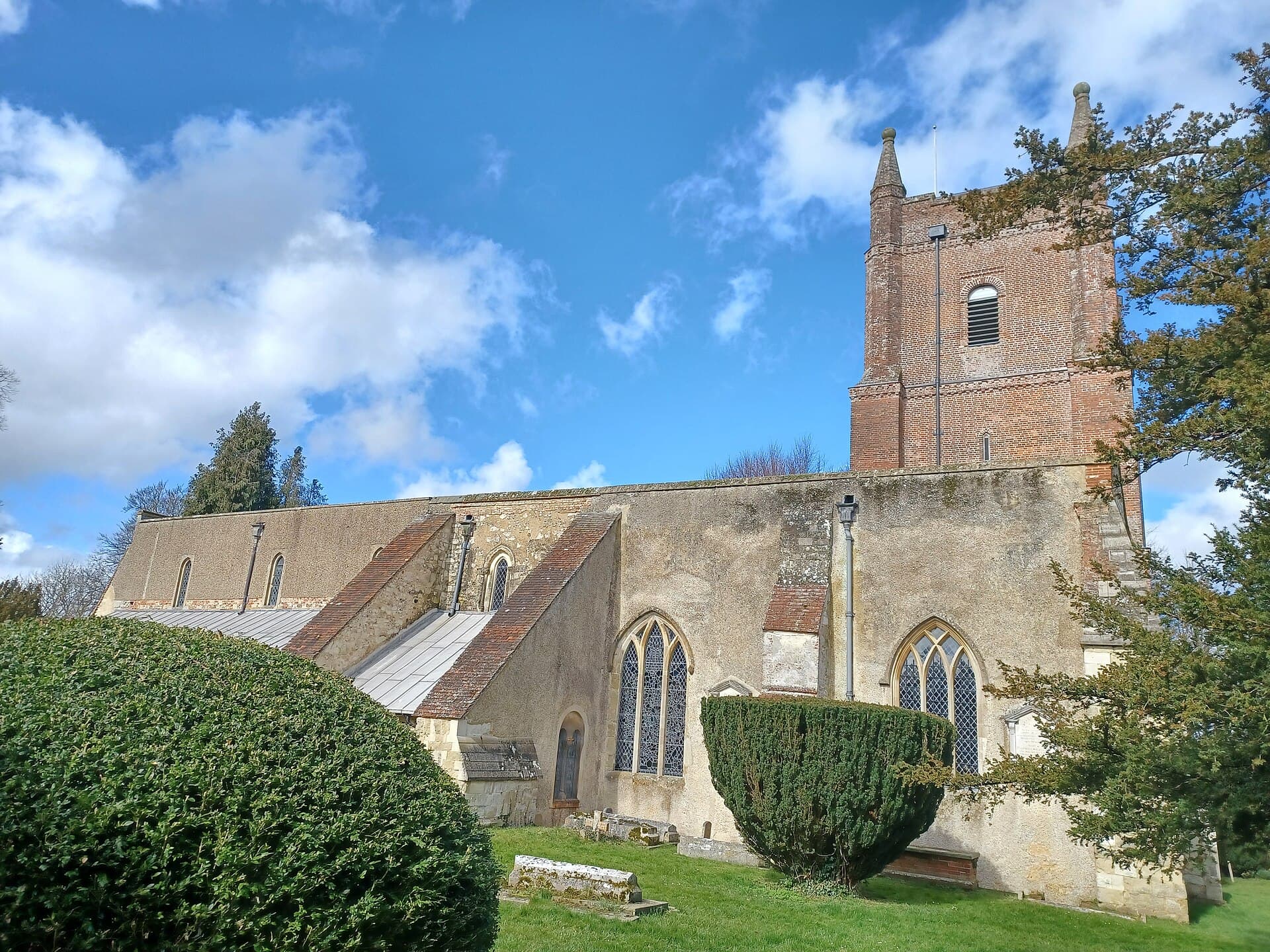
All Saints Church stands at the highest point of the village of Crondall, in the rolling countryside of north-east Hampshire — a magnificent Norman church so grand in scale and quality that it has been called "the cathedral of North Hampshire". A Grade I listed building, much of it dating from the twelfth century, it is admired by every authority who has written about it: Nikolaus Pevsner called it "a puzzle church and an extremely powerful one", Sir Simon Jenkins included it among England's thousand best churches, and Sir John Betjeman thought its chancel "splendid". With its great Romanesque arcades and its extraordinary detached brick tower, it is one of the finest parish churches in the country.
A church has stood on this site for more than a thousand years. In the ninth century, when Alfred the Great owned the manor of Crondall, an Anglo-Saxon church stood here, and the rector of Crondall had responsibility for the whole surrounding hundred — a vast area of north-east Hampshire stretching as far as Aldershot and Yateley. The church appears in the Domesday Book of 1086, by which time Crondall belonged to the Bishop of Winchester. The present building, however, was raised around 1170 on the orders of Henry of Blois, the powerful Bishop of Winchester and half-brother of King Stephen, possibly with the help of masons who had just completed their work on Winchester Cathedral. It is a noble Romanesque church, its nave arcades built on the foundations of an earlier Norman church, with a Transitional chancel of the late twelfth century covered by a fine quadripartite ribbed vault, the central boss carved with the Lamb of God. The richly moulded west doorway of about 1200, capped by a sculpted head, and the twelfth-century font are among its treasures.
The church preserves moving reminders of the medieval age of faith. On the doorways of the north porch are carved crosses: some are Crusader crosses, one of which may have been cut in the thirteenth century by Sir Alexander Giffard of the local Itchell Manor, who kept a vigil at the altar before setting out on crusade; others are pilgrims' crosses, made, by tradition, by pilgrims travelling the nearby Pilgrims' Way from Winchester to the shrine of Thomas Becket at Canterbury. On the chancel floor is a fine brass to Nicholas de Kaerwent, a fourteenth-century rector, and in the chancel recesses are the Tudor tombs of the Gifford and Paulet families, the latter to Sir George Paulet, a commissioner of the Dissolution and brother of the 1st Marquess of Winchester.
The church's most remarkable feature is its tower — and its story is an unusual one. The original Norman church had a central tower, but by the 1650s, after extra bells and a heavy lead roof had been added, this had become dangerously unstable, and in 1659 it was taken down. In its place was built an entirely new, free-standing brick tower at the north-east corner of the church, modelled on the tower of St Matthew's, Battersea. Costing £428 and requiring 110,000 bricks, this fine four-stage tower, capped with octagonal pinnacles, was at first joined to the church by timber galleries, "as if part of a Shakespearean theatre"; Betjeman admired it as a "proud tower". It holds a ring of six bells, the oldest dating from 1616, and a clock. The thrusting-out of the arches and the distortions in the chancel vault, where the old central tower once stood, can still be seen today.
The church was much altered in the Victorian period, in two phases — by Benjamin Ferrey in 1847 and, more extensively, by George Gilbert Scott the younger in 1871, who reordered the chancel, raised its floor and added oak choir stalls. Yet, unusually, the Norman building triumphed over the Victorian work, especially in the splendid chancel that so impressed Betjeman. The Civil War, too, left its mark, for in 1643 Parliamentarian soldiers seized and fortified the church, and local legend tells of the ghosts of those troopers — including a mounted soldier said to ride up the avenue of limes and vanish through a doorway — still haunting the churchyard.
Today All Saints continues as a busy and much-loved Anglican parish church, drawing visitors who come to admire one of the grandest Norman churches in southern England.
The church stands at The Court in the village of Crondall, in the countryside of north-east Hampshire near Farnham. The historic market town of Farnham with its castle, the heaths and woods of the Surrey and Hampshire borders, the North Downs and the Pilgrims' Way, the towns of Aldershot and Fleet, and the wider countryside of the area are all within easy reach.
From its Anglo-Saxon origins in the age of Alfred the Great, through its building as a great Norman church around 1170 by Henry of Blois, its crusader and pilgrim crosses, its remarkable detached brick tower of 1659 and its Civil War history, to its life today, All Saints Church, Crondall, gathers more than a thousand years of Hampshire history into one building. A Grade I listed Norman church known as the "cathedral of North Hampshire", it remains one of the finest and most powerful parish churches in the whole of England.
Plan a visit
Visiting hours & services.
Visitor information
All Saints is an active Anglican parish church at the highest point of Crondall village, in the Diocese of Guildford. As a Grade I listed Norman church it welcomes visitors who come to see its great Romanesque arcades and vaulted chancel, its crusader and pilgrim crosses, its Tudor tombs and its remarkable detached brick tower of 1659. Regular services are held and the church is generally open to visitors. Service and opening times are published by the parish; visitors are advised to check before travelling.
Where to find it
Location & contact.
In the neighbourhood
Nearby attractions.
Gallery
Sources
Where this record comes from.
This entry is reconciled from open data. Follow the sources to verify the details or suggest a correction.
Nearby