Bolton, United Kingdom№ 000060852
Church of All Souls, Bolton
- Founded
- 1881
- Tradition
- Anglican / Episcopal
- Architect
- Paley and Austin
- Style
- Gothic Revival
About this place
History & significance.
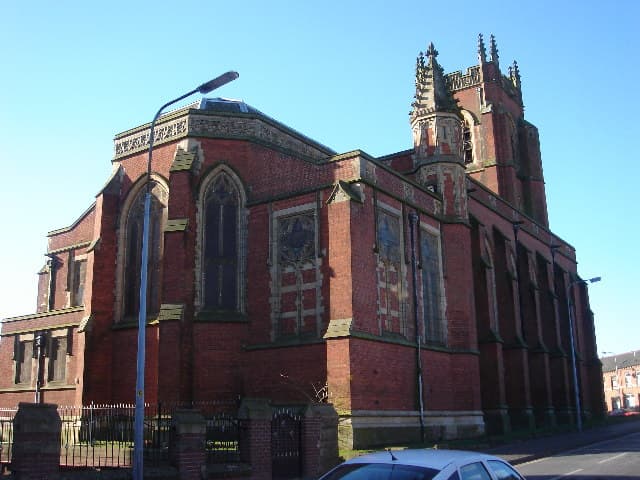
The Church of All Souls stands on Astley Street in Astley Bridge, a residential district of Bolton in Greater Manchester (historically Lancashire) — a great brick church of 1878–81 by Paley and Austin with one of the widest unsupported interiors of any parish church in England. Grade II* listed and redundant since 1986, it has found a new life: since December 2014 it has flourished as a business and community centre.
The church was the gift of Thomas Greenhalgh, an Evangelical mill-owner, who paid for it with money inherited from his brother Nathaniel, who had died in 1877 aged sixty; it was one of two churches financed from the inheritance, the other being St Saviour's. The total cost, including fittings, stained glass, organ and boundary walls, was £23,000 — about £2.4 million today. The district's population had boomed in the second half of the nineteenth century, and the church was built for the people working in the nearby mills. The design brief was thoroughly Evangelical: a congregation of about 800, every one of them with a good view of the proceedings and able to hear the sermon clearly. The Lancaster architects Paley and Austin answered with a remarkable solution, built by Cordingley and Stopford of Manchester and consecrated in 1881 by Dr James Fraser, Bishop of Manchester.
Their answer was to abolish the pillars altogether. The interior is a single undivided space spanning 52 feet — among the widest of any parish church in England — achieved by a complex timber roof with rib vaulting carried on octagonal shafts between the windows. There are no aisles at all: the plan is a five-bay nave, a two-bay chancel with canted apse, an organ chamber to the north, chapel and vestry to the south, a small west gallery, and a west tower 118 feet tall with protruding north porch and stair turret. The church is built of brick with Longridge sandstone dressings outside and Stourton stone within, under slate roofs. The four-stage tower rises from a west door and frieze through a round window and Perpendicular bell openings to a traceried parapet with crocketed corner pinnacles; buttresses divide the nave bays, each with two tiers of three-light Perpendicular windows, and a quatrefoil frieze runs round the chancel parapet between octagonal crocketed pinnacles.
The furnishings were of a piece. The stone reredos of traceried panels, its outer panels inscribed with prayers, and the font were designed by John Roddis of Birmingham; the oak choir stalls, pews, organ case, altar, communion rails, credence table and pulpit were all designed by the architects themselves. The apse glass, designed by Paley and Austin and made by Clayton and Bell, depicts New Testament scenes in memory of Nathaniel Greenhalgh, whose money built the church; the east chancel windows of 1887, showing Faith and Hope, are by Burlison and Grylls. The two-manual organ was built in 1881 by Isaac Abbott of Leeds, and the tower carries a ring of eight bells, all cast in 1881 by John Taylor & Co of Loughborough. A war memorial was added for the parishioners who died in the First World War; otherwise the building changed little.
The twentieth century brought decline. The local population shrank, the parish was combined with St James's on Waterloo Road in 1962, and in 1970 the tower's stained glass — a Creation series by Shrigley and Hunt, damaged by vandals — was removed. The church closed in 1986 and was vested in the Churches Conservation Trust. But the story turned again: the building was redeveloped and reopened in December 2014 as a business and community centre, managed by a small charity created for the purpose, All Souls Bolton. The millworkers' great pillar-free preaching space now serves its neighbourhood in a different way — meetings, enterprise and community life filling the 52-foot span that Paley and Austin built so that every soul could see and hear.
Plan a visit
Visiting hours & services.
Visitor information
All Souls, Bolton, is a FORMER church: closed in 1986 and vested in the Churches Conservation Trust, the Grade II* building reopened in December 2014 as a business and community centre run by the All Souls Bolton charity, hosting meetings, events and community activities. Visitors can experience Paley and Austin's extraordinary 52-foot pillar-free interior — one of the widest of any English parish church.
Where to find it
Location & contact.
In the neighbourhood
Nearby attractions.
Sources
Where this record comes from.
This entry is reconciled from open data. Follow the sources to verify the details or suggest a correction.
Nearby