Stoke Poges, United Kingdom№ 000066271
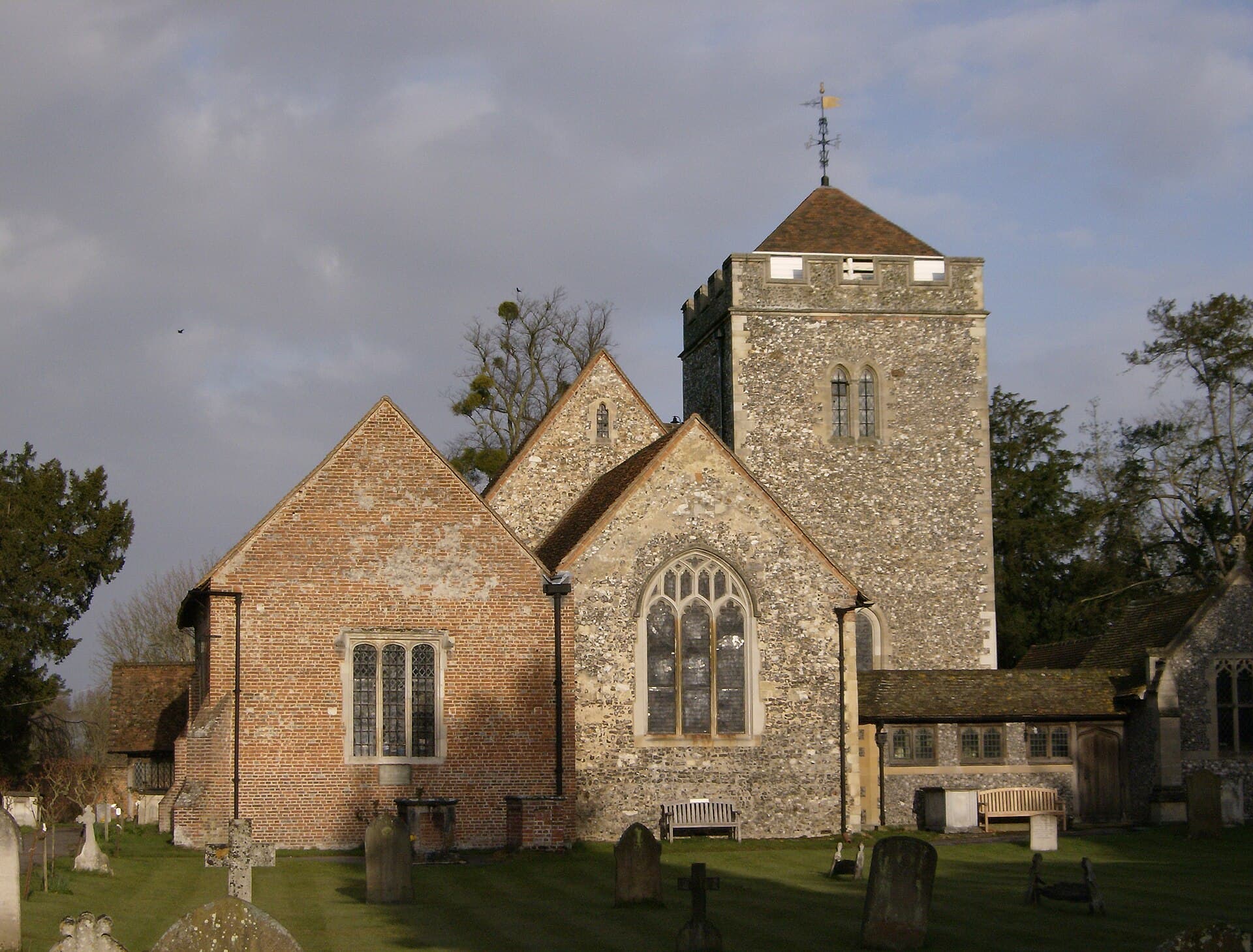
Church of St Giles, Stoke Poges
- Founded
- 1150
- Tradition
- Anglican / Episcopal
- Style
- Norman and Gothic
About this place
History & significance.
The Church of St Giles, Stoke Poges, in Buckinghamshire is among the most famous village churches in the English-speaking world, not for its size or splendour but for a poem: its churchyard is, by near-universal consent, the country churchyard of Thomas Gray's Elegy Written in a Country Churchyard, and the poet himself lies buried there. An active Church of England parish church in the Diocese of Oxford and a Grade I listed building, St Giles stands in the grounds of Stoke Park, the late-Georgian mansion built by John Penn, grandson of the founder of Pennsylvania, and gathers within its flint and chalk walls a thousand years of manor, military and literary history.
The church's origins are Anglo-Saxon and Norman, with the tower rising in the thirteenth century. The building comprises a battlemented tower, nave, chancel and the Hastings Chapel, built mainly of flint and chalk stone beneath tiled roofs, with one striking exception: the red-brick Hastings Chapel, added in 1558 by Edward Hastings, first Baron Hastings of Loughborough, lord of the manor of Stoke Poges, in a style Simon Jenkins describes simply as Tudor, a warm contrast to the Gothic of the rest. Later centuries added a Victorian entrance and vestibule, built to give the owners of the adjoining manor house private access to the church, an addition Elizabeth Williamson, in the Pevsner Buildings of England volume for Buckinghamshire, dismisses as an excrescence, and an early twentieth-century vestry. The Victorian restoration was carried out by George Edmund Street; Jenkins judged that the exterior fared better than the interior, where the stripping of the nave plaster, the replacement of the Norman chancel arch and the opening of the hammerbeam roof left the church, in his phrase, with the appearance of a barn.
The interior is nonetheless rich in monuments. Beside the altar is the church's oldest brass, to Sir William de Moleyns, who died in 1425 at the Siege of Orléans, and his wife Margaret; an Easter Sepulchre is traditionally associated with the tomb of the robber baron Sir John de Moleyns; and the north aisle holds John Flaxman's monument to the gem-engraver Nathaniel Marchant. A tablet in the south aisle, beside the pew that Thomas Gray used, commemorates the descendants of William Penn, founder of Pennsylvania, including his son Thomas Penn and grandsons John and Granville Penn, whose family held Stoke Park and the manor; the church's nineteen funeral hatchments, the largest collection in any building in Buckinghamshire, hang in chancel, chapel and tower, emblazoning the Penns, the Howards and Howard-Vyses of Stoke Place, including two Field Marshals, the Duke of Leeds of Baylis House and Viscount Cremorne. Military memory runs deep: the chancel carries the marble First World War memorial by Sir Ernest George and the sculptor Basil Gotto naming forty-eight men of Stoke Poges; the west window of 1947 by Lawrence Lee remembers the eight dead of the Second World War, incorporating the curious restored medieval image of a figure on a hobby horse blowing a trumpet known as the bicycle window; the Hastings Chapel keeps the Book of Remembrance and battle-honours flag of the 4th Prince of Wales's Own Gurkha Rifles, whose officers' association the vicar serves as honorary chaplain; and a standard of the Royal Horse Guards rests in the nave beside the Howard-Vyse memorials, Major General Sir Richard Howard-Vyse having been colonel of the Blues.
The stained glass fills virtually every window and spans four centuries, from seventeenth-century heraldic panels associated with Sir Edward Coke, the great jurist who once owned the manor house, to the 1998 Love of God window in the tower by Richard Molyneux and David Wasley. The Hastings Chapel received armorial glass in 1946 along with a new Crucifixion window by Martin Travers and Lawrence Lee; the great west window is by Charles Kempe in memory of Edward Coleman of Stoke Park; Louis Davis designed windows remembering pupils of Stoke House School who died in the South African War; and Mayer and Company made the vivid south aisle windows mourning a small child of the Howard-Vyse family. One treasure escaped: huge panels of early sixteenth-century glass, installed by Edward Coleman in the private vestibule in mid-Victorian times, were sold in 1929 and now rank among the major documents of period stained glass at the Detroit Institute of Arts.
It is the churchyard, though, that has drawn pilgrims for two and a half centuries. Thomas Gray was a constant visitor to Stoke Poges, home of his mother and aunt, and though scholars have proposed rival churchyards at Everdon in Northamptonshire and Upton-cum-Chalvey, and note that much of the poem was probably drafted in Cambridge, the Elegy was completed at Stoke Poges in June 1750, when Gray wrote to Horace Walpole, I have been here at Stoke a few days and having put an end to a thing, whose beginning you have seen long ago, I immediately send it to you. The biographer A. L. Lytton Sells found no doubt in the identification, and Robert L. Mack calls it very close to irrefutable. In 1771 Gray was buried, by his own instruction, in the vault he had raised for his mother and aunt; with characteristic self-effacement the tomb records only the women, including his own tribute to the careful tender mother of many children, one of whom alone had the misfortune to survive her, while the poet's death is noted on a plaque in the outside wall of the Hastings Chapel. In 1799 John Penn commissioned the Gray Monument from James Wyatt, a great sarcophagus on a pedestal inscribed with stanzas of the Elegy, at once a memorial, a tribute and an eye-catcher for the Stoke Park landscape; owned by the National Trust, it is listed at Grade II*, the tomb itself at Grade II, and the lychgate by John Oldrid Scott at Grade II. Artists from William Blake to John Constable, with Joseph Barrow, William Barron, Hendrik de Cort and Jasper Cropsey, have painted the church and tomb, and Humphry Repton illustrated the church in his Red Book for Stoke Park.
The tower holds a ring of eight bells, rung full circle, the three oldest cast in 1728; six were restored by Mears and Stainbank of Whitechapel in 1894, rehung in a new iron frame in 1912, and augmented to eight in 1938 by Gillett and Johnston, the ringing chamber having been created in 1924 above the old Manor House and Penn pews after the removal of the spire. Beside the churchyard lie the Stoke Poges Memorial Gardens, founded in 1935 by Sir Noel Mobbs to secure the maintenance in perpetuity of the peace, quietness and beauty of the ancient church and churchyard, landscaped by Edward White with private plots for the interment of ashes within a park itself listed at Grade I; the ashes of the film director Alexander Korda and the broadcaster Kenneth Horne rest there. The churchyard holds the war graves of six servicemen of the two world wars, and the cinema has come calling more than once: in the opening of the James Bond film For Your Eyes Only, Bond walks through the lychgate to visit the grave of his wife Teresa, and the churchyard appears in Judy Garland's final film, I Could Go On Singing. The paths of glory, Gray wrote here, lead but to the grave; at St Giles they also lead, daily, to a living parish church where the curfew still tolls the knell of parting day.
Plan a visit
Visiting hours & services.
Visitor information
St Giles' is an active Church of England parish church in the Diocese of Oxford, with regular Sunday worship and a ring of eight bells rung full circle. The church and the churchyard containing Thomas Gray's tomb are open to visitors free of charge; guides describe the brasses, hatchments and stained glass. The adjoining Stoke Poges Memorial Gardens, preserved for peace and quiet in perpetuity, are open daily.
Where to find it
Location & contact.
In the neighbourhood
Nearby attractions.
Gallery
Sources
Where this record comes from.
This entry is reconciled from open data. Follow the sources to verify the details or suggest a correction.
Nearby