Tatham, United Kingdom№ 000060670
Church of St James the Less, Tatham
- Founded
- 1100
- Tradition
- Anglican / Episcopal
- Architect
- Sharpe, Paley and Austin
- Style
- Norman and Perpendicular Gothic
About this place
History & significance.
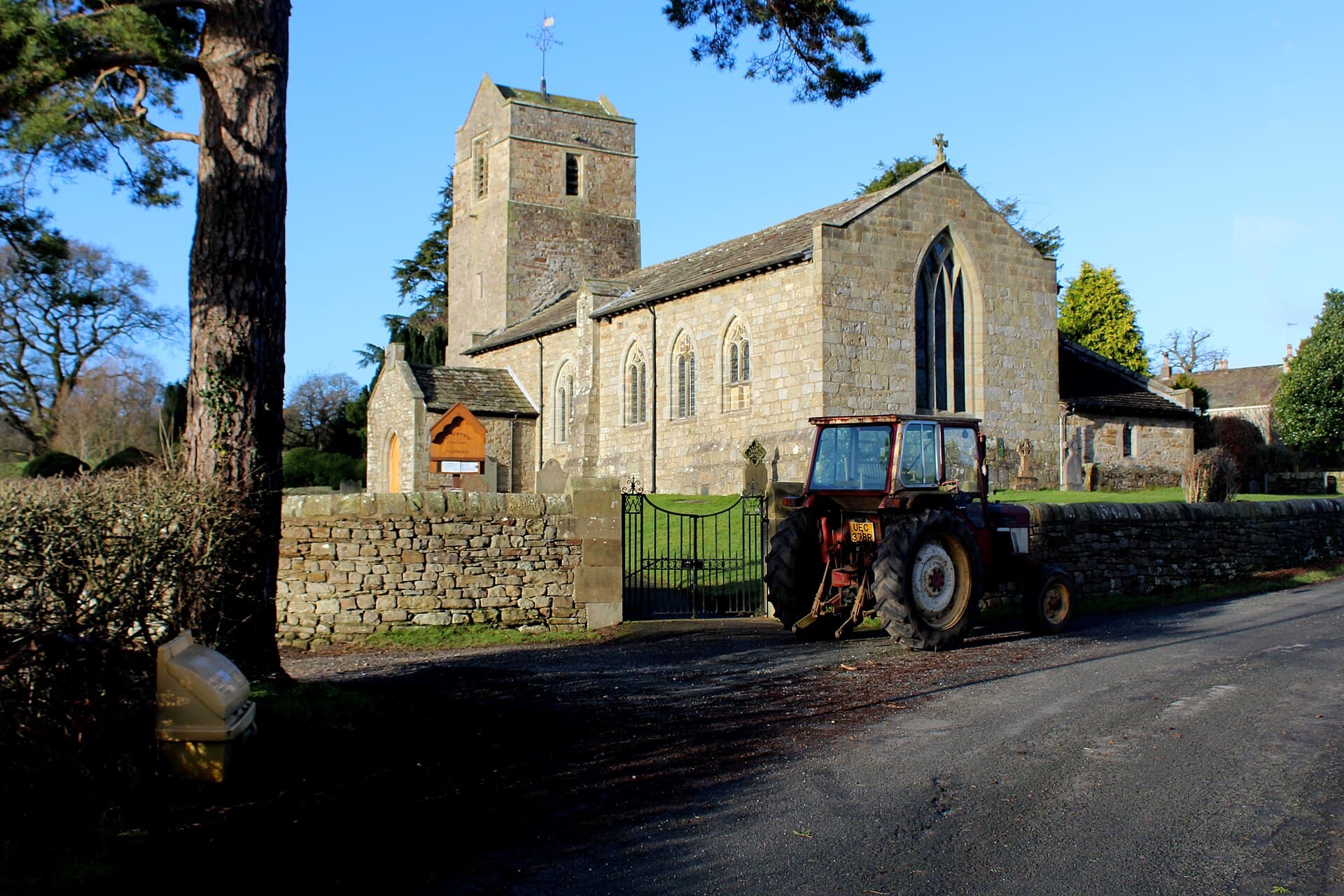
The Church of St James the Less stands in the small village of Tatham, in the Lune valley of north Lancashire, above the flood plain of the River Wenning. A Grade II* listed building and an active Anglican parish church in the Diocese of Blackburn, it is a modest but ancient country church whose fabric carries the marks of more than eight centuries of worship — Norman doorways and twelfth-century capitals embedded in a largely fifteenth-century church, given its present character by the great Victorian architects Paley and Austin. In a quiet corner of the historic district of Lonsdale, it is the kind of church that rewards the visitor who seeks it out: small, weathered, and full of history.
A church has stood on this site since at least the Norman era, and a place of Christian worship at Tatham may be older still. Most of the fabric of the present building dates from the fifteenth century, but elements survive from the Norman period and from the thirteenth century, so that the church is in effect a palimpsest, each age writing over but not quite erasing the last. The tower was rebuilt in 1722, giving the church a Georgian chapter, and then in 1885–87 the celebrated Lancaster firm of Paley and Austin — the leading church architects of the north-west — carried out an extensive restoration. They added a saddleback roof to the tower, the distinctive gabled cap that now crowns it, and an organ loft and vestry, repaired the walls, inserted windows, fittings and a new floor, and removed the old ceiling. The work cost £3,269, a considerable sum equivalent to several hundred thousand pounds today, and it is to Paley and Austin that the church owes much of its present interior.
St James' is built of sandstone rubble under a stone-slate roof, and its plan is that of a typical small medieval church: a nave with a north aisle, a south porch, a chancel, a north-east vestry and organ chamber, and a west tower. The tower stands on a plinth with two setbacks, rising to the saddleback roof with its north and south gables. Along the south wall are Perpendicular windows of two and three lights, and the porch carries a slate sundial above its pointed outer doorway — but the treasure of the porch is within, for the inner doorway is Norman, much restored but unmistakably of the twelfth century, a survival from the earliest stone church on the site. The north aisle has windows with trefoils under flat heads, the gabled organ chamber a Perpendicular window, and the east window three lights of intersecting tracery.
Inside, the church keeps its layers of history close together. A three-bay arcade of pointed arches on octagonal piers separates the nave from the aisle, and the bases and capitals of those piers are said to date from the twelfth century — Norman stones still bearing the weight of the medieval church. In the chancel floor lies a medieval grave-cover, and the chancel also holds a triple sedilia and a piscina with trefoil heads, both restored and reconstructed but medieval in origin. The font is of carved octagonal sandstone, and the choir stalls, pews and pulpit are the work of Paley and Austin from the Victorian restoration. The glass is notably rich for so small a church: the east window is by Burlison and Grylls of the late nineteenth century, and incorporates older glass depicting the arms of the Duke of Lancaster in grisaille, dating from somewhere between about 1300 and 1400 — medieval heraldic glass surviving across six centuries. The west window of the aisle holds glass of 1909 by Shrigley and Hunt depicting St Helen, and the church also preserves seventeenth-century memorial brasses and the painted royal arms of George II, a reminder of the long Hanoverian centuries when the monarch's arms hung in every parish church. The two-manual organ was built in the 1880s by Abbott, and the tower holds a ring of three bells, the oldest cast in 1771 by an unknown founder, the other two by John Taylor and Company in 1887.
The churchyard, like the church, holds its quiet memorials, among them the war grave of a sailor of the Royal Naval Patrol Service of the Second World War — the little ships' service that swept mines and guarded the coasts — laid to rest far inland in his home parish. The setting is the gentle hill country of the Lune valley, in the district of Lonsdale that gives the modern benefice its name: St James' parish is now united with a string of neighbouring churches — St Wilfrid at Melling, St John the Baptist at Tunstall, St Peter at Leck, the Good Shepherd at Lowgill and Holy Trinity at Wray — to form the benefice of East Lonsdale, the way that small rural congregations across England now share their clergy.
From a Norman foundation above the Wenning, through a fifteenth-century rebuilding, a Georgian tower and a Paley and Austin restoration, St James the Less has served the people of Tatham for the best part of a thousand years. Its Norman doorway and twelfth-century capitals, its medieval ducal glass and Georgian royal arms, its saddleback tower and its quiet riverside churchyard make it a model of the English village church — modest in scale but deep in history — and it remains a living Anglican parish church in the Lune valley, one of the oldest buildings, and one of the longest memories, in its corner of north Lancashire.
Plan a visit
Visiting hours & services.
Visitor information
St James the Less is an active Church of England parish church in the Diocese of Blackburn and a Grade II* listed building, part of the East Lonsdale benefice; services rotate around the benefice's churches. Standing above the River Wenning at Tatham, it preserves a Norman inner doorway in the porch, 12th-century arcade capitals, a triple sedilia and piscina, medieval ducal heraldic glass (c.1300-1400) in the east window, the painted royal arms of George II, and furnishings by Paley and Austin. The churchyard holds a WWII naval war grave.
Where to find it
Location & contact.
In the neighbourhood
Nearby attractions.
Gallery
Sources
Where this record comes from.
This entry is reconciled from open data. Follow the sources to verify the details or suggest a correction.
Nearby