Whalley, United Kingdom№ 000060776
Church of St Mary and All Saints, Whalley
- Founded
- 1086
- Tradition
- Anglican / Episcopal
- Style
- Gothic
About this place
History & significance.
The Church of St Mary and All Saints stands in the village of Whalley in Lancashire's Ribble Valley, in the shadow of the ruined Cistercian abbey whose treasures it inherited. An active parish church in the Diocese of Blackburn and a Grade I listed building, it is among the most rewarding medieval churches in the county — Simon Jenkins suggests it "could qualify as a museum of ecclesiastical seating", and its choir stalls and misericords from Whalley Abbey are works of national importance.
Christian worship here long predates the Normans. Three remarkably well-preserved Anglo-Saxon crosses, probably of the tenth or eleventh century, stand in the churchyard — each protected as a Scheduled Monument — and fragments of the same era survive in the church's outer walls. The "Church of St Mary held in Wallei" appears in the Domesday Book of 1086, endowed with "two carucates of land free of all custom", an endowment suggesting it was among the wealthiest churches in what would become Lancashire. Most of the present building was raised in the thirteenth century, replacing a simpler structure that likely had an aisleless nave and chancel; the doorway within the 1844 south porch still incorporates parts of the pillars of the eleventh-century Norman church. The Perpendicular tower followed in the late fifteenth century — seventy feet high, buttressed and crenellated, of a type Pevsner and Claire Hartwell relate to many North Lancashire towers. A north porch came in 1909, and restorations in 1866 and 1868 treated the fabric gently.
The church is built of sandstone rubble under slate, with a clerestoried nave of four Early English bays, north and south aisles, and a chancel lit by a great Perpendicular east window of five cinquefoil lights. The north arcade stands on round piers, the south on octagonal ones, all with moulded caps beneath pointed, double-chamfered arches. The fifteenth-century octagonal font of yellow gritstone wears a seventeenth-century oak cover.
But it is the woodwork that makes Whalley famous. The chancel stalls were carved around 1430 for the church of Whalley Abbey, and came here after the Dissolution; rarest of all among medieval works, the name of their craftsman — a Mr Eatough — has survived. Their misericords range exuberantly across the medieval imagination: angels, devils and the Holy Trinity; two eagles carrying Alexander the Great to heaven; St George and the dragon; a girl with a weeping satyr; griffins, vines and pomegranates; a blacksmith shoeing, a goose — and a wife beating her husband with a pan. Jenkins judges them "beautifully executed", deserving "nationwide repute". Around them the church preserves an unmatched parade of historic seating: a churchwarden's pew for eight dated 1690, a constables' pew, benches of 1638 and a rectory pew of 1702 line the north aisle. Most extraordinary is St Anton's Cage beside the Lady Chapel, a grand enclosed pew made in 1534 for the Nowell family of Read and twice extended in the seventeenth century. In the early nineteenth century the Fort and Taylor families fought for possession of it — their initials stand above its doors — until an ecclesiastical court divided the pew between them in 1830. The compromise pleased neither side: both families abandoned the Cage and built private galleries elsewhere in the nave, which have since vanished. An oak box inside the pew still holds a 1684 edition of Foxe's Book of Martyrs and an early copy of Whitaker's History of Whalley.
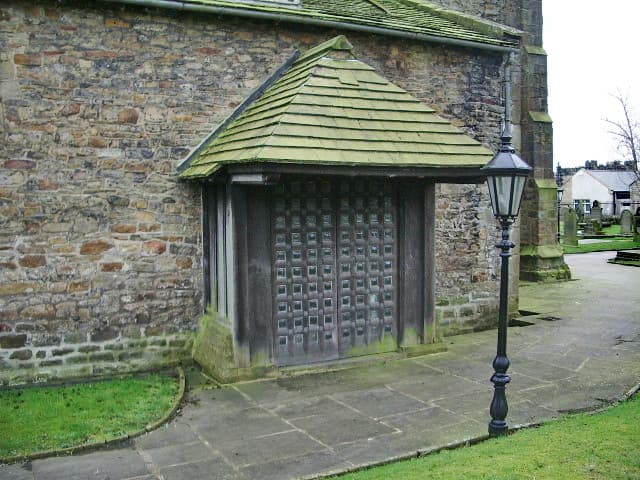
The church has two medieval chantry chapels behind fifteenth-century screens: St Nicholas's, or the Soldiers' Chapel, at the east end of the north aisle, with traces of a rood-loft stair, a piscina and a medieval altar stone; and St Mary's at the east end of the south aisle, with a fourteenth-century ogee-headed piscina and square wooden pews. The north door of oak, set with glass bullseyes, is enclosed in its own wooden porch. The organ has its own distinguished pedigree: built in 1727 for Lancaster Priory, it was purchased for Whalley in 1813 for three hundred guineas. In the churchyard, east of the church, stands a Grade II listed sundial of 1757 among the Anglo-Saxon crosses.
Whalley's parish life continues unbroken: in 2015 the Revd Jonathan Carmyllie was appointed vicar of the West Pendleside parishes that include the old church. With its Saxon crosses, Norman fragments, abbey stalls and three centuries of squabbled-over pews, St Mary and All Saints compresses a thousand years of Lancashire history into one sandstone shell beside the Calder.
Plan a visit
Visiting hours & services.
Visitor information
St Mary and All Saints is the active Church of England parish church of Whalley, Lancashire, in the Diocese of Blackburn. Grade I listed, it is renowned for its c.1430 choir stalls and misericords from Whalley Abbey, the extraordinary St Anton's Cage pew of 1534, three Anglo-Saxon churchyard crosses and a 1727 organ from Lancaster Priory. The church is normally open to visitors during the day and holds regular Sunday services.
Where to find it
Location & contact.
In the neighbourhood
Nearby attractions.
Gallery
Sources
Where this record comes from.
This entry is reconciled from open data. Follow the sources to verify the details or suggest a correction.
Nearby