Bradford Peverell, United Kingdom№ 000068295
Church of St Mary
- Founded
- 1849
- Tradition
- Anglican / Episcopal
- Style
- Gothic Revival
About this place
History & significance.
St Mary's Church, Bradford Peverell, is the Church of England parish church of a small village in the Frome valley just north-west of Dorchester in Dorset. A Grade II* listed building, it was designed by Decimus Burton — the celebrated architect of Hyde Park screens, Kew glasshouses and Regency seaside towns — and built in 1849–50, replacing a medieval predecessor and inheriting from it, and from one of Oxford's great colleges, treasures older than itself.
The original church was small and ancient: a nave, chancel, south aisle and porch, with a wooden turret containing three bells. By the 1840s it had fallen into a dilapidated condition, and the decision to rebuild had been taken by 1847, when Burton made his early drawings for a new church and the local builder John Wellspring of Dorchester prepared an estimate of costs. Burton finalised his plans in 1848, and in 1849 a faculty was granted for the old church to be demolished and the new one built on the same site. The majority of the cost was met by the Lord of the Manor, Hastings Nathaniel Middleton of Wollaston House, Wellspring carried out the construction, and St Mary's was consecrated by the Bishop of Salisbury, the Right Rev. Edward Denison, on 28 October 1850.
Burton's church is built of coarse ashlar with ashlar dressings under clay-tiled roofs, comprising a five-bay nave, a two-bay chancel, a north vestry, a south porch and a three-stage west tower carrying an octagonal broach spire of Portland stone — a graceful landmark above the Frome meadows. The pulpit and font are of 19th-century date, and the tower holds five bells, one cast by Thomas Purdue in 1674 and two added in 1897. The organ, built by Bishop and Son of London, was installed in 1888, around the same time the churchyard was first extended; it was enlarged again around 1955.
The chancel's east window is the church's particular glory, and it carries a remarkable provenance. It was created using fragments of 13th- and 14th-century glass from the chapel of New College, Oxford — glass that had been removed from the chapel and stored in a box until the warden of the college offered it to Hastings Nathaniel Middleton for use in his new church. Middleton travelled to Oxford on 25 May 1850 to inspect the glass in person, and the medieval fragments now glow above the altar of Burton's Victorian chancel. The north window keeps the connection local, using fragments from the old church that include the coat of arms and motto of Bishop William of Wykeham — the founder of New College itself, whose family name is woven into this stretch of the Frome valley.
Much else was carried over from the demolished church. The west tower holds a marble tablet by Lester of Dorchester to the rector Rev. Middleton Onslow, dated 1837, and floor slabs in the nave commemorate John Jobbins (1696), Thomas Meggs (1696), another Thomas Meggs (c. 1698), Harry Meggs (1702) and a later Harry Meggs (1782). The Royal coat of arms of Queen Victoria hangs over the tower arch, and inside the tower stand two stools and a table, all of the 17th century. A marble tablet in the chancel remembers the rector Rev. H. Blackstone Williams (1879), while the nave's brass tablets tell the cost of empire and the World Wars to one family above all: Frank Middleton, a captain in the Dorset Regiment (1915), Ernest Middleton, Second Lieutenant in the Queen's Own Dorset Yeomanry (1917), Captain Thomas Winwood MC of the Royal Field Artillery (1919), and Walter Middleton (1931). Memorial windows honour members of the Middleton family, Lieutenant Edward Williams, who fell in the Sudan campaign, and Vice-Admiral Sir Robert O'Brien FitzRoy.
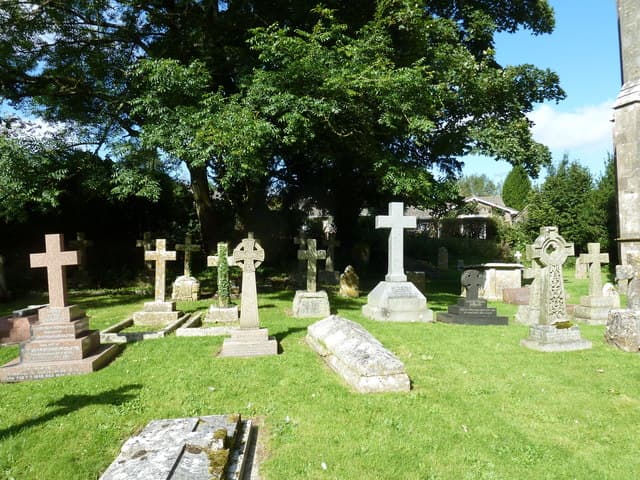
The churchyard has its own listed heritage. Four table tombs were listed Grade II in 1985 — three belonging to the Dearing family, all from the second half of the 17th century, including that of Luke Dearing the Elder (1666), and the fourth to Hastings Nathaniel Middleton senior, who died in 1821, father of the church's great benefactor. The village war memorial also stands here: completed and erected in January 1921, made of Dartmoor granite and bearing the names of the fallen of both World Wars, it was listed Grade II in 2015. Decimus Burton's spire, medieval Oxford glass and the long roll of Middletons together make St Mary's a Victorian church with far older bones — the parish church of the Frome valley village it has served for over 170 years.
Plan a visit
Visiting hours & services.
Visitor information
St Mary's is the active Grade II* Anglican parish church of Bradford Peverell, designed by Decimus Burton and consecrated in 1850. Visitors can see the east window of 13th- and 14th-century glass from New College, Oxford, fragments bearing William of Wykeham's arms in the north window, the 1674 Purdue bell, 17th-century furniture in the tower and the Middleton family memorials. The Dartmoor granite war memorial of 1921 stands in the churchyard.
Where to find it
Location & contact.
In the neighbourhood
Nearby attractions.
Gallery
Sources
Where this record comes from.
This entry is reconciled from open data. Follow the sources to verify the details or suggest a correction.
Nearby