Newark-on-Trent, United Kingdom№ 000060414
Church of St. Mary Magdalene, Newark-on-Trent
- Founded
- 1180
- Tradition
- Anglican / Episcopal
- Style
- Perpendicular Gothic
About this place
History & significance.
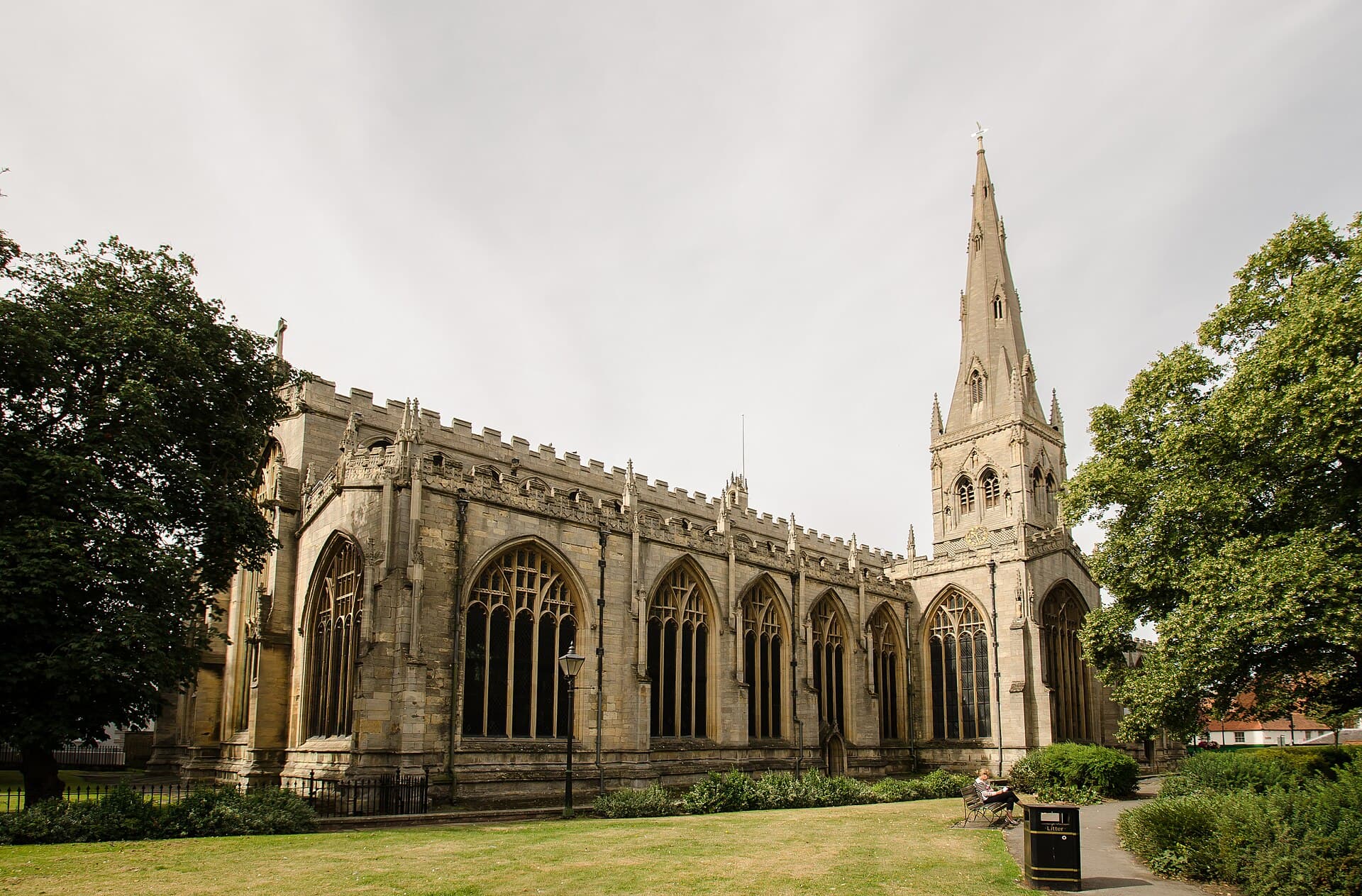
The Church of St Mary Magdalene is the great parish church of Newark-on-Trent in Nottinghamshire, and one of the largest and finest parish churches in all of England. Its magnificent tower and spire, rising 232 feet, make it the tallest structure in the town and one of the tallest parish churches in the country. A Grade I listed building, built over many centuries and culminating in the soaring Perpendicular Gothic of the later Middle Ages, St Mary Magdalene's is a church of cathedral-like scale and beauty — described by Simon Jenkins, who awarded it four stars in his England's Thousand Best Churches, as "exhilarating", with "mystic" vistas and "a wonder of proportion" in its nave.
There has been a church on this site for a thousand years, and the present building is the third to stand here. About the year 1180 the church was substantially rebuilt, and the crypt of that period still survives beneath the chancel. The piers of the crossing and the west tower date from around 1220, and the tall octagonal spire that crowns the tower was added about a century later. The greater part of the church as it now stands — the spacious nave with its aisles and clerestory, and the chancel — is fifteenth-century work, built during the great age of Perpendicular Gothic that followed the Black Death, with the transepts and chapels added in the early sixteenth century. As Jenkins observes, the breadth of the aisles derives from the older Decorated ground plan, while the later masons added the soaring height, giving the interior its remarkable sense of proportion and space.
The church is built on a grand scale, with an aisled and clerestoried nave and chancel, transepts, and the single great west tower topped by its spire — the tower rising some 115 feet and the octagonal spire a further 117 feet, to a total of 232 feet to the base of the weathervane. On the south side is a two-storey porch with a library above it, presented by Bishop White in 1698, and the exterior is finished with crenellated parapets, the asymmetrical west front terminating in a large gabled window. Within, the church is rich in treasures: a medieval wall painting of the Dance of Death, a theme made vivid by the horrors of the plague; an exceedingly fine fourteenth-century brass, one of the largest and best in England, commemorating a Flemish merchant; old stalls with carved misericords; and a fine reredos designed in 1937 by the great church artist Sir Ninian Comper, who carried out restoration work here in the twentieth century. The tower holds a peal of ten bells cast by John Taylor and Company of Loughborough in 1842, and the church's choral tradition reaches back to a choir founded in 1532.
Newark was a place of great strategic importance, and its church witnessed dramatic events. During the English Civil War the town was a Royalist stronghold, besieged three times by Parliamentary and Scottish forces, and St Mary Magdalene's suffered damage in the fighting. In the mid-nineteenth century the church was thoroughly restored by the most prolific of Victorian church architects, Sir George Gilbert Scott, who repaired and refurnished the great building, reopening it for worship in 1855, and further careful restoration was carried out in the twentieth century by Comper and others.
Today St Mary Magdalene's is a thriving Anglican parish church in the Diocese of Southwell and Nottingham, with a full round of services — nine each week — and active youth and children's programmes, as well as its fine organ, its ring of bells and its choir. It is both the spiritual heart of Newark and one of the architectural glories of Nottinghamshire, drawing visitors who come to admire its scale, its craftsmanship and its soaring Gothic beauty.
The church stands in the historic market town of Newark-on-Trent, in the east of Nottinghamshire near the borders of Lincolnshire. The town's handsome cobbled market place lies beside the church, along with the ruins of Newark Castle on the bank of the River Trent — where King John died in 1216 — the National Civil War Centre, which tells the story of the town's sieges, and the Georgian and medieval streets of the town, with the cathedral city of Lincoln and the wider East Midlands within easy reach.
From the church of about 1180 with its surviving crypt, through the building of the tower and spire in the thirteenth and fourteenth centuries and the great Perpendicular nave and chancel of the fifteenth, the trials of the Civil War sieges and the restorations of Scott and Comper, the Church of St Mary Magdalene gathers a thousand years of Newark's history into one building. A Grade I listed church whose spire is a landmark for miles around, and one of the largest and finest parish churches in England, it remains the living parish church of Newark-on-Trent — a Gothic masterpiece at the heart of its Nottinghamshire town.
Plan a visit
Visiting hours & services.
Visitor information
St Mary Magdalene's is a thriving Anglican parish church in the market town of Newark-on-Trent, in the Diocese of Southwell and Nottingham, with nine services a week, a fine organ, a peal of ten bells and a choral tradition reaching back to 1532. One of the largest and finest parish churches in England, it is open to visitors most days; do see the Dance of Death wall painting, the great 14th-century brass, the crypt and the Comper reredos.
Where to find it
Location & contact.
In the neighbourhood
Nearby attractions.
Gallery
Sources
Where this record comes from.
This entry is reconciled from open data. Follow the sources to verify the details or suggest a correction.
Nearby