Gamlingay, United Kingdom№ 000065867
Church of St Mary the Virgin
- Founded
- 1120
- Tradition
- Anglican / Episcopal
- Style
- Early English Gothic
About this place
History & significance.
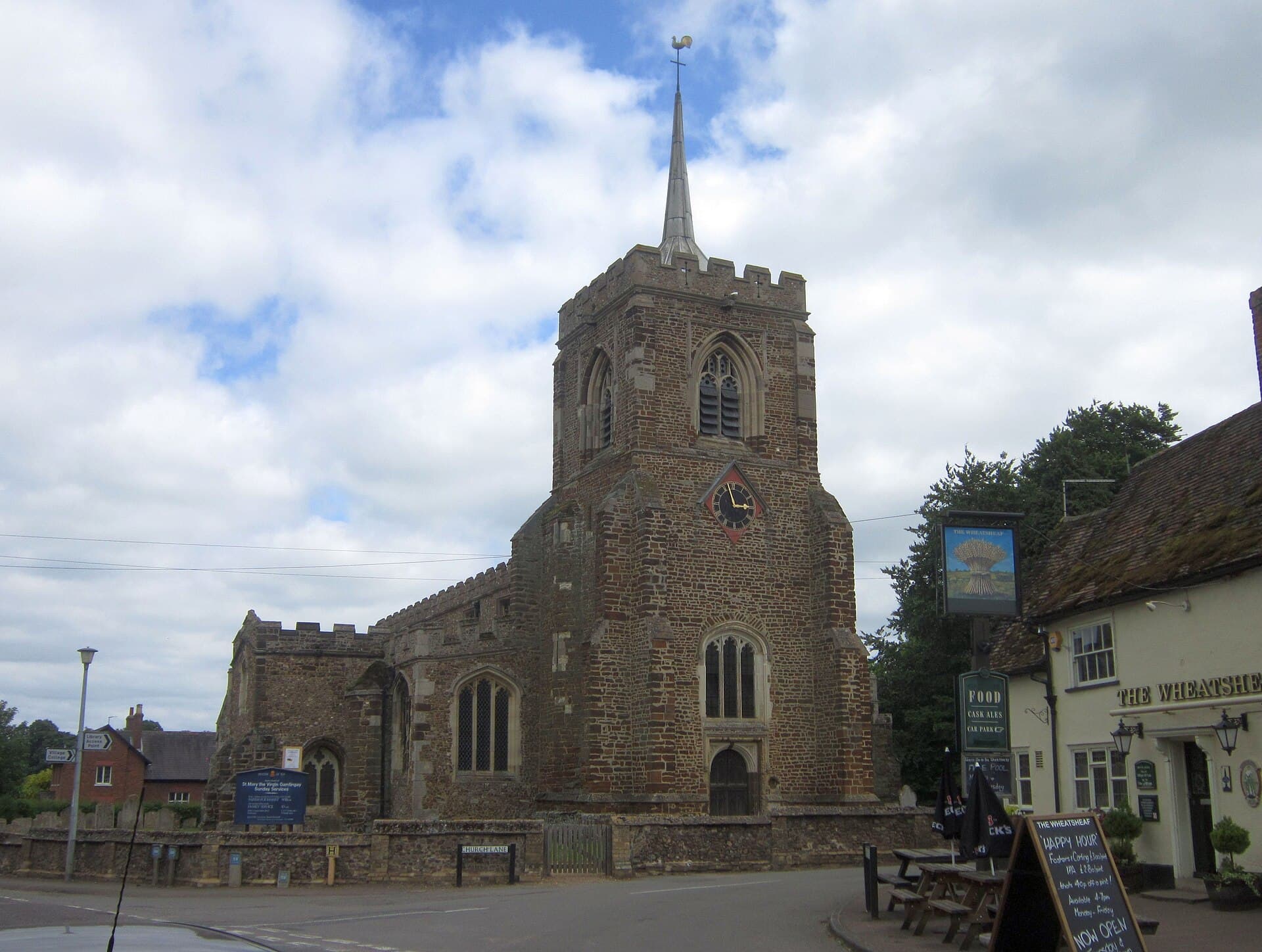
The Church of St Mary the Virgin is the parish church of Gamlingay in Cambridgeshire, part of the ecclesiastical parish of Gamlingay with Hatley St George and East Hatley, within the St Neots Deanery of the Diocese of Ely. A Grade I listed building since 1967, it is mainly thirteenth-century work with extensive rebuilding in the fourteenth and fifteenth centuries, and it drew from Nikolaus Pevsner in 1954 one of his crisper verdicts: "the most impressive church in this part of the county."
A church existed in the parish before 1120, but nothing visible today is earlier than the thirteenth century, when the south and north nave arcades, the north aisle and the chancel were built in the Early English style, the fabric raised from fieldstones and local ironstone. The south aisle and south chapel followed around 1300, the north porch in the fourteenth century, and remodelling in the fifteenth and sixteenth centuries touched the entire building except the nave arcades. The square west tower — now holding eight bells — is thirteenth-century in origin but was largely rebuilt in the fourteenth and fifteenth centuries. It rises in two stages divided by a string course at the base of the belfry, which carries an embattled parapet, with a gargoyle above each tower window. Inside, a doorway at the east end of the north wall opens to the stair turret ascending to the bell chamber; on the tower's east face the line of an earlier, steeper-pitched nave roof can still be traced. The ground stage of the tower's east wall is unusually thick and the tower arch rather oddly contrived — earlier walling may have been encased within it. The acute spire is a modern replacement, though the cross tree is original.
The medieval church's fortunes were closely tied to Merton College, Oxford, who were part patrons: in 1442–43 the college spent 151 shillings and twopence on repairs to the chancel, which retains its typically thirteenth-century chamfered plinth and embattled parapet but owes much of its detail to that campaign. The south transept chapel was remodelled between 1460 and 1490 by the Guild of the Blessed Trinity and the Gamlingay Guild, while the fourteenth-century north transeptal chapel was remodelled at the expense of Walter Taylard (died 1466), Merton College's steward in Gamlingay, who may have been a descendant of the college founder's sister. The consecration of the high altar and a north altar by Bishop John Alcock in 1490 probably marks the completion of these alterations — Alcock also blessed two new bells in the church around the same time, and the bell frame still has four pits likely dating from about 1490. Of the six bells now hung, the second, third and sixth are by Miles Graye, dated 1653; the rest are modern or recast.
The interior rewards slow looking. The fourteenth-century chancel arch is of two orders, and the nave's north arcade runs five bays on octagonal piers with moulded caps and bases; the voussoirs of both arcades still show traces of medieval painting in red ochre, particularly distinct on the north side, and a squint pierces the nave wall toward the chancel. The rood screen is mainly late medieval, in five bays with an extra-wide middle bay for the entry, its oldest parts thought to have been in place after the restoration of the 1480s; traces of the original red, green, cream and gold paint survive. A small winding staircase — a vice — once led up to the top of the screen from behind the present pulpit; it was bricked up at the Reformation, but its doorway is still visible and the first few steps remain beside the pulpit. Within the east side of the screen are stalls, three on each side of the opening, believed to have been brought from another site and repositioned during the 1880 restoration; they may have served the six priests known to be in the village in 1490. Their carvings include a mitred ecclesiastic, a collared animal, a long-winged bird with turned-back head, an angel, a winged beast, and two misericords — a crouching man with a demon's head on the north, an ape with grapes in vine leaves on the south — possibly dating to about 1442.
The thirteenth-century font has an octagonal limestone marble bowl with two pointed arched panels in each face, on a cylindrical central pier with nineteenth-century shafts; intriguingly, its sub-base may incorporate the bowl of an earlier font that could have served the very first church on the site. Its restored octagonal ogee cover, with crocketed ribs and finial, is probably sixteenth-century. Before 1880 the church had two fonts, one in the centre aisle. Other medieval survivals include the late medieval two-leaf door in the tower's ground stage, originally hung in the west doorway; a medieval locker east of the south door, probably for the banner staves carried in guild processions — evidence of a thriving community; a late medieval stoup with broken bowl beside the west door; a medieval sundial incised on a block of clunch in the chancel's south wall; stone coffin lids built into the north porch benches; and, in the south chapel's east window, reset glass quarries and fragments of the fifteenth to seventeenth centuries, including two small shields of the Fitzjames arms, possibly those of Richard Fitzjames, Warden of Merton College from 1483 to 1507. In the churchyard south of the church stand the remains of the medieval preaching cross — a square base with angle stops and the stub of a shaft — destroyed as idolatrous after a visit from the iconoclast William Dowsing on 16 March 1643.
The church is rich in brasses' ghosts: six indents of the fifteenth or sixteenth centuries set in slabs of limestone marble, including a cleric in the chancel and several couples beneath the nave arches, one with a prayer picture above the inscription plate. Part of a thirteenth-century limestone marble slab in the nave's south-west corner carries an undeciphered inscription in Lombardic capitals. The monuments span the centuries: a mutilated thirteenth-century tomb recess with trefoil head where the north aisle meets the north chapel; a polychromatic wall monument to Ralph Lane of Woodbury Hall (1732) and his wife Elizabeth (1754), with another to their daughter Elizabeth (1717); a wall monument to Ann Say (1793) in white marble against grey; a small painted wooden panel to Phillip Burton (1683); and ledger stones to Dixie Windsor (1743), Thomas Sclater (1696), Edward Sclater (1688) and others. William Meadston of Woodbury (died 1683) left a bequest that furnished the communion rails, a reredos and other fittings, and his ledger stone with achievement of arms lies in the chancel.
Perhaps most evocative of all is the graffiti. On the first pier of the north arcade, in a small fifteenth-century hand, is scratched "hic est sedes Margarete Tayl..d" — "this is the seat of Margaret Tayl[ar]d" — possibly cut by Margaret herself, wife of the Walter Taylard who rebuilt the adjoining north chapel. On the third pier is a possibly medieval drawing of three small houses, perhaps along a street; on the second pier of the south arcade a late medieval hand has carved the memento mori "mors comparat umbre que semper sequitur corpus" — death is like a shadow that always follows the body; and on the tower's west window splay a bold sixteenth-century hand records "Thomas Jekyll, Clarke of Gamlyngaye". The major Victorian restoration came in 1880, when the vestry and south porch were rebuilt to the designs of J. P. St Aubyn; the vestry table's unusual shape suggests it may be the sounding board of an earlier pulpit, the old pulpit itself having come from Ely House in Holborn. The chancel roof is modern but rests on eight fifteenth-century corbels carved as half-angels holding blank shields — a fitting image for a church where seven centuries of parishioners, from Merton stewards to scratching schoolboys, have left their marks in the stone.
Plan a visit
Visiting hours & services.
Visitor information
St Mary the Virgin is the parish church of Gamlingay, a large village in south-west Cambridgeshire near the Bedfordshire border, about 12 miles west of Cambridge. The Grade I listed church stands at the heart of the village and is normally open to visitors during daylight hours, with regular Sunday worship as part of the parish of Gamlingay with Hatley St George and East Hatley (Diocese of Ely). Look for the medieval rood screen with its surviving paint, the misericord carvings, the 13th-century font, and the remarkable medieval graffiti on the arcade piers — including Margaret Taylard's 15th-century claim to her seat. Admission is free; donations are welcomed. Parking is available in the village.
Where to find it
Location & contact.
In the neighbourhood
Nearby attractions.
Gallery
Sources
Where this record comes from.
This entry is reconciled from open data. Follow the sources to verify the details or suggest a correction.
Nearby