Thornaby, United Kingdom№ 000064323
Church of St Peter ad Vincula
- Founded
- 1150
- Tradition
- Anglican / Episcopal
- Style
- Norman
About this place
History & significance.
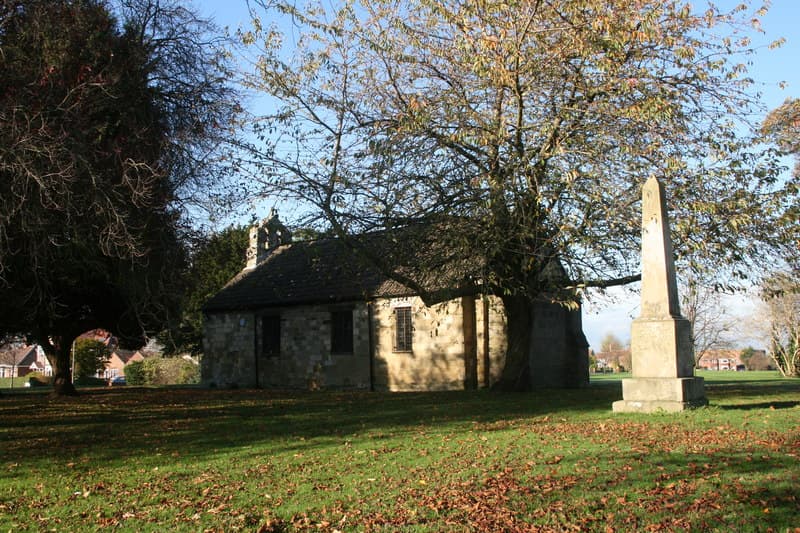
The Church of St Peter ad Vincula, Thornaby, is an Anglican church standing on Thornaby Green in Thornaby, North Yorkshire — a Grade II* listed building of the twelfth century, replacing an earlier church on the same site, and cherished locally as the supposed baptismal place of Grace Pace, the mother of Captain James Cook. Often called the Old Church of St Peter, it is probably the oldest building in the area: a single-roomed Norman survivor around which the ancient village of Thornaby once gathered.
The Domesday Book records that Thornaby had a church in 1086, though the present structure dates from the twelfth century. It was originally dedicated to St Mary Magdalene, and only after a major renovation in the early twentieth century was it rededicated, in 1908, as St Peter ad Vincula — "St Peter in Chains" — after the basilica of San Pietro in Vincoli in Rome. Its medieval history carries one of Teesside's most romantic stories. In 1495 the church was tied to the priory at Guisborough, and the income from the church, together with that of a nearby agricultural cottage and its land, paid for the five lamps that lit the church and the surrounding green. Those lamps illuminated a shrine to St Mary built by Robert de Thormodbi — a crusader who, severely wounded in an encounter at Acre in the thirteenth century, swore that if he survived he would build a shrine to the Virgin. He survived, and kept his vow on Thornaby Green.
The church sits on high ground just east of the River Tees, at the heart of what was the old village of Thornaby: the church, a few houses around it, and a long village green. Industrialisation along the Tees changed everything. A newer settlement grew up on The Carrs, about two miles north — renamed South Stockton by the mid-1800s, and later known as Thornaby-on-Tees — and since the old church could seat only eighty people, a new church had to be built for the booming town. St Peter's was historically described as a chapel, or chapel of ease, lying within another parish: originally in the parish of Stainton, it became the mother church of its own parish of Thornaby-on-Tees in 1844, but the honour was short-lived — by 1858 St Paul's church in Thornaby had become the mother church of the parish. The six-acre graveyard was officially opened in 1869 — though its earliest listed burial dates from 1746 — and closed to burials just a year later, in 1870; burials nevertheless continued for those with close relatives already interred, so that they "might have the privilege of being buried there on their decease", with some recorded as late as 1905. In the 1970s the lych gate was removed and the churchyard landscaped, moving most of the headstones to the edges.
The Captain Cook legend endures. Grace Pace was certainly born and lived in the village of Thornaby, and local tradition holds that she was baptised in the church around 1702. Sceptics point out that at that date the church was not the mother building of the parish of Stainton, so baptisms, marriages and funerals were most likely held elsewhere — but the church retains its original Norman font, so baptisms are assumed to have taken place here at some point in its history, and Thornaby has never surrendered its claim to the great navigator's mother.
Architecturally, the church is a rare and precious survival. Built in the Norman Romanesque style, it consists of a single room forty feet long by seventeen feet six inches wide, its outer walls varying in thickness from side to side, with some evidence of pre-Conquest fabric. Stones in the south wall show signs of re-use — at least two have dials cut into them representing twenty-four hours, ancient sundials recycled by the medieval masons. The two buttresses on the east wall were added in a fifteenth-century renovation, along with the bellcote at the west end. Inside, the design of the columns and roof features crossed leaves — a motif so rare in North Yorkshire that it is recognised in only one other church in the region, St Wilfrid's at South Stainley — and some of the supporting columns date from the twelfth century. A chancel once stood at the east end but was removed at some unknown date, its access arch walled up. The pantile roof installed around 1908 was replaced around 1950, and a new roof of Welsh slate was installed over 2020 and 2021. A plaque on one wall honours No. 608 Squadron RAF, formed at RAF Thornaby in 1930 — the aerodrome that wrote Thornaby's twentieth-century chapter.
The church now lies in the Deanery of Middlesbrough — having previously been in the Deanery of Cleveland — within the Archdeaconry of Cleveland and the Diocese of York, and its current vicar, the Reverend Tom Bates-Bourne, was appointed in January 2024. Nine centuries after its Norman masons set re-used Saxon sundials into the south wall, the little church on Thornaby Green keeps its lamps burning — the crusader's shrine, the navigator's font, and the oldest walls on this stretch of the Tees.
Plan a visit
Visiting hours & services.
Visitor information
St Peter ad Vincula (the Old Church) is a working Church of England parish church on Thornaby Green in Thornaby-on-Tees, in the Tees Valley (Diocese of York). A Grade II* listed Norman church of the 12th century — the oldest building in the area, and the supposed baptismal place of Captain Cook's mother — it retains its Norman font. Visitors are welcome; check the parish for service times.
Where to find it
Location & contact.
In the neighbourhood
Nearby attractions.
Gallery
Sources
Where this record comes from.
This entry is reconciled from open data. Follow the sources to verify the details or suggest a correction.
Nearby