Patney, United Kingdom№ 000077531
Church of St Swithin
- Founded
- 1280
- Tradition
- Anglican / Episcopal
- Style
- Early English Gothic
About this place
History & significance.
The Church of St Swithin is the Anglican parish church of Patney, a village and civil parish in the Vale of Pewsey in Wiltshire, south-west England. The place of worship dates from the thirteenth century, lies within the Diocese of Salisbury, and has been a Grade II listed building since 19 March 1962 (list entry 1365966) — a small Malmstone church at the west end of the village whose dedication points straight to its medieval masters, for St Swithin was the patron of the great cathedral priory of Winchester that long held its advowson.
In the twelfth century the advowson of Patney church belonged to the prior and monks of the church and convent of St Swithun at Winchester. Their right to appoint rectors was apparently challenged early in that century by William Giffard, Bishop of Winchester, though he seems later to have restored it; the priory's right of presentation was confirmed by the bishop in 1172. By the early thirteenth century, however, the right was in the hands of the bishops of Winchester themselves, and in 1284 the convent finally surrendered its claim to them. The bishops presented rectors until the mid-nineteenth century, with only three exceptions: in 1280, when the king presented during a vacancy of the see; in 1573, when the lord of the manor of Patney, Henry, Earl of Pembroke, presented; and in 1639, when for reasons unclear the king again presented. In 1869 the right of presentation passed to the Bishop of Oxford, and in 1953 to the Bishop of Salisbury. The rectory was held in plurality with the united benefice of Chirton with Marden from 1951, and united with it in 1963; in 1976 Charlton and Wilsford were added to form the united benefice of Chirton, Marden, Patney, Charlton and Wilsford, with patronage exercised in five turns — the first and fifth assigned to the Bishop of Salisbury, the second and fourth to the chapter of Christ Church, Oxford, and the third to St Nicholas's Hospital, Salisbury.
The church's tithes, recorded from the twelfth century, were considerable. At the inclosure of 1780, for example, the rector was allotted fifteen acres in lieu of part of his tithes, and the estate so formed was later called Rectory Farm; the net annual income of the benefice averaged £225 between 1829 and 1831, and the 143-acre farm was leased in 1928 to H. W. H. Snook, succeeded after his death in 1975 by his son D. Snook in 1977. A rectory house is first mentioned in 1341, then in 1608 and 1705; though the house standing around 1829 was considered habitable, it was demolished and replaced — apparently on the same site south of the church — by a house designed and built in 1833 by William Dyer of Alton, extended in red brick to the north at the end of the nineteenth century, and let as a farmhouse to the tenant of Rectory Farm from about 1949.
Patney's rectors were a distinguished, if frequently absent, company. John of Ilsley, rector from 1307 to 1318, repeatedly obtained study leave between 1308 and 1312 — a deputy was appointed to serve the cure in 1309 — and went on to become a royal secretary, a baron of the Exchequer and Chancellor of the Exchequer. Thomas Romsey, rector from about 1401 to 1405, was also headmaster of Winchester College. Robert Parker, rector 1591–93, was later forced to live abroad on account of his strong Puritan views, while Geoffrey Bigge, rector around 1593–94, was master of St Thomas's Hospital in Salisbury. James Wedderburn, rector from 1631 to 1639, accumulated many offices including the bishopric of Dunblane, to which he was elected in 1636; his successor Samuel Marsh was ejected in 1647, by which time a Puritan, John Massey — a signatory of the Concurrent Testimony of 1648 — had been accepted. In 1783 the rector lived at Britford, where he was vicar, the rector of Woodborough serving as curate; a curate also assisted in 1818, and from 1949 to 1951 the incumbent of Chirton with Marden was curate-in-charge of Patney. The pattern of worship in 1783 was modest: Sunday services with sermons alternately morning and evening, no weekday services, and the Eucharist — attended by about six people — at Christmas, Easter and Whitsun. On census Sunday in 1851, sixty-five people attended in the morning and seventy in the afternoon; by 1864 average congregations were about thirty in the morning and forty-five in the afternoon, with the sacrament administered to about eight people on the Sunday after Christmas, at Easter and at Whitsun.
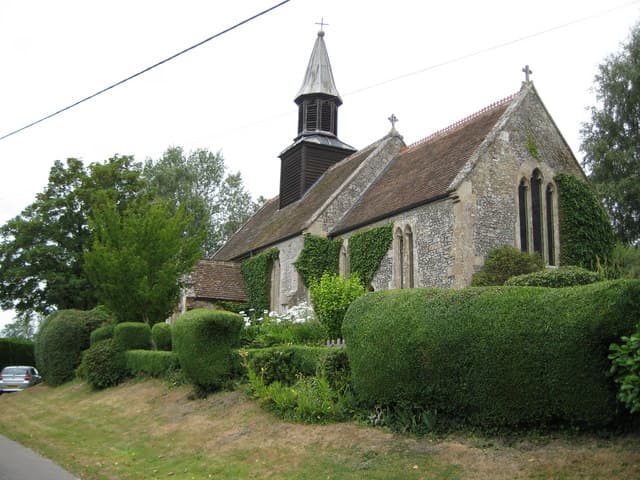
The church that survives is partly of the late thirteenth century. Its chancel was reported in a state of neglect in 1662, and between 1876 and 1878 the building was partly rebuilt and thoroughly restored — with fairly scrupulous respect for the original structure — by Henry Weaver of Devizes, who removed the west gallery, added the north vestry and extensively renovated the rest. The church is built of Malmstone with limestone dressings, formerly rendered, comprising chancel and nave with north vestry, south porch and a central timber belfry — a square louvred bell-stage with an octagonal turret crowned by a lead-covered spirelet, with crosses on the gables, the roofs tiled, the community's churchyard all around. Light enters through trefoiled windows and three-light east and west windows, and the south porch door is of two chamfered moulded orders. Inside, the plastered nave has a six-bay ceiled roof with moulded tie-beams on large wall brackets that carry the belfry. The chancel arch has Bath stone half-columns with stiff-leaf capitals carved in grey limestone, possibly medieval; the chancel keeps its priest's door on the south and a faceted cross-vault. Among the fittings are a thirteenth-century stoup with chamfered hood, bracket and pinnacles; a nineteenth-century font bowl with a continuous ornamental band on a short column and a thirteenth-century round spurred base; a seventeenth-century panelled pulpit with finely worked borders and cornice on a nineteenth-century stone base; a turned seventeenth-century altar rail; two seventeenth-century chairs and columns behind the altar; and six nineteenth-century iron lamp brackets fixed to the nave pews.
The monuments repay attention: in the chancel, four wall tablets of the nineteenth and twentieth centuries commemorate three reverends who served the church and Eliza Cookson, daughter of a Ludgate Hill apothecary, who died in 1755. In the nave are a white marble tablet with pillars and urn to Thomas Lewis of Wedhampton (died 1814) and his wife; a plain marble plaque to Jane Patrick (died 1851); a narrow limestone aedicule with fluted columns, broken ogee pediment and central torch, with putto and painted panel, to Robert Hayward of Marden (died 1722); and another limestone aedicule with painted panel, fluted pilasters and a curved finial shaped like a pineapple or acorn, to Robert Amor (died 1740). Two brass plaques record ten burials between 1786 and 1891 and commemorate Frederick Butler, who died in 1900 in the South African War. In 1553 the church had two bells, and both remained in the twentieth century — one, of about 1500, probably cast in Dorset; in the same year 475 grams of silver were taken from the church treasury for royal use, a 280-gram chalice being left to the parish. The plate by 1976 comprised a chalice of 1706, a paten of 1722 and a flagon of 1766, all given in 1830 by Miss Lewis of Wedhampton in Urchfont. The registers of baptisms and burials survive from 1592 and marriages from 1594, lacking only the burials of 1765–73 — four centuries of Patney lives recorded beside the little church of Winchester's saint in the Vale of Pewsey.
Plan a visit
Visiting hours & services.
Visitor information
St Swithin's stands at the west end of Patney, a small village in the Vale of Pewsey, Wiltshire, reached by lanes off the A342 between Devizes and Upavon. The Grade II listed church serves the united benefice of Chirton, Marden, Patney, Charlton and Wilsford in the Diocese of Salisbury, with services rotating around the benefice churches — see A Church Near You for times; the building is generally open during the day. Note the timber belfry with its lead spirelet, the 17th-century panelled pulpit and altar rails, the 13th-century stoup, and the Hayward and Amor limestone aedicules in the nave. Admission is free; donations support the church. Parking is on the village lane.
Where to find it
Location & contact.
In the neighbourhood
Nearby attractions.
Gallery
Sources
Where this record comes from.
This entry is reconciled from open data. Follow the sources to verify the details or suggest a correction.
Nearby