Godney, United Kingdom№ 000077155
Church of the Holy Trinity
- Founded
- 1839
- Tradition
- Anglican / Episcopal
- Architect
- George Phillips Manners
- Style
- Victorian Gothic Revival
About this place
History & significance.
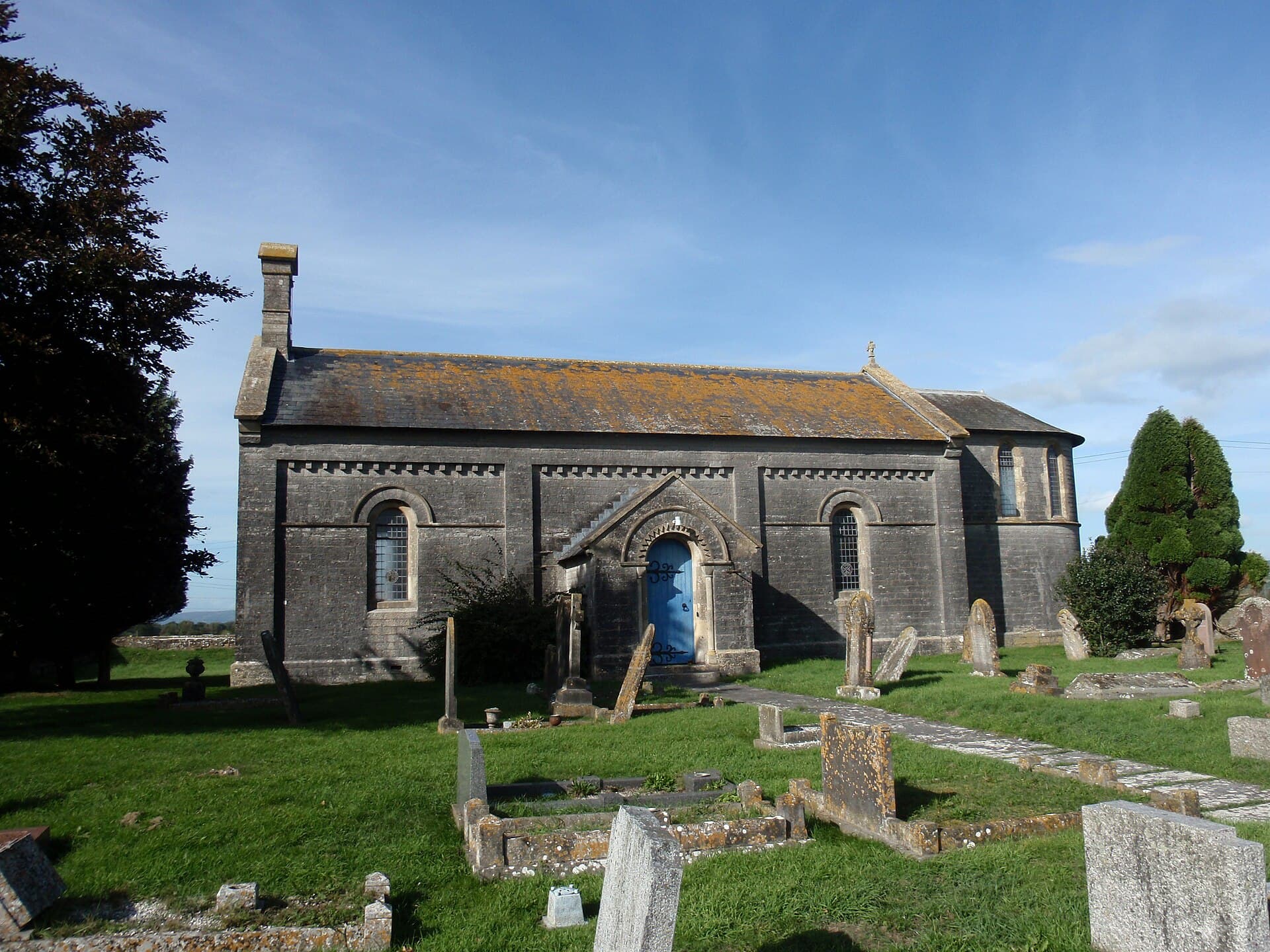
Holy Trinity Church at Godney, in the heart of the Somerset Levels near Glastonbury, is a former Church of England church with a history reaching back to the age of Glastonbury Abbey — a Grade II listed Victorian building, raised on the site of a medieval chapel, that has in our own century found an unexpected new life as a wedding and events venue. Designed by the Bath architect George Phillips Manners and built in 1839–41, it served the little moorland village of Godney for a century and a half before redundancy in 1999, and today, restored and adapted, it welcomes couples as the Glastonbury Wedding Venue beneath the same Blue Lias walls.
Christian worship at Godney is far older than the present building. A chapel dedicated to the Holy Trinity existed here from the twelfth century, when it belonged to the great Benedictine monastery of Glastonbury Abbey — Godney lay among the abbey's watery estates on the Levels, the name itself meaning "God's island", one of the dry rises in a landscape of marsh and moor. After the Dissolution of the Monasteries in 1539 the chapel was sold as part of Godney Manor, and by 1675 the medieval chapel had been abandoned. Worship did not cease, however: a new place of worship was established at a fresh site by Peter Davis in 1737, carrying the village's religious life into the eighteenth century.
By 1838 Godney had grown to a population of 270, but its chapel was in poor repair and could seat only eighty. The problem was made acute by the geography of the Levels: in the winter floods that regularly drowned the moors, the villagers could not reach their parish church of St Mary at Meare, and Godney needed a dependable church of its own. A scheme was launched to rebuild and enlarge the chapel to hold 250 worshippers, funded by public subscription and grants — including £60 from the Bath and Wells Diocesan Church Building Association. The church was rebuilt in 1839–41 to the designs of George Phillips Manners, the county surveyor and a leading Bath architect of his day, and was consecrated on 22 July 1841 by the Bishop of Bath and Wells, the Right Reverend George Henry Law. Godney was given its own ecclesiastical parish in 1869, a recognition of the independent community the new church had helped to create.
By the turn of the twentieth century the building again needed attention, its flooring, seating and gallery in poor condition. A restoration campaign led by the vicar, the Reverend J. M. Alcock, to designs by the diocesan architect Edmund Buckle, was carried out in 1903 by Messrs J. Merrick and Son of Glastonbury. The work added a chancel to the church for the first time — its foundation stone laid by Major Charles D. Sherston on 20 July 1903 — and included the removal of the old west gallery, the installation of new pitch-pine pews, the concreting and re-laying of the floor with wooden blocks, and a new oak pulpit given in memory of a former vicar, the Reverend William J. Marshall. The whole cost between £700 and £800. The church reopened on 12 December 1903; the Bishop of Bath and Wells, who had attended the laying of the chancel foundation stone, had agreed to conduct the reopening but fell ill, and the service was taken in his place by the Assistant Bishop, the Reverend Waite Stirling.
The restoration was completed over the following years with the church's furnishings. A new organ was dedicated on 17 December 1908, built by the Positive Organ Company for £150 and paid for by public subscription with a £60 donation from the philanthropist Andrew Carnegie — whose money built libraries, organs and institutions across Britain and America, here reaching a tiny church on the Somerset Levels. On 22 October 1911 an oak screen forming a vestry at the west end of the nave was dedicated by the Bishop of Bath and Wells, the Right Reverend George Kennion, marking the completion of the 1903 scheme.
Holy Trinity is a modest but well-built church of Blue Lias ashlar — the blue-grey limestone of the region — with slate roofs. As first built it consisted of a three-bay nave, an east vestry and a south porch, with a gallery at the west end and a bellcote on the west gable; the apsidal chancel added in 1903 replaced the original east vestry, and the new vestry was formed at the west end of the nave. One notable feature came with the rebuilding of 1839: heraldic glass of late sixteenth-century origin, brought from a recently demolished house at Lillington, was installed in the church — a fragment of Elizabethan craftsmanship set into a Victorian village church. The churchyard wall, also of 1839, is Grade II listed in its own right.
The church's later parochial history followed the consolidation of rural benefices. Godney was a sole benefice until 1972, when it was united with St John's at Glastonbury, and in 1985 it became part of the Abbey Five Benefice alongside Glastonbury, Meare and West Pennard. Repairs costing £2,700 were carried out in 1980, replacing plasterwork and mending the roof. But the long decline of small Levels congregations told in the end: Holy Trinity closed in 1998 and was formally declared redundant on 1 July 1999. The pews were removed in 2001 and the building used for storage, and it might easily have slipped into dereliction. Instead, in 2016 planning permission was obtained to convert the church into a venue for civil weddings, with a kitchen and toilets installed, and it reopened as the Glastonbury Wedding Venue. The conversion has kept the building in good repair and in regular use — couples now marry where generations of Godney villagers were baptised, married and mourned.
The setting gives Holy Trinity much of its appeal. Godney lies on the Somerset Levels and Moors, the great expanse of drained wetland between Glastonbury and Wells, a landscape of rhynes and willows, peat moors and big skies, rich in birdlife and in some of the most important prehistoric archaeology in Britain — the Iron Age lake villages of Glastonbury and Meare lay close by, and the famous Sweet Track, one of the oldest engineered roads in the world, crossed the marsh nearby. From this watery parish the Tor of Glastonbury rises on the horizon, a few miles south. From a chapel of Glastonbury Abbey on an island in the marsh, through a flood-prompted Victorian rebuilding and a Carnegie-funded organ, to a redundant church saved as a wedding venue, Holy Trinity, Godney holds eight centuries of the Somerset Levels' religious history within its blue-stone walls — no longer a parish church, but still a place where the village's milestones are marked.
Plan a visit
Visiting hours & services.
Visitor information
Holy Trinity is a former Church of England church, declared redundant in 1999 and since 2016 run as the Glastonbury Wedding Venue, so it no longer holds regular services; it is licensed for civil weddings and events. The Grade II listed Blue Lias building, with its 1903 apsidal chancel and a fragment of late-16th-century heraldic glass, stands in the village of Godney on the Somerset Levels. Access is via the wedding venue; the Grade II listed churchyard wall dates from 1839.
Where to find it
Location & contact.
In the neighbourhood
Nearby attractions.
Gallery
Sources
Where this record comes from.
This entry is reconciled from open data. Follow the sources to verify the details or suggest a correction.
Nearby