Cambridge, United Kingdom№ 000060942
Emmanuel United Reformed Church, Cambridge
- Founded
- 1687
- Tradition
- Reformed
- Style
- Victorian Nonconformist Gothic
About this place
History & significance.
Emmanuel United Reformed Church was, for more than three centuries, one of the oldest and most influential Nonconformist congregations in Cambridge — a church whose roots run back to the very dawn of religious toleration in England, and whose long story is woven into the history of Dissent in the university city. Though the congregation has, since 2018, been united with another to form Downing Place United Reformed Church, the Emmanuel community and its handsome Victorian church on Trumpington Street remain a significant chapter in the religious life of Cambridge, embodying the endurance of the Free Church tradition through more than three hundred years of change.
The congregation's origins lie in the year 1687, when it was founded as the Cambridge "Great Meeting" at Hog Hill — on the site of what is now the Old Music School in Downing Place. This was the moment when Dissenters, long persecuted under the law, were at last beginning to worship openly, and the Great Meeting quickly became the principal gathering of Independent (Congregationalist) Christians in the town. From 1691 its minister was Joseph Hussey, a figure of such standing that he would later be commemorated in the stained glass of the Emmanuel church alongside a remarkable company of Puritan and Nonconformist heroes — the early Separatists John Greenwood and Henry Barrow, the Lord Protector Oliver Cromwell, the poet John Milton, and the ejected Cambridgeshire minister Francis Holcroft. Hussey's congregation proved a seedbed of Cambridge Dissent: it split in 1696, with some members departing for the meeting in Green Street, and again in 1721, after Hussey had left for London, when a group founded the church that became St Andrew's Street Baptist Church — so that several of the city's Free Churches can trace their descent from this single ancient congregation.
Over the centuries the church was known by a succession of names — the Hog Hill Independent Church, and later the Emmanuel Congregational Chapel or Emmanuel Congregational Church — reflecting both its changing buildings and the evolving identity of English Congregationalism. The original meeting house at Hog Hill was rebuilt on the same site and reopened as the Emmanuel Congregational Chapel in 1790. Then, in 1874, the congregation moved to a new and grander church on Trumpington Street, in the heart of the university quarter. The old chapel did not fall idle: from 1881 it was put to use as the Balfour Biological Laboratory for Women, providing laboratory space for the female science students of the University of Cambridge at a time when women were only beginning to be admitted to higher education — a fitting second life for a building raised by a community that had always valued learning and conscience.
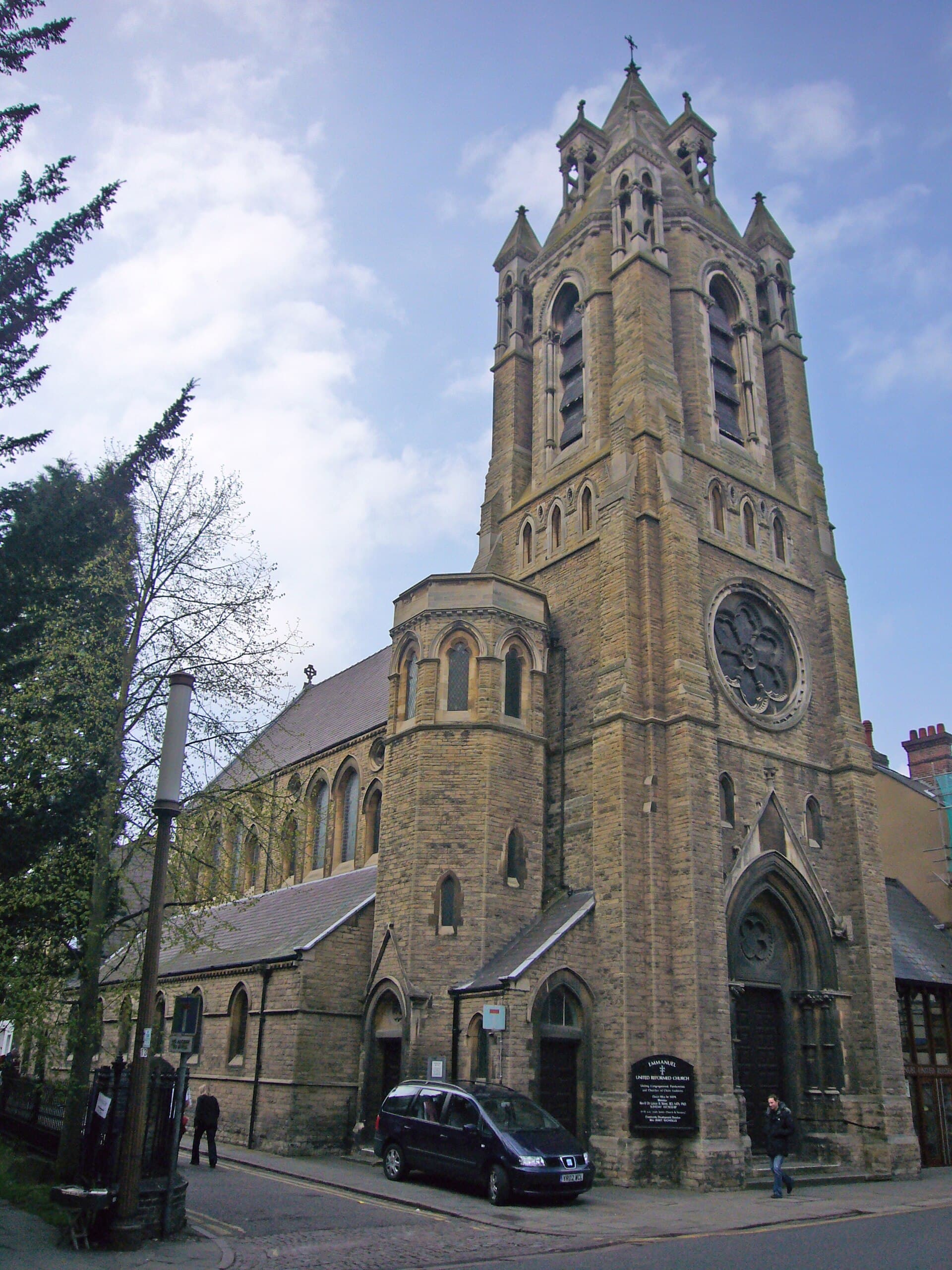
The new church on Trumpington Street, from which the congregation took the name Emmanuel Congregational Church, was built to the designs of the architect James Cubitt in 1875. A dignified Victorian Nonconformist church, it was listed at Grade II in 1996 in recognition of its architectural quality. In 1972, when the Congregational Church in England and Wales joined with the Presbyterian Church of England to create the United Reformed Church, Emmanuel voted to enter the new denomination, becoming Emmanuel United Reformed Church and continuing its witness within the reunited Reformed tradition.
In its modern life Emmanuel was a busy and outward-looking congregation. Alongside its regular Sunday worship it ran a volunteer-staffed fairtrade café, hosted a popular series of lunchtime music recitals, and took a share in Hope Cambridge's Churches Homeless Project, opening its doors to the vulnerable of the city. In July 2018 the Cambridge branch of the Open Table Network — a fellowship welcoming LGBT+ Christians — was founded at Emmanuel, a sign of the inclusive ethos that the congregation had come to embody.
That same year marked a turning point. In 2018 Emmanuel United Reformed Church merged with St Columba's Church, Cambridge — a congregation of originally Presbyterian foundation, whose own roots reached back to a Presbyterian congregation registered in the city in 1689 — to form a single new church, Downing Place United Reformed Church. The united congregation made its home in the former St Columba's building on Downing Place, close to the very site where Emmanuel's congregation had first gathered before 1874, so that the church came, in a sense, full circle to where its story had begun. The Emmanuel building on Trumpington Street was subsequently sold to Pembroke College, becoming part of the college's Mill Lane development. The newly merged church was refurbished to continue the same pattern of worship, music, and social outreach — Sunday services, concerts, a therapy centre, and a night-time drop-in run with the Cambridge Street Pastors — carrying the inheritance of both founding congregations into the future.
The church stands at the heart of historic Cambridge, among the colleges, museums and churches of one of the world's great university cities. Pembroke College, Emmanuel College, the Fitzwilliam Museum with its outstanding art collections, the Botanic Garden, and the ancient churches and chapels of the university — including the incomparable King's College Chapel — all lie within a short walk, as do the River Cam with its punts, the open green of Parker's Piece, and the bustling streets and markets of the city centre.
From the Cambridge Great Meeting of 1687 and the ministry of Joseph Hussey, through the congregation's many offshoots, its rebuilt chapel of 1790 and James Cubitt's church of 1875, its entry into the United Reformed Church in 1972 and its lively modern ministry, to its union with St Columba's as Downing Place United Reformed Church in 2018, Emmanuel United Reformed Church gathers more than three centuries of Cambridge Nonconformity into a single continuous story. Though its name and building have passed into new hands, the Emmanuel congregation remains a living part of the United Reformed Church in Cambridge — a witness to the long and honourable tradition of Dissent in the university city, carried forward in the worship and service of its successor church.
Plan a visit
Visiting hours & services.
Visitor information
The Emmanuel congregation, founded in 1687, merged with St Columba's in 2018 to form Downing Place United Reformed Church, which now worships in the former St Columba's building on Downing Place with Sunday services, concerts and community outreach. Emmanuel's own Grade II listed church of 1875 on Trumpington Street, by the architect James Cubitt, was sold to Pembroke College and is no longer used for worship; the living congregation continues at Downing Place in the heart of the city.
Where to find it
Location & contact.
In the neighbourhood
Nearby attractions.
Gallery
Sources
Where this record comes from.
This entry is reconciled from open data. Follow the sources to verify the details or suggest a correction.
Nearby