City of Edinburgh, United Kingdom№ 000061271
Kirk of the Canongate
- Founded
- 1691
- Tradition
- Presbyterian
- Style
- Dutch-influenced 17th-century
About this place
History & significance.
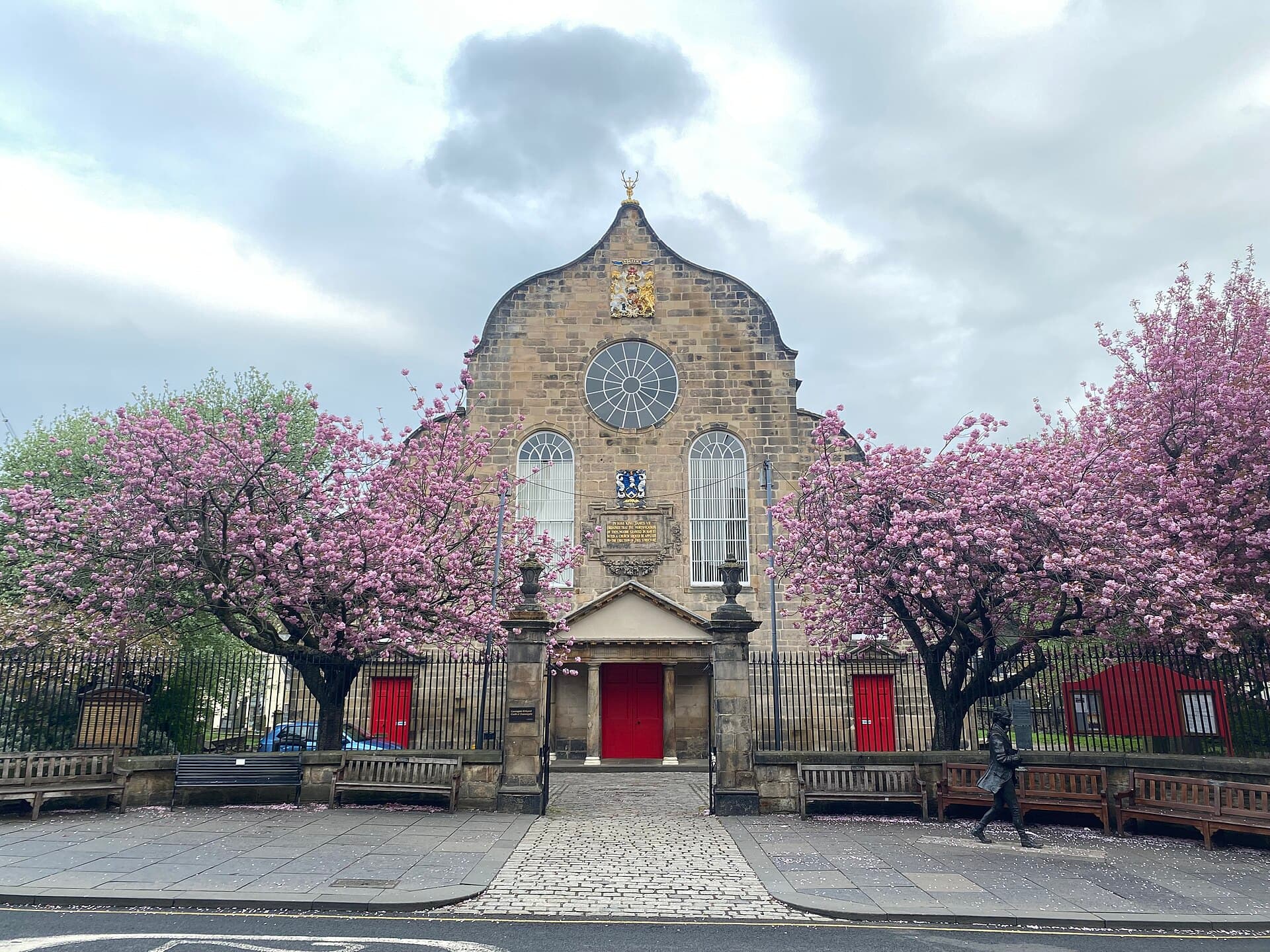
The Kirk of the Canongate, or Canongate Kirk, serves the Parish of Canongate on Edinburgh's Royal Mile, a Church of Scotland congregation whose parish embraces the Palace of Holyroodhouse, the Scottish Parliament and, though detached from the rest, Edinburgh Castle itself. With its Dutch-style gable crowned by a gilded cross within a stag's antlers, its royal pew, and its kirkyard holding Adam Smith and the poet Robert Fergusson, it is one of the most distinctive churches in Scotland — and the church where Zara Phillips, granddaughter of Queen Elizabeth II, married the England rugby captain Mike Tindall on 30 July 2011.
The kirk owes its existence to a king's change of religion. After the Reformation the Canongate congregation worshipped in the nave of Holyrood Abbey, until on 28 June 1687 James VII ordered the abbey repurposed as a Roman Catholic chapel for his newly founded Order of the Thistle. The displaced congregation was lodged at Lady Yester's while a new church was built, funded by a diverted mortification of 20,000 merks left in 1649 by Thomas Moodie, the Covenanting treasurer of Edinburgh, for a church in the Grassmarket; after decades of rival schemes, the King ordered the accumulated fund toward a church in the Canongate in May 1688, and Moodie's arms still grace the façade. James Smith was the architect, and the congregation occupied the completed church in 1691 at a cost of some 34,000 merks. The building is remarkable for its cruciform interior, highly unusual in a post-Reformation, pre-Victorian Church of Scotland kirk, behind a curious small Doric-columned portico; the antlers on the gable, bearing the obsolete arms of the burgh of Canongate, were first set up in 1824 and replaced in 1949 with those of a stag shot at Balmoral by George VI.
The eighteenth century brought famous voices to the pulpit: George Whitefield preached here in 1741 and twice in 1748 with Ralph Erskine, and Hugh Blair, the great rhetorician, served the second charge from 1743. In 1745 the army of Charles Edward Stuart occupied the Canongate and used the church to hold prisoners from the Battle of Prestonpans. The Reverend Robert Walker, minister from 1784 to 1808 and a campaigner against the slave trade, achieved immortality of another kind as the subject of Henry Raeburn's beloved painting The Skating Minister, gliding across Duddingston Loch. Three generations of one family, all named John Warden, later Macfarlan, held the ministry in succession, the second a co-founder of the Royal Society of Edinburgh in 1783. But the nineteenth century brought decline: the new Regent and London Roads diverted traffic from the old burgh, the prosperous moved to the New Town, and Walter Buchanan described his parish's "dismal abounding of iniquity... of a populous and polluted city"; by mid-century the minister counted only 45 families of Reformed attachment among 411. Revival came through the liturgical pioneers: Andrew R. Bonar, minister from 1849, introduced hymn-singing and a choir, and in 1874 one of the first pipe organs in the Church of Scotland; James McNair doubled the membership in four years from 1869, and the American evangelists Moody and Sankey held meetings in the kirk during their 1874 Scottish campaign. Fire damaged the church in 1863, probably destroying the old Canongate records.
The twentieth century restored the kirk's royal lustre and its fabric. Thomas White's half-century ministry spanned the First World War, in which every available man of the Canongate enlisted and ninety members of the congregation died. His successor, Ronald Selby Wright, minister from 1937 to 1977, became famous as the wartime "Radio Padre"; while he served as an army chaplain, George MacLeod, founder of the Iona Community, supplied locums and made the Canongate manse the community's mainland headquarters, and forty more members died in the Second World War. In 1937 George VI gave the church a Christmas tree from Balmoral, beginning a royal gift repeated every year since. The renovation Selby Wright had announced for the kirk's 250th anniversary was completed after the war: Queen Elizabeth and Princess Margaret visited on 17 July 1947, the first royal visit in the church's history despite its ancient royal pew, and on 25 June 1952 the new Queen Elizabeth II came during her first visit to Scotland as monarch, the first reigning sovereign ever to worship there; she returned regularly throughout her reign. The unsympathetic Victorian alterations of 1882 were stripped out in the early 1950s with the galleries, restoring the kirk's dignified simplicity and flooding it with light; a further restoration by the Stewart Todd partnership followed in 1991, and in 1998 a Danish Frobenius organ, the thousandth built by the firm, was installed in memory of Selby Wright. The Canongate itself, described around 1900 as "the centre of dirt and poverty and squalor", was sympathetically redeveloped from the 1950s, culminating in the opening of the Scottish Parliament in 2004, with the kirk adding Russell House student residences in 1964 and the Harry Younger Hall in 1967.
The kirkyard is among Edinburgh's most visited: here lie Adam Smith, author of The Wealth of Nations, his biographer the philosopher Dugald Stewart, Agnes Maclehose, the "Clarinda" of Robert Burns's letters, by tradition David Rizzio, the murdered secretary of Mary, Queen of Scots, and the poet Robert Fergusson, whose jaunty bronze statue by David Annand strides outside the kirk gate, placed there because Burns himself paid for Fergusson's headstone. The kirk is the regimental chapel of the Royal Regiment of Scotland, successor to the Royal Scots, and keeps both a Royal Pew and a Castle Pew in its front row. Today the congregation worships every Sunday morning with a monthly evening service, celebrates Communion monthly, hosts concerts year-round and becomes Venue 60 of the Edinburgh Festival, while the present minister, Neil Gardner, a former Black Watch chaplain appointed in 2006, continues a succession that runs back through two Moderators of the General Assembly to John Craig, colleague of John Knox, in 1561.
Plan a visit
Visiting hours & services.
Visitor information
Canongate Kirk is an active Church of Scotland congregation with a Sunday service at 10:30am and a monthly evening service; the church is regularly open to visitors, free of charge, and serves as Venue 60 during the Edinburgh Festival. The kirkyard with Adam Smith's and Robert Fergusson's graves is open daily — find Fergusson's bronze statue striding outside the gate — and the Frobenius organ features in regular concerts.
Where to find it
Location & contact.
In the neighbourhood
Nearby attractions.
Gallery
Sources
Where this record comes from.
This entry is reconciled from open data. Follow the sources to verify the details or suggest a correction.
Nearby