Biburg, Germany№ 000023755
Maria Immaculata
- Founded
- 1133
- Tradition
- Roman Catholic
- Style
- Romanesque
About this place
History & significance.
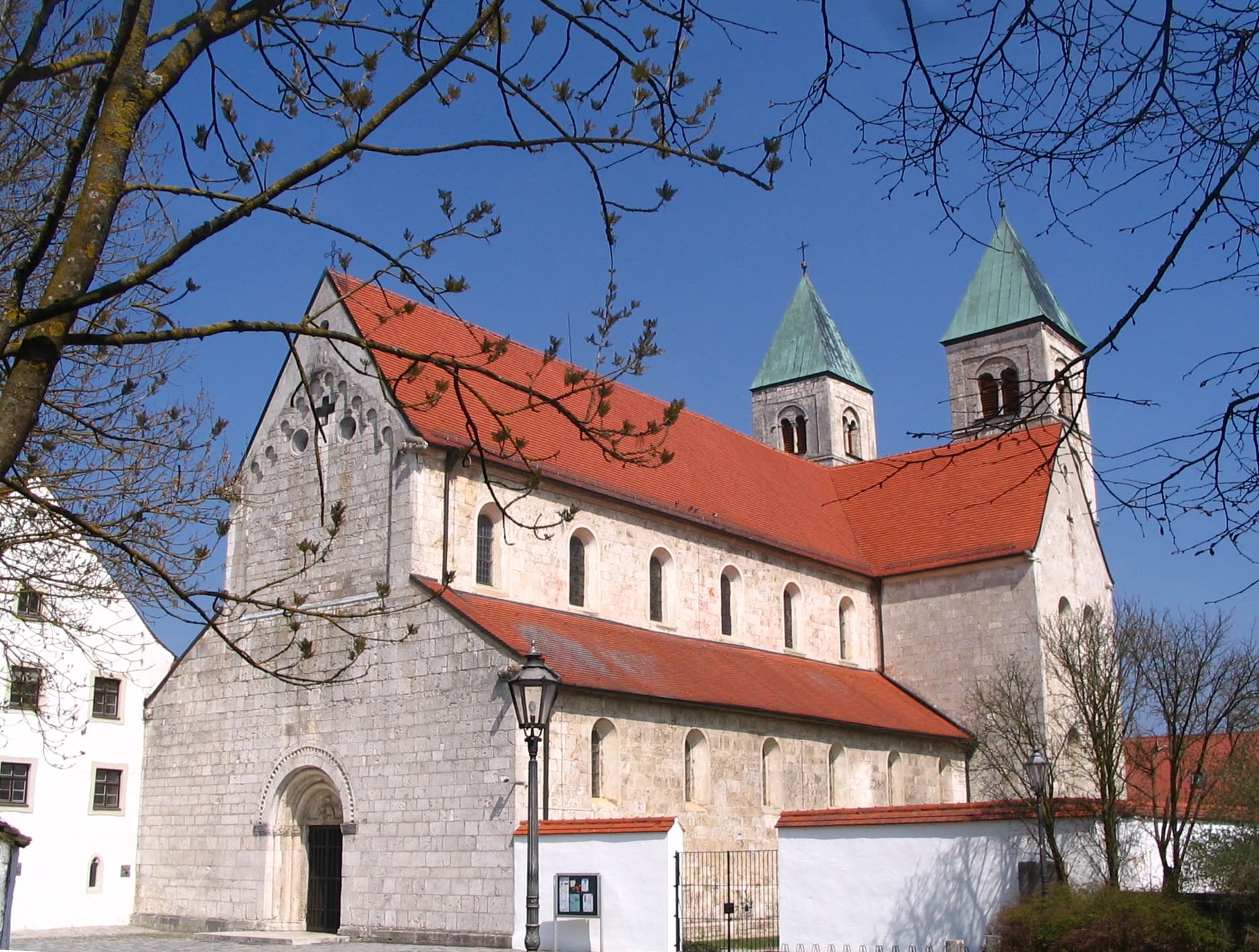
The Roman Catholic parish church of Maria Immaculata in Biburg, near Abensberg in the Lower Bavarian district of Kelheim, is one of the most important Romanesque monuments of Old Bavaria — and, with a consecration date of 1133, one of the oldest churches still standing in the whole of Bavaria. Known equally as the Klosterkirche Biburg, it was built as the church of a monastery that passed in turn through the hands of Benedictines, Jesuits and the Knights of Malta, and it crowns a rise above the valley of the river Abens at the northern edge of the Hallertau, the hop country of Bavaria. The building is registered as a protected monument with the Bavarian State Office for Monument Protection.
Its founding is a family story. In 1125 Count Heinrich I of Sittling, his wife — the Blessed Bertha of Ratzenhofen — and their sons Konrad and Arbeo gave the castle of Biburg to Bishop Otto of Bamberg for the establishment of a monastery, and the building of the church began at once. By 1133 (other sources say 1134–35) work on the Romanesque pillared basilica was largely complete and the church received its preliminary consecration; the formal consecration in honour of Our Lady followed in 1140, performed by Bishops Heinrich of Regensburg and Egilbert of Bamberg. Around the same time the Benedictine house was raised to the rank of abbey under Abbot Eberhard of Sittling and Biburg, who led the community until 1147 — when he was called away to become Archbishop of Salzburg. Biburg was originally run as a double monastery of monks and nuns, but the women's convent burned down in 1278 and was never rebuilt; the church and the men's house escaped the flames.
The Gothic centuries left their mark inside. Abbot Heidenreich Starzhauser (1394–1407) had the originally flat-ceilinged side aisles vaulted in the Gothic style, and under Abbot Benedikt Collmann (1526–1550) the nave and transept received their late Gothic net vaults — a keystone carries the date 1532, presumably the year of the vaulting. The Reformation drove the Benedictines from their monastery by 1555, and in 1589, with the permission of Pope Sixtus V, the monastery and all its possessions passed to the Jesuit order as an endowment for the University of Ingolstadt. The Jesuits kept only a few fathers and brothers here, using Biburg chiefly as a summer residence for the Ingolstadt college; they baroquised the church in works completed by 1687 — chiefly widening the windows to let in more light and installing a rich array of altars and figures — though, tellingly, they left the walls free of fresco and stucco, and the nineteenth century later swept the Baroque furnishings away again. After a fire in 1701 they rebuilt the monastery buildings in plain form. When the Jesuit order was suppressed in 1773, the monastery passed in 1781 to the Knights of Malta, who held it until the Bavarian secularisation of 1803. The church's salvation came in 1785, when it was declared the parish church of Biburg — and so escaped demolition, a fate that instead befell the village's old parish church of St. Stephan.
What makes Biburg precious is that, although the original furnishings are gone, the architecture still corresponds largely to its original Romanesque state. The church is an east-facing, three-aisled pillared basilica on the ground plan of a Latin cross, its unplastered walls showing the squared limestone and tufa blocks of the twelfth-century masons. Over the side choirs rise two towers, thirty-six metres high, plain below and pierced in their two upper storeys on all four sides by paired sound arcades set in blind arches, the whole crowned by pyramid spires with ball and cross; all four bells now hang in the south tower. Otherwise the exterior is austere, articulated only by round-arched windows and the round-arch friezes on the three apses and the west and east gables — Romanesque architecture at its most elemental.
The west portal, surviving from the time of construction, is the building's sculptural treasure, and it preaches a complete sermon in stone. Originally the only entrance for lay people, it has a twice-stepped surround with two three-quarter columns on each side, archivolts decorated with roll mouldings and a tooth frieze, and capitals carved into a gallery of the vices: a siren holding her two fishtails, symbol of lust; two winged dragons spitting fire in opposite directions, for envy; a monster with three bodies and one head, paws on its middle belly, for gluttony; a grimacing face thrusting out its tongue and preening its beard, read as wrath and vanity; and a crouching man with hands braced on his lap, for sloth. On the imposts, roundels show the devil as an archer — a medieval image of pride — and two birds pecking at a grape cluster, the emblem of greed. Above it all, the tympanum carries a stone relief of Christ in blessing: the vices below, salvation above.
Inside, the six-bay nave rises between aisles half its width and considerably lower, divided by round arcades on massive rectangular piers — with the curious refinement that the second and fifth bays are slightly narrower, tightening the rhythm of the arches. The transept arms barely project beyond the nave and match the height of the central vessel, and choir and side choirs all end in semicircular apses. The Gothic vaults overhead tell their own dates: groin vaults of about 1400 in the aisles, one bay enriched with a star-rib vault, and the late Gothic net vaults of around 1532 over nave and transept. The three leaded glass windows in the choir, from about 1885, are the chief survivors of the neo-Romanesque refurnishing of 1885–87, showing the Immaculata flanked by John the Baptist and St. Joseph; the organ case on the small gallery in the south transept survives from the same campaign. From 1960 the nineteenth-century furnishings were progressively removed, and in 1983 — for the church's 850th anniversary of consecration — the artist Hans Wurmer of Hausen gave the church its modern bronze furnishings: the people's altar with twelve roundel reliefs of the life of Mary, the ambo with the four evangelist symbols, and the candlesticks, their circular forms a deliberate echo of the Romanesque round arch.
The older treasures repay searching out. The limestone font of about 1200, the church's only Romanesque furnishing, came from the demolished St. Stephan and stands in the south side choir, a shell basin on an octagonal base ringed by a blind-arch frieze and lily motif, its wooden lid carrying a Baroque group of the Baptism of Christ. A late Gothic figure of St. Barbara of about 1510–20 stands over the sacristy door; panel paintings of about 1520–30 from a lost winged altar show Abbot-Bishop Virgil of Salzburg with his church model and St. Nicholas with his three golden balls; and paintings of around 1600 include a crescent-moon Madonna modelled on the famous Schöne Maria of Regensburg. In the south side choir stands the tomb of the Blessed Bertha of Biburg, mother of the founders: a narrow limestone slab of the late twelfth century with her figure in flat relief, the hand of blessing in the corner alluding to her beatification — brought here in 1968 from the pilgrimage church of Allersdorf. Around the west end of the church and along the churchyard wall stretch grave monuments from the fifteenth to nineteenth centuries, finest among them the red marble epitaphs of the Benedictine abbots, four of them with full-length relief portraits. North of the church stand the former monastery buildings; to the south lies the old monastery and village graveyard with the Seelenkapelle, a gabled chapel of about 1600 with fine tracery windows.
Nine centuries after Count Heinrich and the Blessed Bertha gave their castle away, their church still serves the parish of Biburg — a Romanesque basilica of rare completeness in the Bavarian hop country, with the seven deadly sins still snarling around its west door and Christ still blessing all who walk beneath them.
Plan a visit
Visiting hours & services.
Visitor information
Maria Immaculata is the active Roman Catholic parish church of Biburg (Diocese of Regensburg) and is generally open to visitors during the day outside service times. The great sight is the Romanesque west portal of the 1130s, its capitals carved with the deadly sins - siren, fire-spitting dragons, three-bodied glutton, grimacing wrath - beneath a tympanum of Christ in blessing. Inside, look for the tomb slab of the Blessed Bertha of Biburg, the c.1200 font from the lost church of St. Stephan, the red marble epitaphs of the Benedictine abbots, and Hans Wurmer's bronze altar of 1983 with its twelve roundels of the life of Mary. The former monastery buildings adjoin the church to the north.
Where to find it
Location & contact.
In the neighbourhood
Nearby attractions.
Gallery
Sources
Where this record comes from.
This entry is reconciled from open data. Follow the sources to verify the details or suggest a correction.
Nearby