Maybole, United Kingdom№ 000073708
Maybole Baptist Church
- Founded
- 1901
- Tradition
- Baptist
- Architect
- Hugh Campbell of Glasgow
About this place
History & significance.
Maybole Baptist Church was a Baptist church in the historic town of Maybole, in South Ayrshire, Scotland, and its red sandstone front on Carrick Street remains one of the most distinctive buildings in the capital of Carrick. The congregation grew out of a small prayer group formed in 1898, was admitted to the Baptist Union of Scotland in 1901, opened its purpose-built church in 1914, and worshipped there for more than a century until the church closed in 2020. In its story can be read, in miniature, the whole arc of the Baptist movement in lowland Scotland: the evangelical ferment of the Victorian decades, the self-sacrificing fundraising of a small-town congregation, the shock of the Great War, the interwar high-water mark, and the long, slow ebb of the twentieth century.
The soil in which the church grew had been prepared over half a century. New Christian congregations multiplied across Scotland in the second half of the nineteenth century — from a handful in the middle of the century to an estimated 184 assemblies in southern Scotland by 1900 — and Maybole was swept along in the trend. The Baptist Union of Scotland had been formed in 1869, giving the movement a national structure. During the 1870s the town experienced the "Maybole Revival", an evangelistic movement energetic enough to publish its own magazine, The Maybole Evangelist. A new Maybole Presbyterian Church opened in 1880, a Baptist Theological College was established in Glasgow in the 1890s to train ministers, and the missionary enthusiasm of the expanding British Empire kept evangelical religion in the public eye. Industrialisation played its part too: nineteenth-century Maybole had become a manufacturing town, known for agricultural implements and above all for shoemaking, and Baptist churches in Scotland characteristically drew their members from exactly this commercially active, middle-class world. Some Maybole worshippers, moreover, chafed against the stricter doctrines of the town's older congregations — the Church of Scotland's rigorous Sabbatarianism among them — and looked for a freer expression of their faith.
Out of this ferment, around 1898, came a prayer group of seventeen Maybole parishioners. Meeting first in private homes and then in the disused Maybole Methodist Church, the little fellowship followed a path trodden by many Scottish congregations of the era: prayer group first, formal recognition second, building last of all. The Baptist Union of Scotland admitted Maybole Baptist Church to membership in 1901, although the congregation still had no building of its own, and in 1903 a building fund was established. Among the early leaders was Thomas Ramsay (1857–1934), who would shape the church's first decades.
Eleven years passed between the start of the building project and its completion — years of patient saving by a congregation that insisted on funding its own church. The building finally opened on 30 October 1914, two months after the outbreak of the Great War, and was greeted as "The Youngest Church in Maybole". It offered seating for 320 worshippers with standing room for 120 more, remarkable capacity for a fellowship that had begun with seventeen people in a parlour. Construction cost £1,720, raised entirely by the congregation itself — a figure that invites comparison with the nearby Maybole Library, built in the same decade for £2,500 on the strength of a single donation from the American philanthropist Andrew Carnegie. Even with personal gifts from the first pastor, Thomas Ramsay, and other elders, the church carried debt for some years. Ramsay's generosity did not end there: on his retirement in 1919 he gave the congregation a manse, citing the Great War as his motivation.
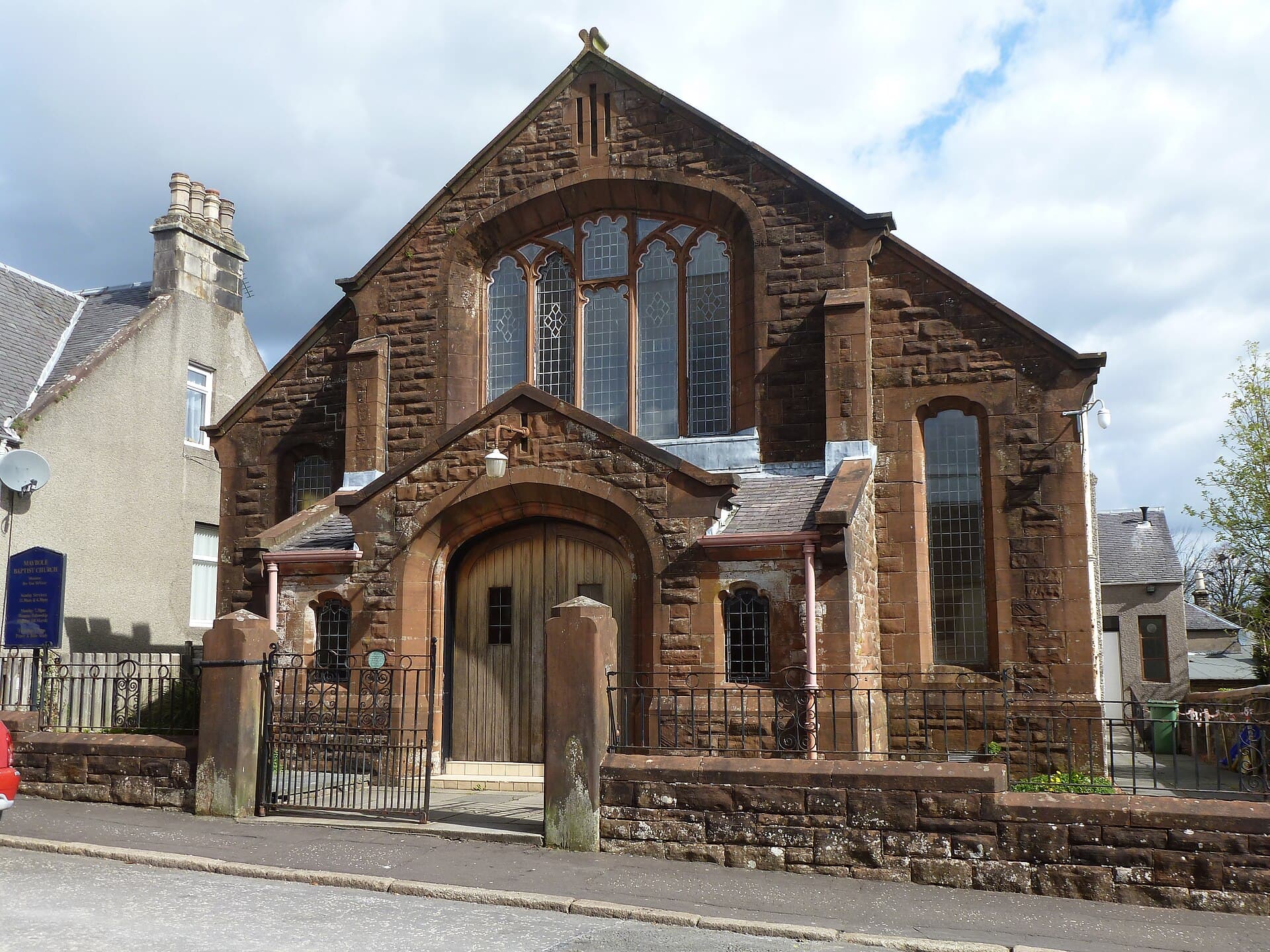
The building the congregation raised was designed by the Glasgow architect Hugh Campbell (1863–1926), and it is recognised as a noteworthy building in Maybole and the wider Carrick district of southern Scotland — a town already noted for its distinctive architecture, so that earning a place in its streetscape was no small distinction. Campbell gave the church a warm red sandstone front with a traditional gable, a projecting entrance porch and an arched doorway, with a large traceried window lighting the gable above. The choice of red sandstone tied the church visually to the building stock of the town around it, while the gabled front and porch announced its nonconformist identity — a chapel front rather than a tower or steeple. The church stands on a tight plot at 14 Carrick Street, immediately north of the A77 road that carries traffic through the heart of Maybole, so the grounds are minimal and the building addresses the street directly, its low boundary wall and iron railings framing the porch. Hemmed in by its neighbours, the church made a virtue of its constraints: everything the congregation could afford went into the facade and the great gable window.
The young church soon looked beyond its own walls. During and after the Great War, the members of Maybole Baptist Church supported a "daughter church" at Girvan, the coastal town nineteen kilometres to the south, which had grown from a prayer group established there in 1907. Girvan Baptist Church opened in 1920; it closed in 2001 and the building was destroyed by fire in 2013, so that the daughter predeceased the mother. Recognition of Maybole's standing in the wider movement came in 1921, when Thomas Ramsay, the congregation's inaugural pastor, was elected President of the Baptist Union of Scotland — a singular honour for the minister of a small Ayrshire town.
The interwar years were the church's high summer. Electricity was installed in the building in 1935, an event thought worthy of a memorial plaque that remained on the wall ever after — a touching reminder of how great a step this was for a self-funded congregation. The registered membership reached 105 in the 1930s, the highest in the church's history. The decades that followed told a quieter story, mirrored across Scotland as Baptist congregations declined from their interwar peak. Yet the cumulative numbers are striking for a small town: by the 1950s Maybole Baptist Church had admitted 404 people into membership of the Baptist Union, and by the 1960s it had baptised 288 believers. There was even a modest revival of attendance in Scottish Baptist churches late in the twentieth century, but the long trend was downward, and after more than a hundred years of worship on Carrick Street the church finally closed in 2020.
The building survives, and its quality is not in doubt: the red sandstone gable front by Hugh Campbell remains a recognised landmark of Maybole's streetscape. For the record-keepers, the site is catalogued in the national inventory — its National Grid Reference is NS 29880 09900 and its Canmore ID is 203792 — a fitting kind of permanence for a church whose history was so carefully documented, from the jubilee booklet of 1950, These Fifty Years, to the histories of the Baptist movement in Scotland in which Maybole repeatedly figures.
Maybole itself adds resonance to the story. The ancient capital of Carrick, with its ruined medieval collegiate church, its sixteenth-century castle and its weavers' and shoemakers' history, is a town where buildings carry long memories; the Baptist church on Carrick Street, though younger than its neighbours by centuries, earned its place among them. The story of seventeen people praying in a front room in 1898, building a church seat by seat and shilling by shilling, sending a daughter congregation to the coast, giving a national president to their Union, and proudly wiring their church for electric light, is the story of Scottish nonconformity at its most human scale — and it deserves to be remembered as part of the rich religious heritage of Ayrshire.
Plan a visit
Visiting hours & services.
Visitor information
Maybole Baptist Church closed in 2020 after more than a century of worship, and no services are held; the congregation's story (1898 prayer group to 2020 closure) is part of the documented Baptist heritage of Scotland. The building, a recognised landmark of Maybole's streetscape, stands at 14 Carrick Street just north of the A77 and its handsome red sandstone gable front by Hugh Campbell can be viewed from the street at any time. The site is recorded in Scotland's national heritage inventory (Canmore ID 203792).
Where to find it
Location & contact.
In the neighbourhood
Nearby attractions.
Gallery
Sources
Where this record comes from.
This entry is reconciled from open data. Follow the sources to verify the details or suggest a correction.
Nearby