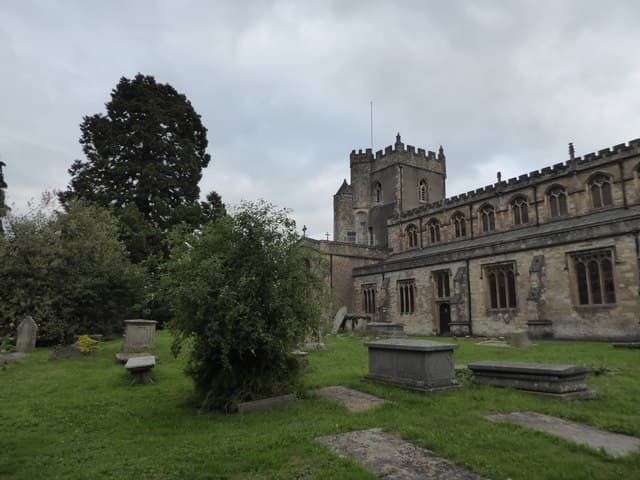
Warminster, United Kingdom№ 000070438
Parish Church of St Denys (the Minster Church)
- Founded
- 1050
- Tradition
- Anglican / Episcopal
- Style
- Norman & Perpendicular Gothic
About this place
History & significance.
St Denys' Church, also known as the Minster Church of St Denys, is the parish church of the market town of Warminster in west Wiltshire, and the oldest church in the town. Its very name carries an echo of great antiquity, for "Warminster" means the "minster on the River Were", implying that a Saxon minster church — a mother church served by a community of clergy — stood here more than a thousand years ago. Begun in the eleventh century, remodelled in the fourteenth and thoroughly restored in the nineteenth, St Denys' is a Grade II* listed building, notable both for its long history and for the exceptional richness of its Victorian furnishings.
Although the Domesday Book of 1086 did not record a church or priest at Warminster, the name of the town was already in use in the early tenth century, which strongly implies the presence of a Saxon minster church on the site. By the twelfth century the church was dedicated to St Denys — the patron saint of France, a dedication shared by only a handful of English churches. The present building stands in the north-west of the town, for Warminster has developed away from the site of the original Saxon settlement around the church. Built of limestone on a cruciform plan, its earliest surviving parts — within the crossing and the base of the tower — date from the eleventh century. There was extensive rebuilding or remodelling in the fourteenth century, and in the fifteenth a two-bay south chapel was added for the Maudit family. The low central tower, with its two joined stair turrets, is a distinctive feature, and the nave was rebuilt in 1723–4.
The church owes much of its present appearance to a thorough restoration carried out by the prolific Victorian architect Sir Arthur Blomfield between 1887 and 1889. Blomfield rebuilt the nave once again, making it longer and giving it a clerestory of ten lights on each side in the Perpendicular style, and he extended the chancel westwards into the crossing. As a result, only the tower, the south wall of the chancel and the south porch remain from the earlier church — but the restoration was carried out with such quality that it created one of the finest Victorian church interiors in the county.
Indeed, it is the Victorian refurnishing that gives St Denys' its special distinction. The Historic England listing describes the restoration as "an exceptionally elegant and generous refurnishing on High Church principles", with the chancel fittings forming an "exceptional ensemble". These include a reredos and choir stalls by the celebrated Exeter firm of Harry Hems, together with metal chancel screens and gates and decorative tiles by William Godwin; Hems also made the nave benches and the octagonal pulpit, which is inlaid with marble. The church is lit by fine nineteenth-century stained glass by some of the leading makers of the age — Burlison and Grylls, Henry Holiday, and Clayton & Bell — with a later window of 1950 by Christopher Webb. The organ, installed in 1792, was built by G. P. England for Salisbury Cathedral, where it had proved insufficiently powerful, and its case was praised by Pevsner as "a delightful piece". The tower holds a peal of eight bells, increased from six in 1881, all recast except for the tenor of 1737, and refurbished again in recent years.
The church's clergy have left their mark on the town. William Dalby, vicar from 1825 to 1841, held services at the workhouse for the poor of Warminster Common and instigated the building of Christ Church there in 1831; his successor Arthur Fane, vicar from 1841 to 1859, was described as talented and zealous, established a reformatory school in 1856, and instigated the restoration of the nearby St Lawrence's chapel — reflecting the energetic social and religious life of the Victorian parish.
The church stands in Warminster, an attractive Georgian market town in west Wiltshire, on the western edge of the great chalk upland of Salisbury Plain. The town's old streets, its independent shops and its association with the army on Salisbury Plain give it a distinctive character; nearby rise the dramatic conical hill of Cley Hill, a noted beauty spot and ancient site, and the magnificent Longleat House, the great Elizabethan mansion of the Marquesses of Bath with its famous safari park and gardens. The Wylye Valley, the chalk downs and the cathedral city of Salisbury are all within easy reach.
From a Saxon minster that gave the town its name, through the Norman crossing and tower, the medieval chapels and the Georgian nave, to Sir Arthur Blomfield's restoration of the 1880s and its exceptional High Church furnishings by Harry Hems, St Denys' Church gathers more than a thousand years of Warminster's history into one building. A Grade II* listed church and the Minster Church of the town, it remains the living parish church of Warminster — the ancient mother church of the minster on the Were, rich in Victorian artistry and centuries of faith.
Plan a visit
Visiting hours & services.
Visitor information
St Denys' (the Minster Church) is an active Church of England parish church in the Diocese of Salisbury, open to visitors as the oldest church in Warminster. A Grade II* listed building with an 11th-century crossing and tower, restored by Sir Arthur Blomfield in 1887-89, it is celebrated for its exceptional High-Church Victorian furnishings - reredos, choir stalls and pulpit by Harry Hems - and its fine 19th-century stained glass.
Where to find it
Location & contact.
In the neighbourhood
Nearby attractions.
Gallery
Sources
Where this record comes from.
This entry is reconciled from open data. Follow the sources to verify the details or suggest a correction.
Nearby