Mirfield, United Kingdom№ 000070861
Parish Church of St Mary, Mirfield
- Founded
- 1280
- Tradition
- Anglican / Episcopal
- Architect
- Sir George Gilbert Scott (1871)
- Style
- Gothic Revival
About this place
History & significance.
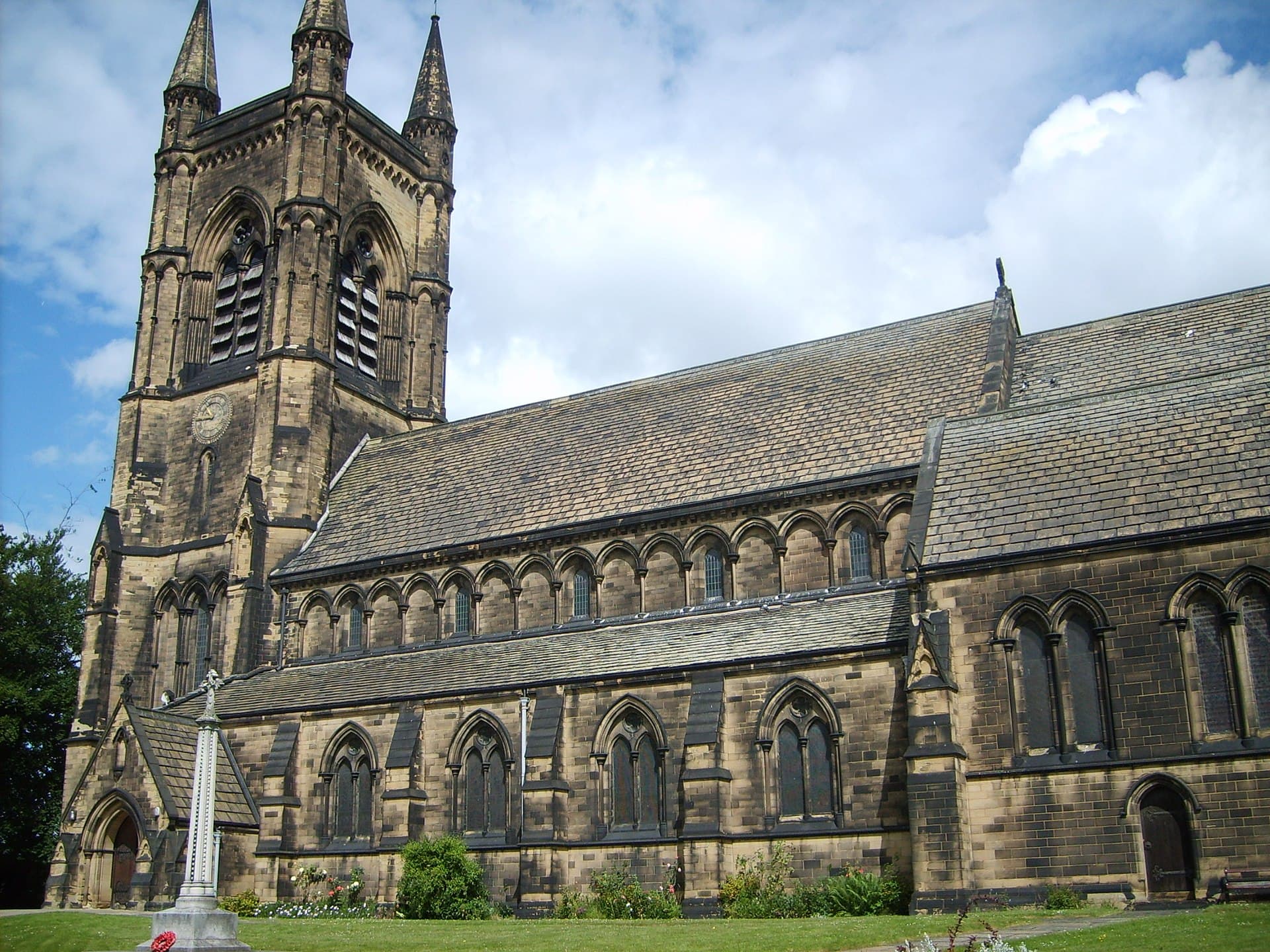
St Mary's Church is the parish church of Mirfield, a town in the Calder valley of West Yorkshire between Huddersfield and Dewsbury. The present building is a large and imposing Gothic Revival church designed by Sir George Gilbert Scott, the most prolific church architect of the Victorian age, and it stands beside the surviving tower of its medieval predecessor on a hilltop site that is Mirfield's most prominent landmark. Listed Grade II*, with the old church tower listed Grade II and an eleventh-century castle mound preserved within its grounds, St Mary's gathers nearly a thousand years of the history of this corner of the West Riding into a single dramatic group of buildings above the town.
The story of worship at Mirfield is older than any of the standing buildings. The first parish church is believed to have been built in the late thirteenth century; before that, the people of Mirfield had to travel to the great minster church at Dewsbury to worship, and the new parish church freed them from that long journey. Little is known of this early building, for the only surviving part is the lower stage of the old church tower — but the upper stage is clearly later, with Perpendicular tracery that shows the tower was heightened in the fifteenth or sixteenth century. This medieval church had itself replaced an even earlier chapel that stood within the nearby castle: for Mirfield possesses, within the churchyard grounds, the mound of an eleventh-century motte-and-bailey castle, a relic of the Norman Conquest and one of the earliest features of the whole site, so that the church stands quite literally in the shadow of the Norman lords who once held the manor.
The medieval church served Mirfield for some five centuries, but the Industrial Revolution made it inadequate. By 1826 the parish had grown to more than five thousand souls, swelled by the textile mills of the Calder valley, and the small medieval church could no longer hold the people. The body of the church was demolished and rebuilt — though, in a common compromise of the period, the new church of 1826 was built adjoining the old medieval tower, which was retained. A thirteenth-century pillar from the medieval church was saved from demolition and preserved, a tangible link to the earliest building. But this second church lasted barely two generations.
In 1871 the church was rebuilt once more, and this time to the designs of Sir George Gilbert Scott, then at the height of his fame as the restorer of cathedrals and the architect of the Albert Memorial and St Pancras station. Scott gave Mirfield a large and confident Gothic Revival church in the medieval manner, with an aisled and clerestoried nave, pinnacled and spired buttresses, and the rich detailing characteristic of the High Victorian Gothic. The result, set beside the retained old tower on its hilltop, made the church the great landmark of the town — the new church and the old tower together forming a picturesque and historic group that dominates views of Mirfield. It is this Scott church, of 1871, that is the present St Mary's, listed Grade II* for its architectural quality.
The church has continued to develop into modern times. Its first organ, a small instrument by F. Jardine of Manchester installed in 1872, was rebuilt and enlarged several times as the congregation and its music grew. More recently the bells were taken down, restored and recast, returning to Mirfield in March 2016 to ring out once more from the tower just after Easter — work hailed as superb, and a sign of the continuing care lavished on the building. That care is much needed, for the church has been on Historic England's Heritage at Risk Register since 2013, requiring substantial repairs to its fabric — the perennial challenge of maintaining a great Victorian church for a modern congregation.
Mirfield itself has a notable place in the religious history of England beyond its parish church, for the town is home to the Community of the Resurrection, the Anglican monastic community founded in 1892 whose theological college at Mirfield has trained generations of priests, giving the town a wider reputation in the life of the Church of England. St Mary's, on its hilltop with its castle mound and its medieval tower, is the ancient parish heart of this religious town, set in the rolling mill-country of the Calder valley.
From a late thirteenth-century parish church that freed Mirfield from the journey to Dewsbury, built beside an eleventh-century Norman castle mound, through a medieval tower heightened in the Perpendicular age, an industrial-era rebuilding of 1826 and Sir George Gilbert Scott's great Gothic Revival church of 1871, St Mary's holds the long history of Mirfield within its walls and its surviving old tower. It remains the living Anglican parish church of the town in the Diocese of Leeds — a Grade II* listed Victorian landmark, with its medieval tower and Norman castle mound beside it, crowning the hill above the Calder valley.
Plan a visit
Visiting hours & services.
Visitor information
St Mary's is the active Church of England parish church of Mirfield in the Diocese of Leeds, a Grade II* listed building; services are listed by the parish. It stands on a hilltop landmark site with the Grade II listed medieval old church tower beside it and an 11th-century Norman motte-and-bailey castle mound in its grounds. The present church is by Sir George Gilbert Scott (1871); look for the preserved 13th-century pillar from the medieval church and the bells recast in 2016. The church is on the Heritage at Risk Register.
Where to find it
Location & contact.
In the neighbourhood
Nearby attractions.
Gallery
Sources
Where this record comes from.
This entry is reconciled from open data. Follow the sources to verify the details or suggest a correction.
Nearby