Robertsbridge, United Kingdom№ 000062101
Robertsbridge United Reformed Church
- Founded
- 1881
- Tradition
- Reformed
- Style
- Italianate
About this place
History & significance.
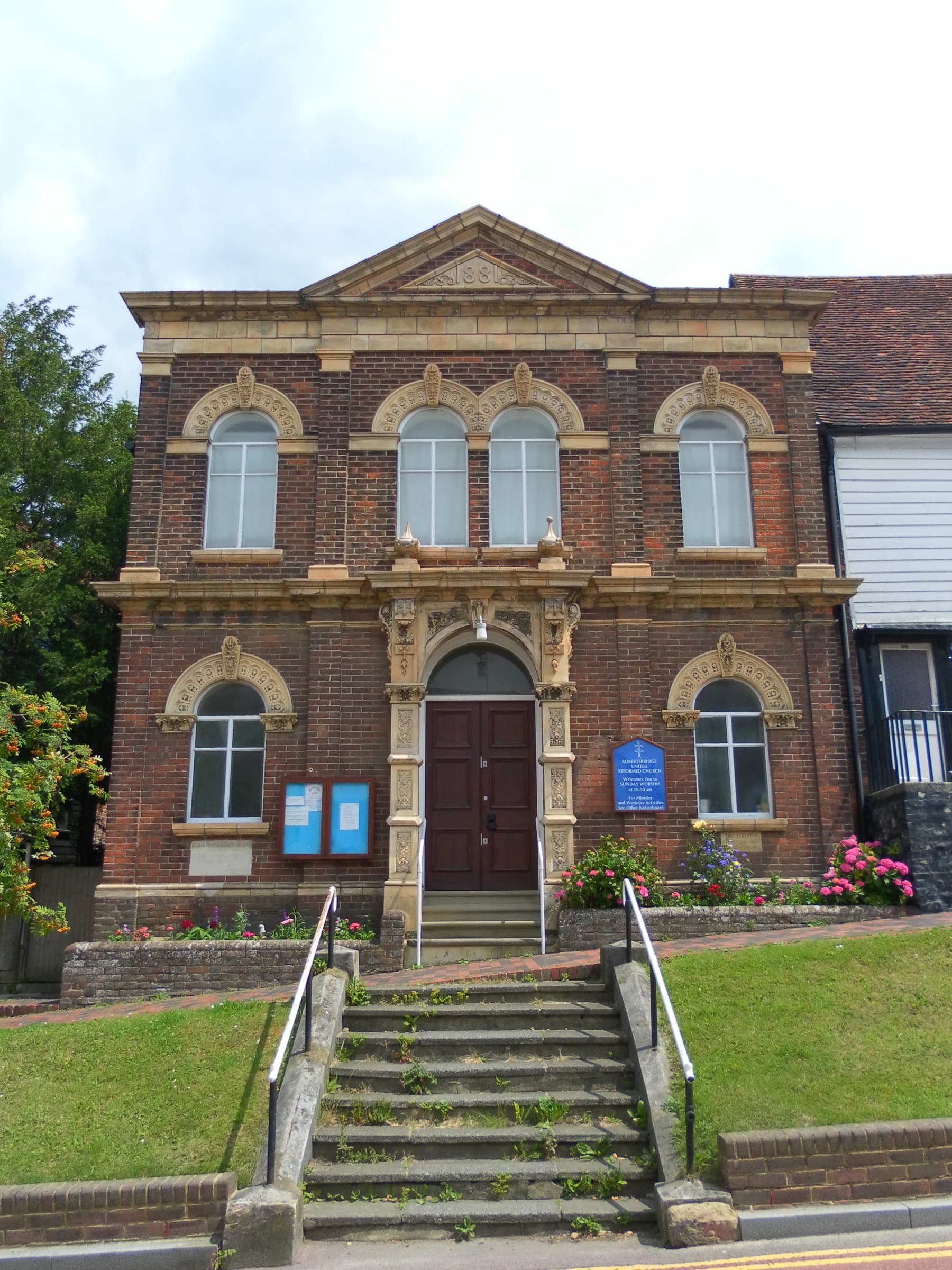
Robertsbridge United Reformed Church, originally the Robertsbridge Congregational Chapel, is a striking and richly decorated Victorian chapel on the High Street of Robertsbridge, a village in the Rother district of East Sussex. Built in 1881 for a Congregational congregation that had seceded from the village's Wesleyan Methodist chapel, it is a Grade II listed building, notable for the flamboyant and much-debated design of its local architect. Although it closed its doors as a place of worship in 2015, it remains a distinctive landmark in the village street, and its story reflects the long and vigorous tradition of Nonconformity in this corner of Sussex.
The religious history of the area is unusual, for the medieval parish church stood not at Robertsbridge but at the neighbouring village of Salehurst. Robertsbridge itself grew up only after a Cistercian abbey moved to the site in the early thirteenth century, and after the abbey's chapel fell out of use at the Reformation, the village was left without an Established Church place of worship of its own. Into this gap stepped the Nonconformists. The parish was recorded in 1676 as having one of the highest numbers of Dissenters in the area, and Wesleyan Methodism took firm root in the late eighteenth century — John Wesley himself preached at Robertsbridge five times between 1771 and 1784, to large crowds — leading to the building of a Methodist chapel in 1812.
The Congregational chapel was born of a division within that Methodist society. In 1876 a group of members seceded, led by a leading local lay preacher, Edward Piper, who began holding Congregational-style meetings in a house on the High Street. Five years later, Piper commissioned the St Leonards-on-Sea architect Thomas Elworthy to design a new chapel on the site of that house, and it was founded on 29 June 1881. Sadly, Piper died on 20 November 1881, aged seventy, just before he was due to preach his inaugural sermon, and an inscribed tablet commemorates him. The chapel maintained close links with the Congregational church at Hastings, and after the village's Methodist chapel closed in 1960, the remaining Methodists joined the congregation here. In 1972, when the Congregational Church merged with the Presbyterian Church of England to form the United Reformed Church, the Robertsbridge chapel became part of that new denomination.
Architecturally, the chapel is one of the most exuberant Nonconformist buildings in the area, and has sharply divided opinion. Thomas Elworthy, an architect closely associated with the Hastings area and with Nonconformist church-building, gave it an eclectic and highly decorated design, blending Classical, Renaissance Revival and Italianate elements with touches of the Gothic. Built of red brick with extensive terracotta dressings, its two-storey façade on the raised pavement of the High Street has three bays divided by pilasters, round-headed windows beneath semicircular fanlights, and a central brick pediment once surrounded by a balustrade and stone urns. Critical reaction has ranged from the scathing — Nikolaus Pevsner called it "truly horrible" and "most dissolute" — to the appreciative, English Heritage describing it as a "rich and fruity example of a Nonconformist church", while a Sussex historian thought Pevsner's judgement harsh and admired it as "an unexpected Renaissance intrusion into the predominantly eighteenth-century High Street".
Listed at Grade II in 1987, the church continued in use until 5 September 2015, when it closed and was put up for sale. Its members did not disband, however, but joined with others to form Community Church Robertsbridge, affiliated with the Baptist Union of Great Britain, which continues to worship in the village, so that the Christian tradition the chapel represented carries on in a new form.
The former chapel stands on the High Street in the centre of Robertsbridge, in the valley of the River Rother in East Sussex. The medieval parish church of St Mary at neighbouring Salehurst, the remains of Robertsbridge Abbey, the steam railway of the Kent and East Sussex line, the High Weald countryside, the historic town of Battle with its abbey, and the gardens of Bodiam Castle nearby are all within easy reach.
From its origins in the Methodist preaching of John Wesley and the Congregational secession led by Edward Piper, through the building of Thomas Elworthy's flamboyant chapel in 1881 and its long life as a Congregational and then United Reformed church, to its closure in 2015, Robertsbridge United Reformed Church gathers the story of Sussex Nonconformity into one building. A Grade II listed Victorian chapel of remarkable character, it remains a notable landmark on the village street, and its congregation lives on in the village's continuing Christian life.
Plan a visit
Visiting hours & services.
Visitor information
This building closed as a place of worship in 2015 and is no longer in religious use; its richly decorated Grade II listed facade can be admired from the High Street in Robertsbridge. The descendant congregation now worships as Community Church Robertsbridge, affiliated with the Baptist Union, meeting in the village youth centre on George Hill.
Where to find it
Location & contact.
In the neighbourhood
Nearby attractions.
Gallery
Sources
Where this record comes from.
This entry is reconciled from open data. Follow the sources to verify the details or suggest a correction.
Nearby