City of Edinburgh, United Kingdom№ 000072484
Southside Community Centre
- Founded
- 1820
- Tradition
- Presbyterian
- Style
- Perpendicular Gothic Revival
About this place
History & significance.
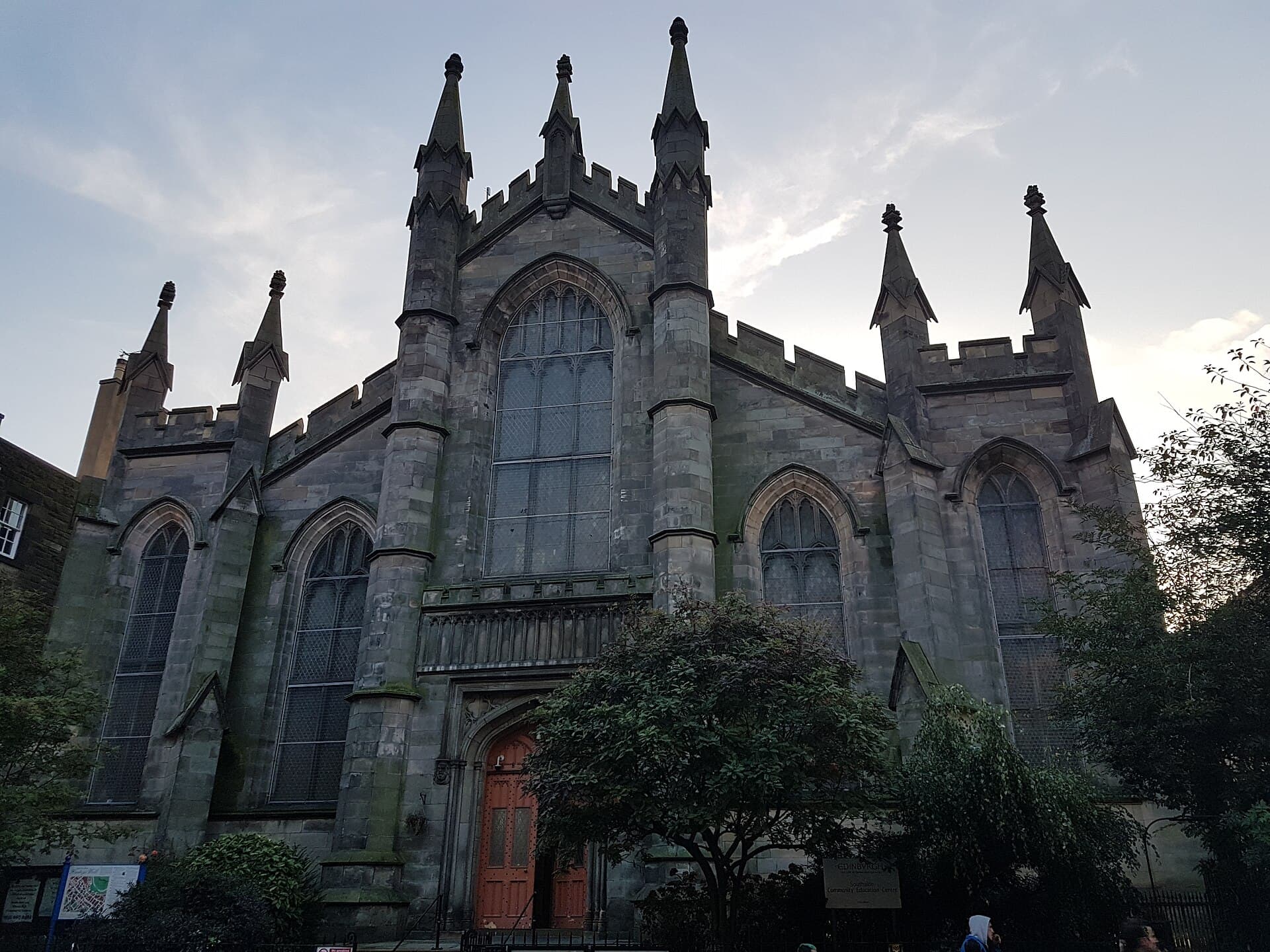
The Southside Community Centre on Nicolson Street in Edinburgh occupies the former Nicolson Street Church, a Perpendicular Gothic building of 1820 by James Gillespie Graham that was for a century and a half the home of one of the most historically important congregations in Scottish dissent: the body that Robert Small, historian of the United Presbyterian Church, called "the mother Secession Church in Edinburgh". A Category B listed building since 2003, it has served the Southside as a community centre since 1986, and during the Edinburgh Fringe becomes the venue Zoo Southside.
The congregation's story begins with one of the great schisms of Scottish church history. Founded at Bristo in 1741 under the formidable Adam Gib, the Secession congregation was soon torn by the controversy over the Burgher Oath of 1690, which required public officials to profess "the true religion presently professed within this realm": the Burghers held subscription lawful, the Anti-Burghers sinful. At a Synod meeting at Bristo on 9 April 1747, in the schism known as "The Breach", Gib led the Anti-Burgher faction out of the meeting-house. For a year the two factions worshipped uneasily together, each with its own collection plate, members of each breaking in to change the locks, until the Court of Session ruled in 1753 that the buildings legally belonged to two Burgher trustees, and the Anti-Burghers, though nine-tenths of the congregation, were expelled. They met first in a tent on Windmill Close, then at the Skinners' Hall, before opening a new church off Crosscauseway on 4 November 1753: a building "plain, square, and barn-like" in John Wishart's words, seatless except in its galleries, with a manse at the passage still called Gib's Entry after its first resident. Gib was a power in the city, regularly drawing over two thousand hearers, though his refusal to lift the bread at communion drove some members to found the Second Secession Church in Potterrow. After his death in 1788 the congregation languished seven years without a minister, reviving from 1797 under John Jamieson, the celebrated lexicographer whose Etymological Dictionary of the Scottish Language remains a landmark of Scots scholarship; under "Dr Jamieson's Meeting-House", as the church became known, halls were built that served as the Anti-Burgher Synod's theological college.
In September 1817 part of the cornice collapsed during a service and the old meeting-house was condemned. The congregation chose a Gothic Revival design by James Gillespie Graham, bought land so the new church could face Nicolson Street, and opened it on 19 March 1820 at a cost of £6,000, seating 1,170. The choice of Gothic scandalised the plain-worship tradition: The Scotsman marvelled that "it is even proposed to rebuild the meeting-house of Adam Gib with a Babylonish and Prelatical front of Gothic architecture", and when John Stark identified the saints' heads on the door's hood mould in 1825, an elderly disciple of Gib declared the founder "would not believe his ain een"; some members left over the architecture alone. The five-bay façade carries traceried windows beneath a crenellated parapet, divided by pinnacles whose central pair rise on shafts to about ninety feet, removed in 1980 but since replaced; behind the front, as George Hay observed, the building remained the typical Secession "gaunt galleried rectangle", or in Andrew Landale Drummond's sharper phrase, "a square meeting-house masked by a pretentious Gothic façade".
The year the church opened, the Burghers and Anti-Burghers reunited at last as the United Secession Church, Jamieson himself, instrumental in the negotiations, elected moderator of the last Anti-Burgher Synod. The successive unions of Scottish Presbyterianism carried the congregation onward: into the United Presbyterian Church in 1847, whose 1852 general assembly elected Nicolson Street's George Johnston moderator; into the United Free Church in 1900; and in 1929, with poetic symmetry, back into the Church of Scotland from which it had seceded almost two centuries before. Under Johnston, who doubled a depleted roll in his first year from 1831, the church ran a school in its halls until 1858, missions at home and abroad, collections for the abolition of slavery, a savings bank, friendly societies, a Sunday school and a 2,000-volume library, adopting hymns in 1862. As the Southside grew industrial and working-class the fashionable congregation declined, recovering under popular ministers around 1900 and tripling under George Wyllie Howie, who added a women's guild, a men's club, Scouts and Guides, extended the halls and installed a pipe organ by Eustace Ingram in 1912. Fire gutted the church in 1932, and John Ross McKay's reconstruction removed the side galleries, recessed the rebuilt organ in a central niche behind a carved wooden screen, and created a richly carved pulpit, communion table and flat ceiling inspired by Robert Lorimer's Scottish National War Memorial, the table incorporating two plaques from the congregation's First World War memorial. Membership peaked at 1,041 in 1930 but post-war population decline in the Southside, and looming redevelopment by corporation and university, doomed the church: after years of failed union schemes, including an ambitious six-way merger, Nicolson Street united with Buccleuch and Charteris-Pleasance on 7 September 1969 as Kirk o' Field Parish Church, taking the carved communion table to the Pleasance.
The building was sold to the corporation and spent years as a furniture saleroom before the long campaign of the South Side Association for a permanent meeting place bore fruit: the Southside Community Centre opened in December 1986, inaugurated by George Foulkes MP. A quintessentially Edinburgh compromise marked the opening: the city council insisted on "Southside Community Education Centre", the association preferred "Southside Community Centre", and the dispute was resolved with two different signs, one on each side of the door, where they remain to this day. The early centre hosted Anti-Poll Tax Alliance meetings, distributed surplus dairy products and ran a children's play-scheme on the Meadows, and its supporters helped create the Crags Sports Centre when plans for sport in the building proved impossible. Today the council-owned building, leased to the South Side Community Association, houses two general-purpose rooms, a café, a large hall and an office, its rooms for hire and its Fringe stage, managed by Zoo Venues as Zoo Southside, graced by performers as celebrated as Bill Bailey — a lively secular afterlife for the meeting-house of Adam Gib, behind the Gothic front he would not have believed with his ain een.
Plan a visit
Visiting hours & services.
Visitor information
The former Nicolson Street Church is now the Southside Community Centre, owned by Edinburgh City Council and run with the South Side Community Association: a café, hall and rooms for hire serve local groups year-round, and during August it becomes the Fringe venue Zoo Southside, hosting theatre and dance. The Gothic façade with its twin name-signs — one each side of the door — can be enjoyed from Nicolson Street at any time; the church interior was partitioned in 1986.
Where to find it
Location & contact.
In the neighbourhood
Nearby attractions.
Gallery
Sources
Where this record comes from.
This entry is reconciled from open data. Follow the sources to verify the details or suggest a correction.
Nearby