Worth Matravers, United Kingdom№ 000059929
St. Aldhelm's Chapel, St. Aldhelm's Head
- Founded
- 1150
- Tradition
- Anglican / Episcopal
- Style
- Norman
About this place
History & significance.
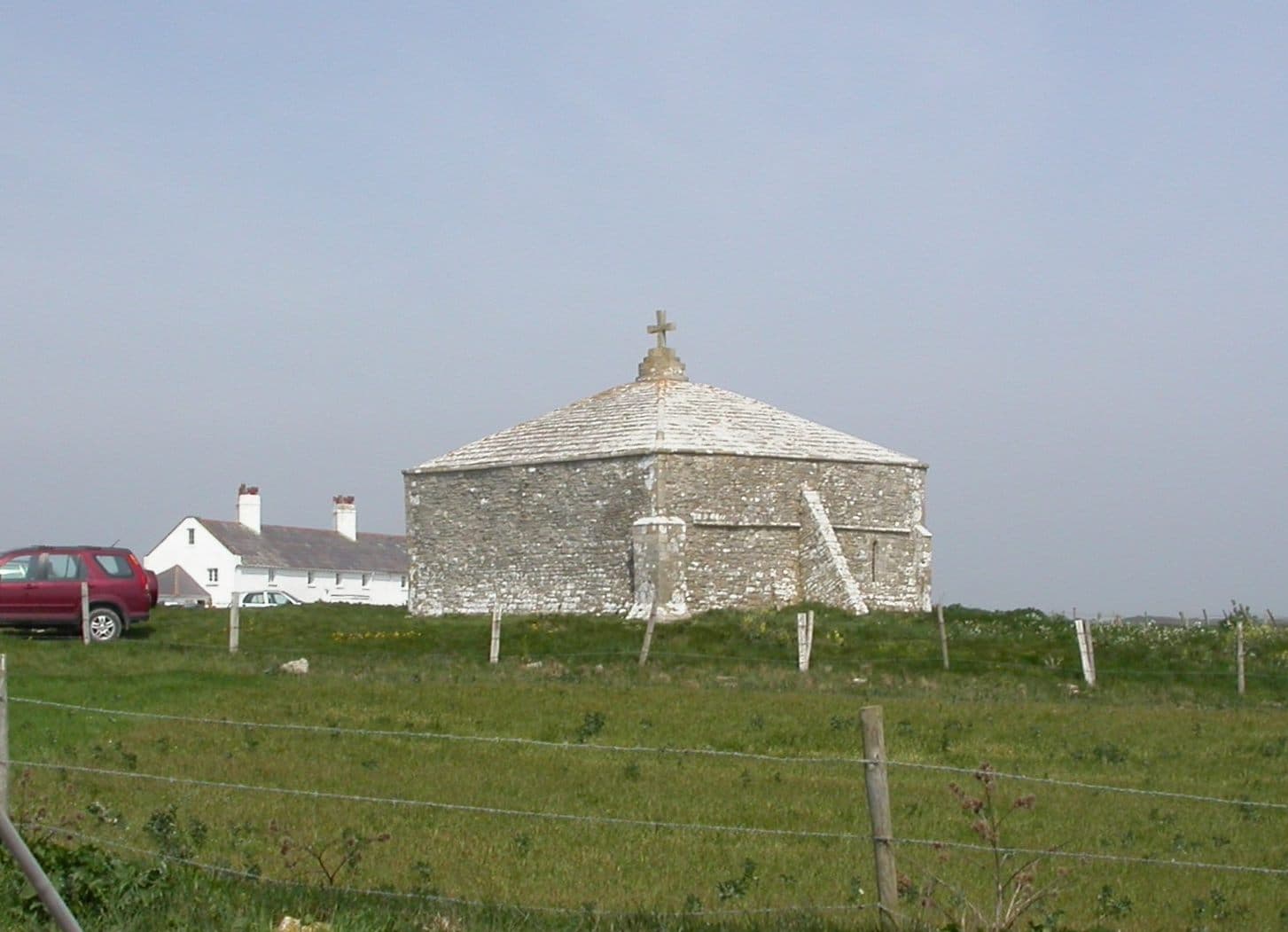
St Aldhelm's Chapel is a Norman chapel standing on St Aldhelm's Head in the parish of Worth Matravers, near Swanage in Dorset — one of the most dramatically sited religious buildings in England, perched close to the cliff edge 108 metres above the sea on the Purbeck coast. A Grade I listed building, the square stone chapel stands within a low circular earthwork that may be the remains of a pre-Conquest Christian enclosure, designated a Scheduled Monument in 2000.
The building is full of architectural puzzles. Its square shape is highly unusual for a chapel, as is its orientation: the corners, rather than the walls, point toward the cardinal directions. Inside, the space — roughly 7.7 metres square — is divided and restricted by a massive central pier supporting four square rib vaults, the heavy stop-chamfered ribs running to transverse arches, a 12th-century vault unlike anything one expects in a small chapel. A Norman round-arched doorway opens in the north-west side, with a small contemporary window. There is no evidence of an altar or piscina, which has led to the suggestion that the building was not originally a chapel at all, but perhaps a watchtower for Corfe Castle, commanding the sea approaches from the south; repairs to the roof in the 20th century turned up evidence that it may once have carried a beacon. Its identification as a purpose-built chapel rests on records of payments to a chaplain in the reign of King Henry III (1216–1272), when it and the chapel of St Mary in Corfe Castle were served by a chaplain paid fifty shillings a year by the County Sheriff on behalf of the Crown. The roof now bears a stone cross erected in 1873.
The documentary trail is thin but telling. In 1291 the parish of the chapel of St Aldhelm was rated at twenty shillings for tax; in 1428 it was assessed at the same sum but described as having no inhabitants. The sale of the nearby Manor of Renscombe in 1557 or 1558 included the advowson of the "chapel of Renscombe", probably this building — a map of 1737 shows the headland and chapel, marked "St Abbon's chapel", as part of the manor. By 1625 the surveyor Thomas Gerard described the chapel as serving as a sea-mark, and it seems to have gone out of religious use before that date. Yet people kept coming: the central column bears dates and initials of the 17th century, and a hole in the column was used by young girls to make wishes, dropping pins or hairpins into it.
By 1797 the roof had partly fallen in. In 1800 William Morton Pitt of the neighbouring Encombe estate took an interest in repairs, and after he sold Encombe in 1807 to the 1st Earl of Eldon — who bought Renscombe too in 1811 — the Earl ordered repair of the collapsed groins, though little major work followed; by then the roof was overgrown with grass. Repairs by local landowners continued through the 19th century, and in 1873 the chapel was fully reconstructed at the cost of the 3rd Earl of Eldon, who also gave the baptismal font. At the reopening service on 18 July 1874, Alfred Gibson, son of the chief boatman of the coastguards, was baptised, and for decades regular weekly services were attended by the coastguards and their families from the nearby cottages.
The Victorians also recorded the chapel's place in village festivity. Articles by the Reverend John Austin in 1858 and H. J. Moule in 1893 describe Whit Thursday celebrations: a procession of the villagers of Worth Matravers out to the Head with music, the dressing of the chapel with flags and flowers, and dancing, with further processions on Worth Fair Day and Club Day — at a time when the chapel was doubling as a coastguard store.
Archaeology has added a haunting footnote. In 1957 ploughing 400 metres north-north-east of the chapel uncovered a monumental slab of Purbeck stone, about two metres long, carved with a Celtic-style cross in relief. Beneath it lay the grave of a woman aged thirty to forty, her arms crossed, set within a row of upright stones with eight pieces of iron bearing traces of wood; the burial was dated to the late 13th century, and the foundations of a small square building stood nearby. The slab now rests in the porch of St Nicholas' Church in Worth Matravers.
The 20th century brought quieter times — damp so severe by the 1930s that the harmonium had to be stored elsewhere between fortnightly services, a fence to keep the cows out (removed in 1963), and wartime, when neighbouring Renscombe Farm was used for radar research. In November 1965 the Encombe Estate gave the chapel to Worth Matravers Parochial Church Council, which carried out repairs funded partly by donations. The most recent chapter came in 2005, during the celebrations of the 1,300th anniversary of St Aldhelm's consecration as Bishop of Sherborne, when a new altar table cut from stone of St Aldhelm's own quarry was consecrated on 4 June by Rowan Williams, Archbishop of Canterbury — restoring, after centuries of doubt, the one thing the mysterious old building on the headland had always lacked.
Plan a visit
Visiting hours & services.
Visitor information
St Aldhelm's Chapel is a Grade I listed Norman chapel on the clifftop of St Aldhelm's Head, 108m above the sea on the Purbeck coast, cared for by Worth Matravers PCC and open to walkers, with occasional services at its 2005 altar of St Aldhelm's quarry stone consecrated by Archbishop Rowan Williams. See the mysterious square plan with corners to the cardinal points, the great central pier with its 12th-century vault and wishing-hole, and the surrounding Early Christian earthwork (Scheduled Monument).
Where to find it
Location & contact.
In the neighbourhood
Nearby attractions.
Gallery
Sources
Where this record comes from.
This entry is reconciled from open data. Follow the sources to verify the details or suggest a correction.
Nearby