London, United Kingdom№ 000061848
St Anne's Church
- Founded
- 1686
- Tradition
- Anglican / Episcopal
- Architect
- William Talman
- Style
- Baroque
About this place
History & significance.
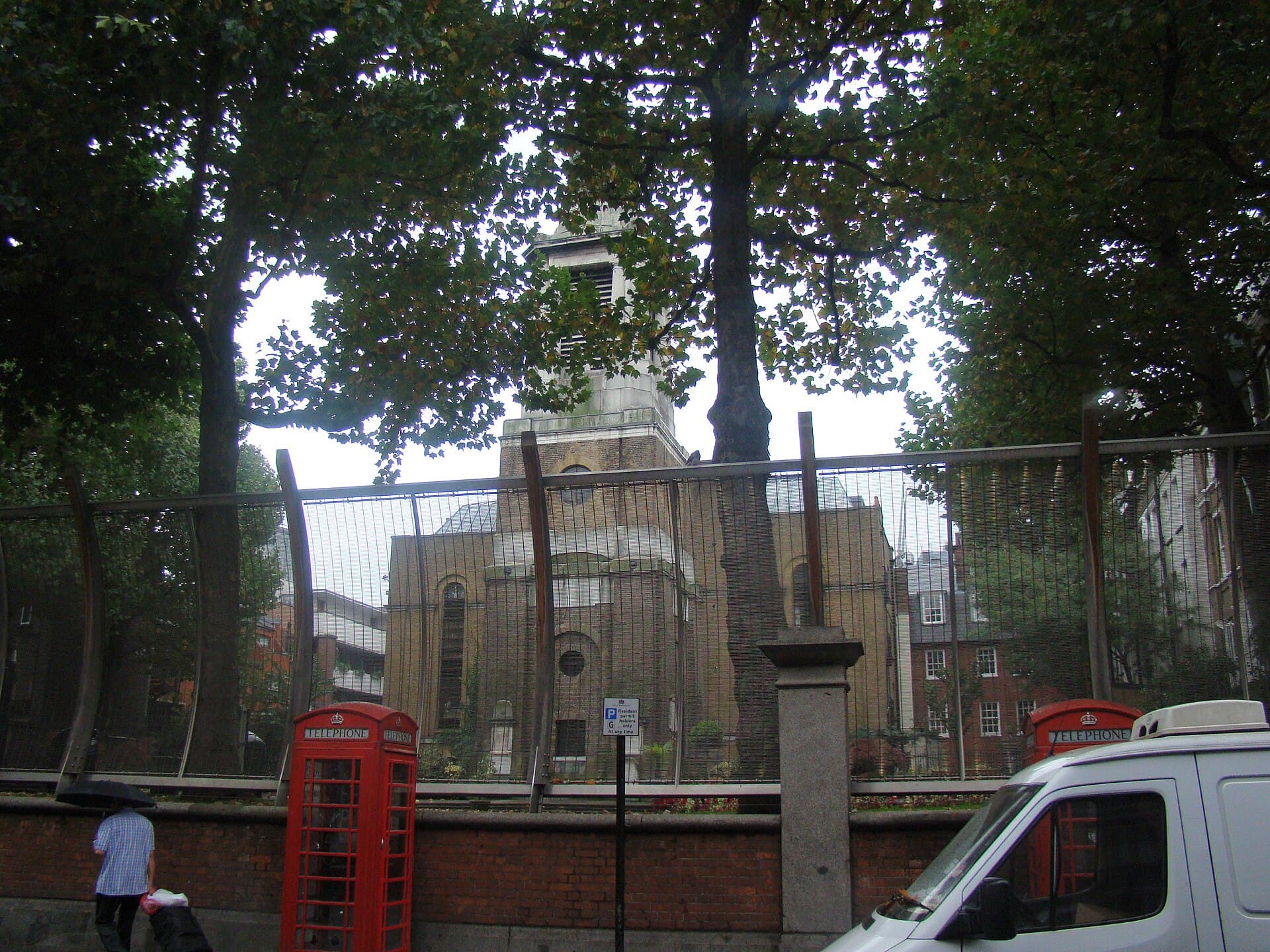
St Anne's Church is the parish church of Soho, in the heart of London's West End. Consecrated in 1686, in the reign of James II, it has served the colourful and cosmopolitan district of Soho for well over three centuries — through fashionable beginnings, a famous musical tradition, destruction in the Blitz, and a remarkable modern rebuilding. Today only its distinctive tower survives from earlier days, a Grade II* listed landmark rising above the public garden that occupies part of its old churchyard, while a new church and community centre carry on its life of worship and service in one of the liveliest corners of the capital.
The church was built to serve the new parish of St Anne Within the Liberty of Westminster, carved out of the parish of St Martin in the Fields as Soho Fields were developed from open countryside into streets and squares. It was consecrated on 21 March 1686 by Henry Compton, Bishop of London, and dedicated to St Anne because Compton had been tutor to the Princess Anne, the future queen. Construction had begun in 1677, with William Talman and possibly Sir Christopher Wren as its architects, producing a basilican church some eighty feet long with a west tower. The parish quickly established a free school, admitting boys from 1699 and girls from 1704, and the church received an organ in 1699; its first organist, from 1700, was the composer William Croft, who wrote the great hymn tune "St Anne", forever associated with the words "O God, Our Help in Ages Past". Over the years the church saw the baptism of a younger brother of King George III and the burials of many notable parishioners.
By 1800 the original tower had become unstable, and after a "Tower Rebuilding Committee" had met forty-one times without solving the problem, the architect Samuel Pepys Cockerell was commissioned to design a replacement. The old tower was demolished — though its clock bell of 1691 was kept and is still in use — and a new and unusual tower, with a copper cupola, was completed in 1803. Beneath it, in a brick chamber, are interred the ashes of the novelist Dorothy L. Sayers, who was for many years a churchwarden of the parish, while the churchyard became the resting place of the great essayist William Hazlitt, who died in 1830. The church's musical fame continued through the nineteenth century under organists such as Sir Joseph Barnby, who gave the first British performance of Bach's St John Passion, and it was from St Anne's, in the 1920s, that the first religious service with music was broadcast by radio.
Disaster struck on the night of 24 September 1940, when the church was burned out in the Blitz, leaving only the tower standing. Worship moved to other premises, and for some years it was assumed that the church would never be rebuilt; in 1953 the surviving east wall was demolished and the parish amalgamated with those of St Thomas, Regent Street, and St Peter, Great Windmill Street. Yet the tower survived, used for a time as a chapel and partly restored by the Soho Society, and the determination to keep Soho a living residential community eventually bore fruit. Under a special Act of Parliament, the site was redeveloped, and a new church was built, its foundation stone laid by Princess Anne in 1990 and the completed complex opened and rededicated on St Anne's Day, 26 July 1991. The new church is a flexible space set within a community centre, able to serve both worship and the many activities of the parish, and it became a focus of mourning after the 1999 bombing of the nearby Admiral Duncan pub.
Throughout its modern history St Anne's has been a centre of both literary and social engagement. From 1941 the St Anne's Society fostered links between the Church of England and the literary world, drawing in figures such as T. S. Eliot, C. S. Lewis, Dorothy L. Sayers, Charles Williams, Agatha Christie and Rose Macaulay. In keeping with a long tradition of philanthropy, it was in the basement of St Anne's House, in 1969, that the priest Kenneth Leech founded Centrepoint, the charity for homeless young people, which remained based at the church for over fifty years. Today the church thrives once more as a worshipping community and as a venue for local and charitable events, housing the Soho Society and other organisations, and since 2024 its own community coffee shop. A striking new entrance on Dean Street, designed by students and unveiled in 2016, won a national church architecture award.
The church stands on Dean Street in the heart of Soho, with its tower rising above St Anne's Gardens, reached from Wardour Street near Shaftesbury Avenue. The theatres of the West End and Shaftesbury Avenue, the restaurants and nightlife of Soho and Chinatown, the markets of Berwick Street, Leicester Square, Piccadilly Circus and Oxford Street are all immediately at hand, in one of the most vibrant districts of London.
From its consecration in 1686 and its associations with William Croft and the hymn "O God, Our Help in Ages Past", through its famous music, the graves of Hazlitt and Dorothy L. Sayers, its destruction in the Blitz and its rebuilding in 1991, to its modern life of worship and social action, St Anne's Church, Soho, gathers more than three centuries of London's history into one place. A Grade II* listed tower and a thriving modern church at the heart of Soho, it remains a living and much-loved parish church of the West End.
Plan a visit
Visiting hours & services.
Visitor information
St Anne's is an active Church of England parish church in the heart of Soho, accessed via a gate on Dean Street, with its historic tower rising above St Anne's Gardens. The modern church and community centre host regular worship as well as many community and charitable events, and a community coffee shop. Visitors are welcome; service and opening times are published on the church website, and visitors are advised to check before attending.
Where to find it
Location & contact.
In the neighbourhood
Nearby attractions.
Gallery
Sources
Where this record comes from.
This entry is reconciled from open data. Follow the sources to verify the details or suggest a correction.
Nearby