Llangristiolus, United Kingdom№ 000062396
St Cristiolus's Church, Llangristiolus
- Founded
- 1101
- Tradition
- Anglican / Episcopal
- Style
- Medieval (Decorated and Perpendicular)
About this place
History & significance.
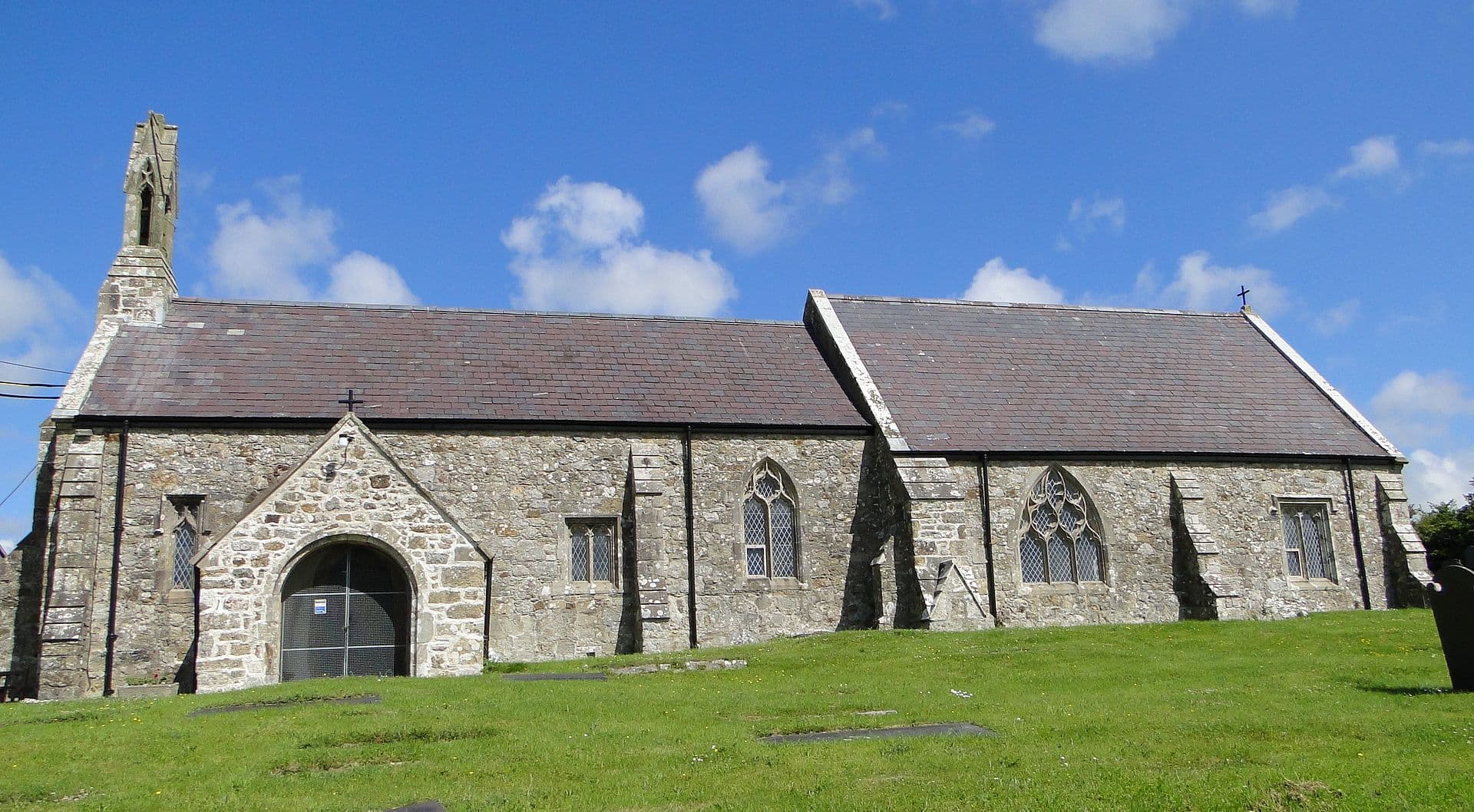
St Cristiolus's Church, Llangristiolus, is a medieval church in central Anglesey, north Wales, standing on raised ground above Malltraeth Marsh just south of the A5 and A55 roads. The modern village of Llangristiolus lies about a mile to the west and takes its name from the church — the Welsh llan originally meant "enclosure" and then "church", with "-gristiolus" a modified form of the saint's name. Reputedly founded by St Cristiolus himself in 610, the present building dates from the twelfth and thirteenth centuries — unusually early for Anglesey, and the only medieval building in its parish — and holds Grade II* listed status, conferred on 30 January 1968, in particular for its age and for the spectacular sixteenth-century east window that one guide to the buildings of north Wales describes as "almost too big to fit" in the wall.
Of the founder, little detail is known. Cristiolus was a seventh-century saint, a follower of St Cadfan, the Breton saint associated with the Christian community on Bardsey Island; he is also credited with founding the church at Eglwyswrw in modern Pembrokeshire, and he was the brother of St Rhystud, who established the church at Llanrhystud in mid-Wales. The date of the first building on the site is unknown, but the present church rose in the twelfth century, and during the thirteenth the chancel was extended — the older part of the church perhaps rebuilt at the same time using its previous stones. By 1535 the rectory of the parish was attached to the office of Archdeacon of Anglesey as part of that dignitary's remuneration, an arrangement long since ended. Windows were added to the chancel in the early sixteenth century, and in 1852 Henry Kennedy, architect of the Diocese of Bangor, restored the nave and chancel, rebuilding the chancel — though retaining the east wall and its great window — and adding further windows.
The church is built of rubble masonry, mainly gritstone, dressed with freestone. The three-bay nave measures forty-four feet nine inches by fifteen feet six; the two-bay chancel, slightly wider than the nave, is thirty-two feet nine by twenty feet six, and both have external buttresses. The slate roof carries an ornate bellcote for a single bell at the west end — Kennedy's addition — with plain iron crosses on porch and chancel, and entry is through a probably sixteenth-century porch on the south side. Inside, the roof's rafters and trusses are exposed, and the thirteenth-century chancel arch — twelve feet wide and nineteen feet high on ten-foot pillars — has been called the best such arch in the region by a 2009 guide to the buildings of north-west Wales; Sir Stephen Glynne, visiting in 1849, found it "of considerable elegance, unusual in North Wales, having excellent moulding and clustered shafts which have a Middle Pointed character". The east window is the showpiece: in the Perpendicular style, in contrast to the mainly Decorated character of the rest of the church, it has five ogee-headed lights separated by vertical tracery, measures ten feet ten inches at its widest by fourteen feet two at its tallest, and unlike most of the church's windows contains coloured glass. A smaller early sixteenth-century window with a square frame and two lights sits in the north wall, matched by a nineteenth-century twin opposite; the other windows are Victorian in various designs, one in the nave's north wall holding stained glass added as a memorial to two local residents who died in the 1990s.
The font is the church's oldest treasure: a circular gritstone bowl of the twelfth century with six decorative panels, one of a group of fonts in north-west Wales using interlace — the medieval decorative style that shows links to Irish and Norse artistic traditions. Similar fonts survive on Anglesey at St Ceinwen's, Cerrigceinwen, St Peter's, Newborough, and St Beuno's, Trefdraeth, and one author finds the patterns at Llangristiolus and at St Beuno's, Pistyll, in Gwynedd "closely linked" to those on one of the stone crosses at St Seiriol's Church, Penmon. The pews and choir stalls are nineteenth-century; the memorials include a brass to William Morgan, Chancellor of Bangor Cathedral, who died in 1713, with his wife and son, and a memorial to the parishioners who died in the First World War. Harry Longueville Jones, writing in 1846 before Kennedy's restoration, also recorded a wooden west gallery above the font inscribed RICHARDUS DE GREY FECIT 1778. LAUS DEO, and judged the chancel arch "workmanship of good character"; the antiquarian Angharad Llwyd called the church "a spacious structure, exhibiting some excellent architectural details, and decorated with an east window, of good design, enriched with tracery", while Glynne summed it up as "a fair specimen of the better sort of Anglesey village church".
The churchyard holds notable graves. Richard Owen, the renowned nineteenth-century Calvinistic Methodist preacher, was born in the parish and is buried here, as are the geologists Edward and Annie Greenly, who pioneered modern geological mapping in Anglesey. Six Commonwealth war graves lie in the ground: two British Army soldiers of the First World War in the eastern part, and three soldiers and an airman of the Second to the north-north-west of the church. Among those associated with the church in earlier centuries were Henry Maurice, elected Lady Margaret Professor of Divinity at Oxford shortly before his death in 1691 and son of the church's perpetual curate Thomas Maurice, and the nineteenth-century writer and priest Owen Wynne Jones, curate here in the early 1860s.
St Cristiolus's remains in regular use as part of the Church in Wales, one of six churches in the combined benefice of Plwyf Seintiau Braint a Chefni — alongside St Michael's, Gaerwen; St Ffinan's, Llanffinan; St Caffo's, Llangaffo; St Edwen's, Llanedwen; and St Mary's, Llanfairpwll — within the deanery of Malltraeth, the archdeaconry of Bangor and the Diocese of Bangor. Services are held every Sunday morning, alternating between a bilingual Holy Communion and Morning Prayer in Welsh and English. The church's modern history has its own small testament to perseverance: when Emlyn Williams was appointed vicar in 2007, the position had stood vacant for twenty years despite many attempts to fill it — yet the fourteen-century-old llan of Cristiolus, brother of Rhystud and follower of Cadfan, kept its Sunday worship alive above the marsh, as it does still.
Plan a visit
Visiting hours & services.
Visitor information
St Cristiolus's is an active Church in Wales parish church in the benefice of Plwyf Seintiau Braint a Chefni, with a service every Sunday morning alternating between bilingual Holy Communion and Morning Prayer. Visitors are welcome; the 12th-century interlace font, 13th-century chancel arch and great Perpendicular east window are the highlights.
Where to find it
Location & contact.
In the neighbourhood
Nearby attractions.
Gallery
Sources
Where this record comes from.
This entry is reconciled from open data. Follow the sources to verify the details or suggest a correction.
Nearby