London, United Kingdom№ 000058842
St George the Martyr
- Founded
- 1734
- Tradition
- Anglican / Episcopal
- Architect
- John Price
- Style
- Georgian
About this place
History & significance.
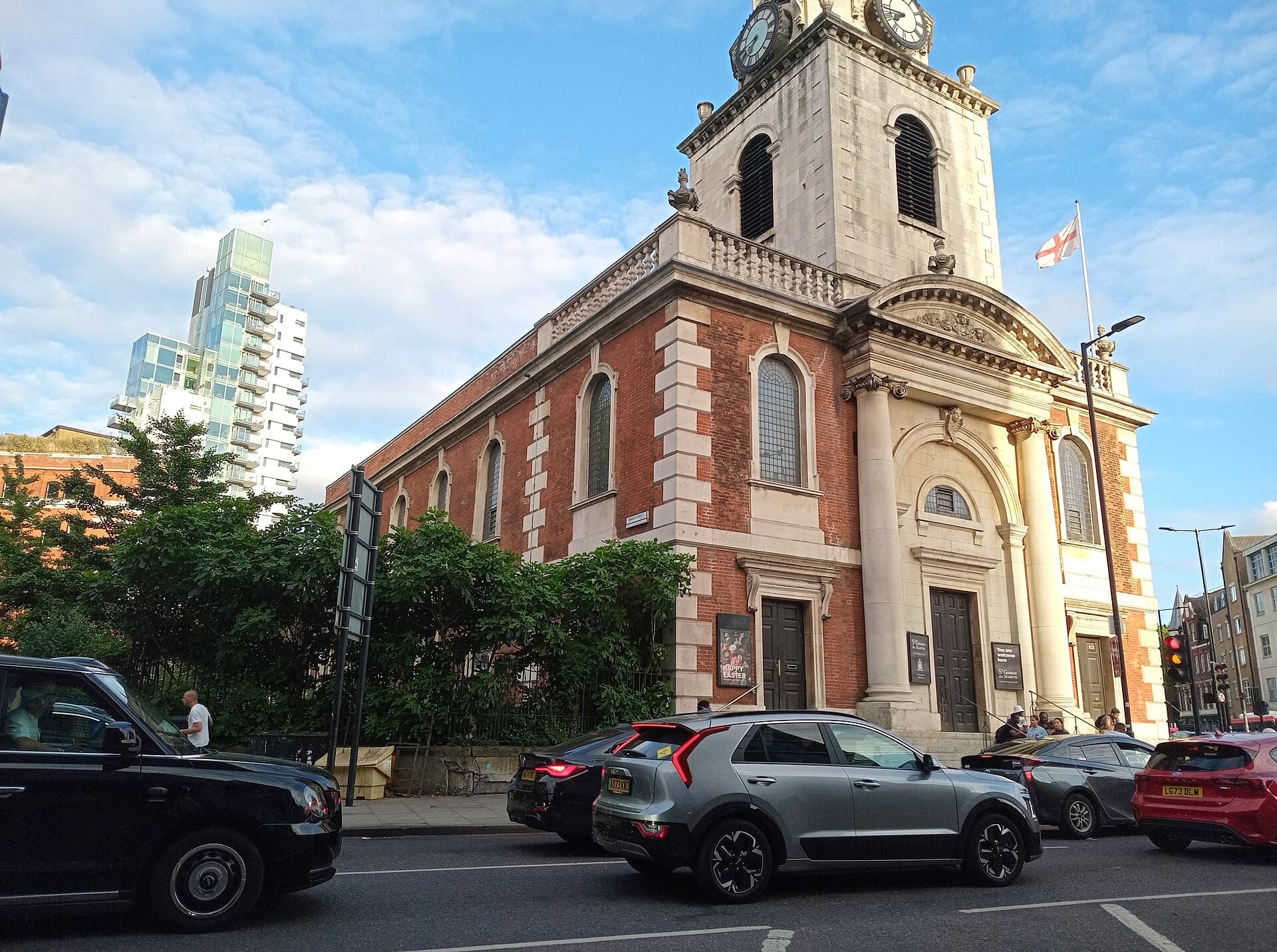
St George the Martyr is an Anglican church in the historic Borough district of south London, standing on Borough High Street at its junction with Long Lane, Marshalsea Road and Tabard Street. A Grade II* listed building dedicated to St George, it is one of the oldest church sites in Southwark and is famous above all for its connection with Charles Dickens, who made it the parish church of Amy Dorrit and so gave it the affectionate name "Little Dorrit's church."
The earliest reference to a church here is in the Annals of Bermondsey Abbey, which record that it was given by Thomas Ardern and his son Thomas in 1122 — making this the first church dedicated to St George anywhere in Greater London, predating Edward III's adoption of the saint as patron of the Order of the Garter by more than two centuries. The gift, which included tithes from the Arderns' manor at Horndon in Essex and "land of London Bridge," is also the earliest reference to the bridge's endowment lands, and the present priest is still nominated by the City's Bridge House Estates. The dedication may reflect the family's involvement in the Crusades, for the date falls soon after tales of St George were popularised by Norman crusaders. In 1415, on his return from victory at Agincourt, Henry V was welcomed by the Aldermen of London on the steps of St George's, and the "Agincourt Song" was commissioned for the celebration — the same campaign in which the red-on-white St George's Cross was first carried as a standard, the year St George became patron saint of England.
The present church is believed to be the third on the site. A Norman church of unknown appearance, known from inscribed stones reused later, was replaced at the end of the fourteenth century by a church with a bell tower; this medieval building appears in Anton van den Wyngaerde's panorama of London and in William Hogarth's 1733 engraving of Southwark Fair, made the year before it was demolished. The church was then rebuilt in a Classical style to the designs of John Price between 1734 and 1736, partly funded by £6,000 from the Commission for Building Fifty New Churches, with further support from the major City Livery Companies and the Bridge House Estates, whose arms decorate the nave ceiling and windows. The west tower, of Portland stone with a tall spire crowned by a ball and weathervane, dominates the curving view along Borough High Street, while the church is built of red brick and Portland stone with a pedimented west entrance on Ionic columns and a tympanum of carved angels.
The church's Dickensian associations run deep. Dickens's father was imprisoned for debt in the Marshalsea, whose surviving wall adjoins the north side of the churchyard, and as a teenager Dickens lodged nearby in Lant Street, in a house belonging to the Vestry Clerk of St George's, during the bleak period when he worked in the blacking factory. He later set several scenes of Little Dorrit in and around the church, where Amy Dorrit is christened and married and, famously, sleeps one night in the vestry. A small figure of Little Dorrit appears in the east window, designed by Marion Grant, who depicted Amy kneeling among the church's other imagery.
In 1852 the Anglican evangelist William Cadman became rector of what was then one of the largest parishes in London, with a nominal congregation of thirty thousand but largely empty services. During his seven years he revitalised the parish, training lay volunteers, scripture readers and teachers, founding schools licensed for worship in the poorest districts, and encouraging local congregations to build new churches and chapels, among them St Paul's, Walworth. The building itself has had a hard structural history: the crypt was cleared of 1,484 coffins in 1899, reburied at Brookwood Cemetery; the south wall was strengthened in 1938, which helped save the church from collapse amid heavy bomb damage in the Second World War; and persistent subsidence led to the nave being declared unsafe in 2000. A Heritage Lottery grant in 2005 funded a complete underpinning of the building and the lowering of the crypt floor to create a new hall and conference venue, during which Georgian lead coffins were removed and substantial medieval and Roman structures found beneath the church — the loss of some remains before full excavation causing controversy. Closed from 2005, St George's reopened on Palm Sunday 2007.
Inside, the nave has galleries on three sides, a ceiling painting of cherubs breaking through a clouded sky by Basil Champneys of 1897, a tall pulpit on Ionic columns and a grey marble font, with the arms of the Skinners, Grocers, Fishmongers and Drapers on a frieze. A recognised church of the City of London Company of Parish Clerks and the guild church of the Guildable Manor, St George's has hosted the annual Southwark Quit Rents ceremony before the Queen's Remembrancer since 2008 — a living link between medieval Southwark, Georgian London and the world of Dickens.
Plan a visit
Visiting hours & services.
Visitor information
St George the Martyr is an active Church of England parish church on Borough High Street, Southwark, in the Diocese of Southwark. A Grade II* listed Georgian church of 1734-36 by John Price, known as 'Little Dorrit's church' for its deep links to Charles Dickens — Amy Dorrit kneels in its east window — it welcomes visitors, with a crypt hall used as a central London conference venue.
Where to find it
Location & contact.
In the neighbourhood
Nearby attractions.
Gallery
Sources
Where this record comes from.
This entry is reconciled from open data. Follow the sources to verify the details or suggest a correction.
Nearby
St. Hugh Bermondsey
London Borough of Southwark
0.3 km
Church of the Most Precious Blood
London Borough of Southwark
0.3 km
Borough Welsh Congregational Chapel
London Borough of Southwark
0.3 km
All Hallows' Church
London Borough of Southwark
0.4 km
Old Operating Theatre Museum and Herb Garret
London Borough of Southwark
0.5 km