Ashby de la Zouch, United Kingdom№ 000061277
St Helen's Church, Ashby-de-la-Zouch
- Founded
- 1086
- Tradition
- Anglican / Episcopal
- Style
- Perpendicular Gothic
About this place
History & significance.
St Helen's Church is the Grade I listed Anglican parish church of the Leicestershire market town of Ashby-de-la-Zouch, in the deanery of North West Leicestershire and the Diocese of Leicester. Though a church stood in the town in the eleventh century, the core of the present sandstone building dates from 1474, when William, first Baron Hastings, rebuilt the church at the same time as he converted his neighbouring manor house into Ashby Castle, beginning a four-century association between church and family that runs through the tombs of the Hastings Chapel and the strange, fervent decades when the "Puritan Earl" made Ashby a national centre of radical Protestantism.
Domesday records a priest resident at Ashby, then a settlement of about a hundred people, the church dedicated to St Helen consisting only of a nave. Around 1144 Philip Beaumains, lord of the manor, granted the church with its lands and revenues to the Augustinian community of Lilleshall Abbey, which held it until 1538; a 2013 excavation found the remains of a two-storey medieval vicarage of this period, cleared away in the Civil War, along with a tithe barn, Civil War trenches and a causeway. Parts of the nave and chancel survive from the fourteenth century, but Lord Hastings's rebuilding of 1474 gave the church its tower, the Hastings Chapel, buttresses and windows, and remodelled the nave piers with incised panels in an unusual style shared only with Sherborne Abbey in Dorset and the church at Syston. The Reformation stripped the images under Edward VI's injunction of 1547, the Civil War left pike marks on the stonework, the church perhaps fortified as an outwork of the Royalist castle, and around 1670 a refurbishment brought the Baroque wooden reredos of 1679, probably by the local craftsman Thomas Sabin and compared favourably with the work of Wren and Grinling Gibbons, together with the great wooden Royal Arms of Charles II now at the west end. Galleries built for the swelling congregation in 1829 were swept away in the major rebuilding of 1878-80 by James Piers St Aubyn, who added two outer aisles, leaving the four-bay nave wider than it is long, a rarity among English churches, at a cost estimated between £16,000 and £18,000; the church, exceptional too in its alignment fully twenty-five degrees north of east, was rededicated in 1974 on its quincentenary, after £13,000 had been spent in the 1960s defeating deathwatch beetle.
The Hastings story fills the church. The advowson passed at the Dissolution to Francis Hastings, second Earl of Huntingdon, whose great alabaster tomb with his countess Catherine, carved by Joseph Pickford to a design by William Kent, dominates the Hastings Chapel; the family held the patronage until 1931. His son Henry, the third Earl, the "Puritan Earl" and Lord President of the Council of the North, was a zealous promoter of Puritanism who founded Ashby Grammar School and brought the Geneva exile Anthony Gilby to the town, where for twenty-five years he preached and pamphleteered beyond the reach of church discipline, making Ashby nationally important for radical Protestantism; a succession of Puritan ministers followed from 1562 to 1632, ending with Arthur Hildersham, who sought to internationalise the movement and was barred from preaching or deprived of his living for seventeen of his thirty-eight years as incumbent, his wall memorial now in the Lady Chapel. Earl Henry was buried in St Helen's in 1595 after a lavish funeral, one of eight earls and their kin interred here, and the chapel's east wall carries Michael Rysbrack's memorial to Theophilus, ninth Earl, beside Rysbrack's sculpture of his mourning widow Selina, Countess of Huntingdon, the famous Methodist patroness who founded a training college for evangelical ministers and is remembered by a great brass in the chancel floor.
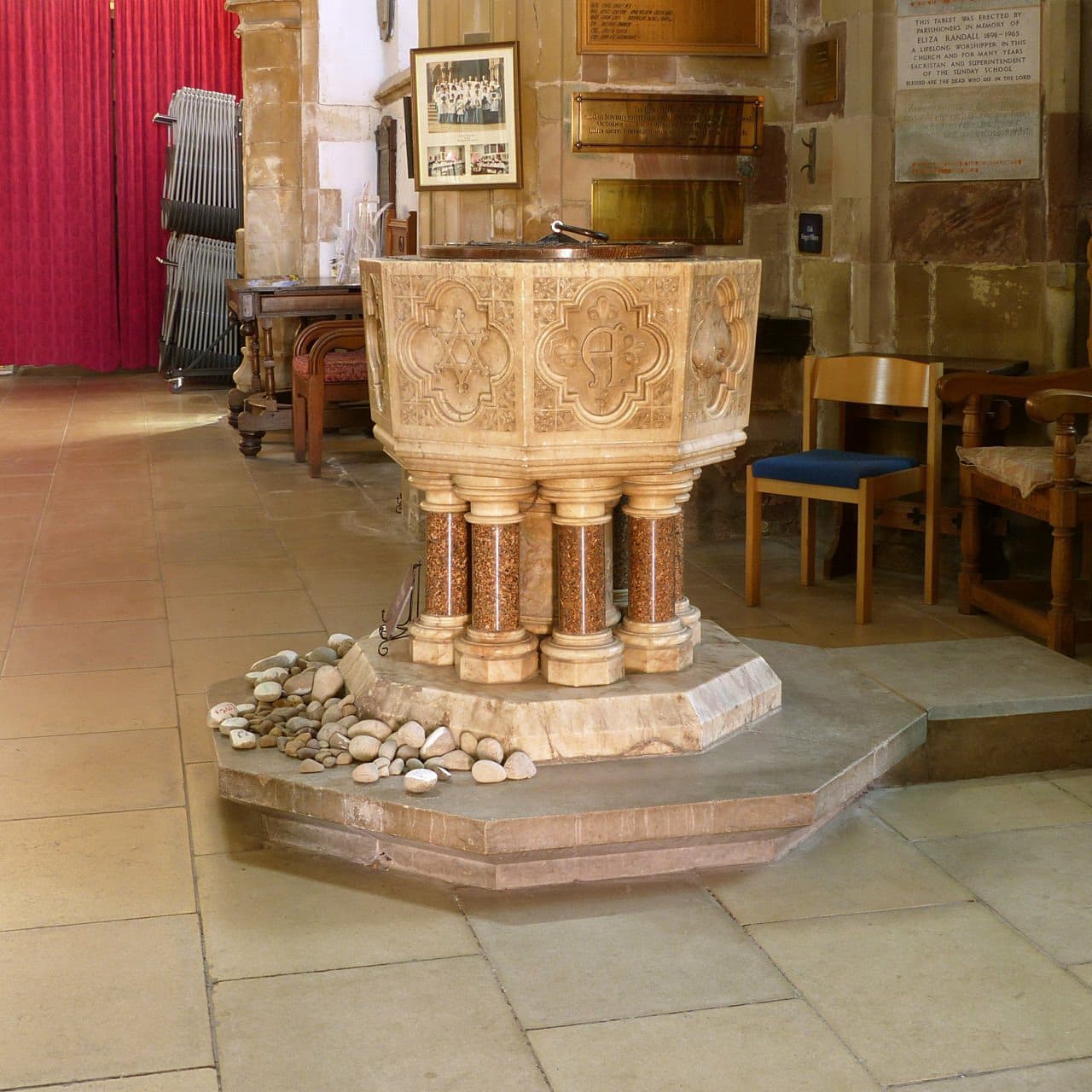
The furnishings are exceptional. The rare finger pillory at the west end immobilised offenders without the public degradation of the stocks. The brass candelabrum in the centre aisle, surmounted by a dove, was given in 1733 by Leonard Piddocke, High Bailiff of Leicester, and made by William Parsons of London; some branches were stolen in 1776 but soon recovered. Thomas Earp of Lambeth carved the alabaster pulpit and the octagonal font, cut from a single block and decorated with Christian symbols on red granite pillars, during the Victorian rebuilding, together with twenty-eight stone heads ranging from Salome and John the Baptist to St Helen, Martin Luther, Queen Victoria and Archbishop Tait. The eleven coloured windows of 1879 by Lavers, Barraud and Westlake tell the Life of Christ from the Annunciation to the Last Supper, while the chancel and Hastings Chapel hold far older treasures, erected in 1924 but mostly once in the castle: German, Swiss and Flemish glass possibly from Farleigh Hungerford, panels of the fifteenth and sixteenth centuries and one perhaps of the thirteenth, the arms of Richard I, Edward I and Queen Catherine Parr, and a fine Last Supper. In the Chapel of St Michael and All Angels lies the alabaster effigy known as "the Pilgrim", a fifteenth-century nobleman with pilgrim's staff, cockle-shelled hat and a dog at his feet, believed to represent Thomas, third brother of William Hastings, once brightly painted. A painted wooden bust remembers Margery Wright, who died in 1623 leaving £43 to provide gowns for the old and needy of the town, and an upright alabaster slab of 1526 commemorates Robert Mundy and his two wives, both named Elizabeth.
The tower carries a north-facing clock, a contemporary sundial rediscovered and repaired in 2000, and a ring whose oldest bell dates from 1571; all eight were repaired by John Taylor in 1886 and, with £42,600 of Heritage Lottery funding in 2006, the tenor was recast and two new trebles added to make ten. The Kirkland organ, of "unusual" type per the National Pipe Organ Register, was last restored in 1955, and one of its Victorian predecessors at the keys, Edward Mammatt, served forty years as organist and won note as a scientist despite being blinded at the age of six. The churchyard, entered through an arch gateway topped with skulls and crossbones, holds the finely carved memorials of prosperous townsfolk including the French wine merchant Jean Gaudin and the Litherland brothers, founders of Royal Crown Derby, together with French prisoners of war quartered in Ashby from 1804 who died before release or stayed to marry local women. The Ashe lectures, endowed by Francis Ashe in 1654 for a "godly, orthodox and ordained minister", have been delivered in the twentieth century by Archbishops Geoffrey Fisher, Donald Coggan and George Carey and by Donald Soper. Today the church anchors the Ashby and Breedon Team Ministry of seven churches, runs the "Little Fishes" toddler group and street pastors, and in 2014 won £648,300 from the Heritage Lottery Fund for a Heritage Centre beside the south churchyard, with displays, guides and craft courses, keeping Lord Hastings's church at the centre of the town he and his castle made.
Plan a visit
Visiting hours & services.
Visitor information
St Helen's is an active parish church at the heart of the Ashby and Breedon Team Ministry, with regular Sunday services, the 'Little Fishes' toddler group and street pastors; visitors are welcome and entry is free. The Hastings tombs, the rare finger pillory, the 'Pilgrim' effigy, the castle's medieval glass and Earp's carved heads reward a visit, and the Heritage Centre beside the churchyard offers displays, guides and craft courses.
Where to find it
Location & contact.
In the neighbourhood
Nearby attractions.
Gallery
Sources
Where this record comes from.
This entry is reconciled from open data. Follow the sources to verify the details or suggest a correction.
Nearby