London, United Kingdom№ 000061818
St James the Less, Pimlico
- Founded
- 1861
- Tradition
- Anglican / Episcopal
- Architect
- George Edmund Street
- Style
- Gothic Revival
About this place
History & significance.
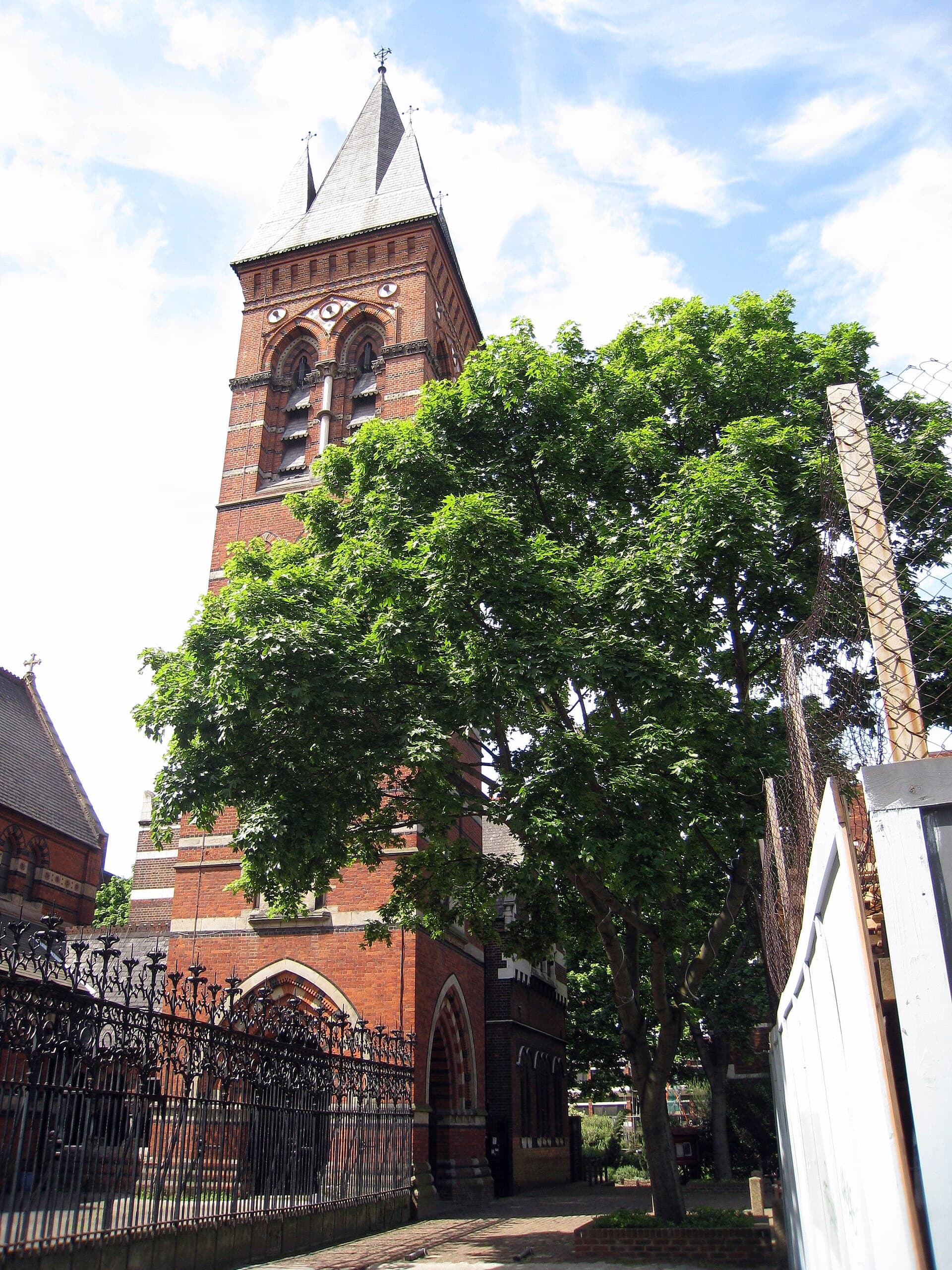
St James the Less is a Church of England parish church in Pimlico, Westminster, built between 1858 and 1861 to the designs of George Edmund Street. One of the great monuments of the Gothic Revival, it has been described by Sir Nikolaus Pevsner as "one of the finest Gothic Revival churches anywhere", and is a Grade I listed building. Its boldly Italian free-standing tower and its richly polychromatic brick interior make it among the most original and admired churches of High Victorian London.
The church was Street's first commission in the capital, undertaken after the work in the Oxford diocese and at All Saints, Boyne Hill, that had won him a wide reputation, and after the success of his 1855 book Brick and Marble Architecture in Italy. In 1858 the three daughters of James Henry Monk, Bishop of Gloucester, commissioned Street to build a church in their father's memory in what was then one of the poorest districts of London, a parish of some thirty-one thousand people living amid slums and run-down tenements. Built on land once owned by Westminster Abbey, the church was consecrated in 1861, and Street added a parish school alongside it in 1861–64; his son Arthur Edmund Street later returned to his father's designs to add an infants' school, now the parish hall, at the west end.
Street built the church chiefly of red brick — fitting, as one contemporary critic observed, for the fact that "London is a brick town" — enriched with black brick, bands of stone, coloured-brick voussoirs and marble shafts. The steeply pitched slate roof is gabled at one end and swept round the apse as a half-cone at the other, and the whole is enclosed by cast-iron railings of Street's own design, topped with wrought-iron lilies inspired by the railings of the cloister chapels in Barcelona Cathedral. The church's most striking external feature is its free-standing tower, modelled on the campaniles of Italy, an architectural form Street admired above all others. Topped by an unconventional spire that rises as a pyramid before splitting into a central spike flanked by four spirelets — an idea drawn from examples he had seen at Tournai and Genoa — the tower follows John Ruskin's prescription that a tower's height is best made apparent when it stands detached as a campanile. It was Street's most pronounced essay in the free-standing tower, and the critic Charles Eastlake declared that the campanile alone would have been "sufficient to proclaim him an artist".
The interior is broad and powerful, with three wide bays leading to the apse. Red brick again dominates, contrasted with black brick and red and yellow glazed tiles, while the nave arcades of notched and moulded brick rest on short granite columns whose carved capitals, by W. Pearce, depict the parables and miracles of Christ. Beyond a prominent chancel arch, the sanctuary is groined in brick and lavishly decorated with mosaic and inlaid marble, making it a darker and more mysterious space than the nave. Many of these forms were inspired by the medieval churches Street had studied across France, Italy and Germany — the columns recalling the cloister of St-Georges de Boscherville near Rouen, the vaulting reinterpreting that of St-Jacques at Compiègne. Yet, as Arthur Street observed, what was Italian had become so wholly absorbed into the architect's own vision that the influence shows less in any single feature than in the choice of materials and the massing of the whole.
The church retains most of its original fittings, all part of Street's complete conception. The heavily carved pulpit is the work of Thomas Earp; the font is capped by an unusual domed iron canopy shown at the 1862 International Exhibition; and the stained glass, by Clayton and Bell, depicts saints including the church's patron, St James the Less. Above the chancel arch is one of the church's treasures: a great composition of the Last Judgement, "The Doom", by George Frederic Watts, first painted as a fresco in 1861 and later remade by the artist himself as a mosaic of Venetian glass when the fresco decayed. The Illustrated London News, contrasting the church with its impoverished surroundings, called it "a lily among weeds".
Founded in the Anglo-Catholic tradition, the church broadened over the decades, and by its centenary dwindling numbers threatened it with closure — a fate averted by a campaign led by Sir John Betjeman and others, after which it was united with nearby St Saviour's, Pimlico. Today it belongs to the Charismatic Evangelical tradition. In a striking tribute to its quality, when the surrounding slums were swept away the architects of the Lillington Gardens estate, built around the church between 1964 and 1972, deliberately clad their low-rise blocks in dark red brick to complement Street's masterpiece — a choice Pevsner praised as "admirable for its understanding of High Victorian values", the architecture of the 1960s proclaiming its appreciation of the style of the 1860s.
From its building as a memorial in a London slum to its place today at the heart of a celebrated modern estate, St James the Less stands as one of the boldest and most beautiful achievements of the Victorian Gothic Revival — a brick "lily among weeds" whose Italian campanile still rises, unmistakable, above Pimlico.
Plan a visit
Visiting hours & services.
Visitor information
St James the Less is a working Church of England parish church off Vauxhall Bridge Road in Pimlico, set within the Lillington Gardens estate. A Grade I listed masterpiece of the Gothic Revival by G. E. Street, it is celebrated for its Italian campanile, polychrome brick interior and the Watts 'Doom' mosaic. Today it worships in the Charismatic Evangelical tradition; check the church website for service times.
Where to find it
Location & contact.
In the neighbourhood
Nearby attractions.
Gallery
Sources
Where this record comes from.
This entry is reconciled from open data. Follow the sources to verify the details or suggest a correction.
Nearby