London, United Kingdom№ 000058940
St John's, Smith Square
- Founded
- 1713
- Tradition
- Anglican / Episcopal
- Architect
- Thomas Archer
- Style
- English Baroque
About this place
History & significance.
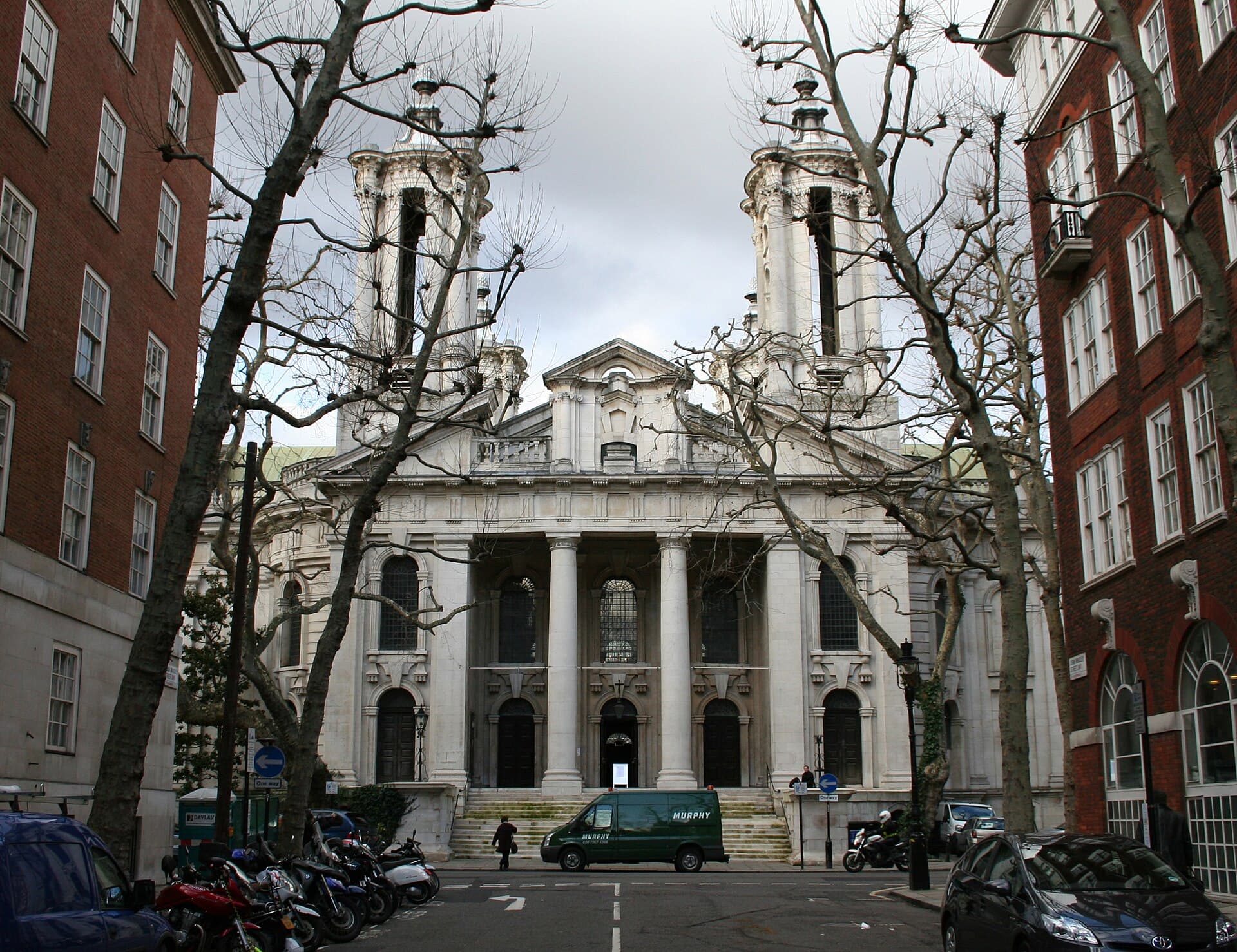
St John's, Smith Square — renamed Smith Square Hall in 2024 by its current operator, Sinfonia Smith Square — stands at the centre of Smith Square in Westminster, a Grade I listed masterpiece of English Baroque that has lived two lives: 213 years as a parish church, and, since 1969, as one of London's major concert halls. Designed by Thomas Archer and completed in 1728 as one of the celebrated Fifty New Churches, it is famous for its four corner towers and monumental broken pediments — and for the legend behind its nickname, "Queen Anne's Footstool": when Archer consulted the ailing Queen about his designs, the story goes, the monarch, never noted for her interest in architecture, petulantly kicked over her footstool, pointed at its upturned shape and snapped "Like that!" In sober fact the towers were added to stabilise the building against subsidence — the church began sinking into its marshy site while still under construction — but the legend has long since won.
The church was born of high politics. In 1710 the long Whig domination of British politics ended as the Tories swept to power under the rallying cry of "The Church in Danger", and amid widespread storm damage to church buildings that November, Parliament concluded that fifty new churches were needed in London and Westminster. An Act of 1711 levied a tax on coal imports into the Port of London to fund the scheme and appointed a commission — Archer serving on it alongside Hawksmoor, Vanbrugh and Wren. The site was bought in June 1713 for £700 from Henry Smith, who was conveniently also Treasurer to the Commissioners, and building began at once, though it proceeded slowly: the church was finally completed and consecrated in 1728 at a total cost of £40,875, built by Edward Strong the Younger, friend of Christopher Wren the Younger.
Archer himself is one of architecture's more entertaining figures. Of country-gentry stock, with three years at Oxford and a Grand Tour behind him, he made his way as a courtier, appointed Groom Porter by Queen Anne in 1705 — responsible for licensing all gambling at court, including tennis, dice and billiards — a post he kept under George I and George II, adding the sinecure of Comptroller of Customs of Newcastle in 1715. He died rich, leaving £100,000 to his nephew, and his architectural output was correspondingly small — work at Chatsworth, Roehampton House, St Philip's Birmingham (now the cathedral) and St Paul's, Deptford — but utterly distinctive, owing more to the Italian Baroque of Borromini, absorbed on his Grand Tour, than to any of his English contemporaries. The style has always provoked: an eighteenth-century commentator found the church "singular, not to say whimsical", and Charles Dickens, in Our Mutual Friend, saw "some petrified monster, frightful and gigantic, on its back with its legs in the air". Sir Hugh Casson, writing in 1981, captured its paradox: outside, "such a turmoil of movement that you could almost say there are no walls or windows ... only a composition of classical elements" handled "with an energy, courage and confidence which is irresistible", looking "rather like some great piece of machinery that has been parked in this tiny domestic little square"; inside, "all is quiet simplicity — a lofty, spacious emptiness filled with a pale, clear light", white Corinthian columns under a barrel vault, "as cool and quiet and evocative as the inside of a seashell"; and beneath, reached by stone spiral stairs, the head-high brick vaults of the crypt, all weight and gravity.
The building's church life was accident-prone from the start. In 1742, the year before Archer's death, the interior was damaged by fire and needed extensive restoration; lightning struck in 1773; the towers and roof had to be shored up in 1815. Under the Ecclesiastical Commissioners Act 1840 the rectory was annexed to a canonry of Westminster Abbey, so that successive canons were rector ipso facto. In 1939 the church hosted the society wedding of the year, when Randolph Churchill, son of Winston, married Pamela Digby before large crowds and intense press attention on both sides of the Atlantic. Then, on 10 May 1940, an incendiary bomb scored a direct hit and the church was gutted by fire — a handwritten account of that night still hangs framed at the top of the stairs to the crypt. The parish was united with St Stephen's, Rochester Row, in November 1950, and the ruin stood open to the sky for more than twenty years.
Its saviour was Lady Parker of Waddington, commemorated by a plaque on the south wall, who founded the Friends of St John's in 1962 to restore the church to Archer's original design as a concert hall. Work began in 1965, and on 6 October 1969 Dame Joan Sutherland and Richard Bonynge gave the inaugural recital. The former cellist Eleanor Warren recognised the hall's gift to broadcasting — far from traffic noise and underground trains — and organised the BBC's Monday lunchtime radio concerts from the restored church. The hall has since hosted everyone from international singers and chamber orchestras to amateur and school choirs and popular artists, its season running from mid-September to the following summer; it receives no state or local subsidy, surviving entirely on concert and recording income and the generosity of trusts, companies and individuals. In 1986 an appeal was launched to commission a new concert organ using the antique case of 1734 by Jordan, Byfield and Bridges, donated by Sir Duncan Oppenheim; the instrument, built by Johannes Klais of Bonn and completed in 1993, was named the Sainsbury Organ for the family whose contribution made it possible. The exterior was cleaned and its stonework repaired in a major project completed in March 1999, supported by the National Heritage Lottery Fund, and the hall's thirtieth anniversary was marked that October with a gala concert. Accessibility came in 2010, with a lift connecting ground, crypt and concert levels, a relocated box office and entrance foyer, adapted facilities and a platform lift to the stage. The hall has even had its screen moments — as the wedding venue of Lola Quincey and Paul Marshall in Atonement (2007), and, anachronistically, as a concert hall in An Education (2009), set before the restoration.
The crypt, undamaged by the bombing and still pure eighteenth-century brickwork, was never used for burials — for most of the eighteenth and nineteenth centuries it was let for storing wine and beer, and it now houses the Footstool Restaurant. The church's actual burial ground lies in Horseferry Road, now St John's Gardens, its eroded grave-slabs arranged around the garden's perimeter. In 2021 the charity running St John's merged with the orchestra Southbank Sinfonia, and in 2024 the building took its new name — but to generations of Londoners, Queen Anne's Footstool it remains: Archer's outsize Baroque swagger, parked forever in its quiet Georgian square, filled most evenings with music.
Plan a visit
Visiting hours & services.
Visitor information
The building is no longer a church: as Smith Square Hall it operates as one of London's leading concert venues, with a season running from September to summer, lunchtime broadcasts and the Footstool Restaurant in the 18th-century crypt. Tickets and programme details are on the Sinfonia Smith Square website; the hall is fully accessible by lift.
Where to find it
Location & contact.
In the neighbourhood
Nearby attractions.
Gallery
Sources
Where this record comes from.
This entry is reconciled from open data. Follow the sources to verify the details or suggest a correction.
Nearby