Stanwick St John, United Kingdom№ 000062193
St John the Baptist's Church, Stanwick
- Founded
- 1250
- Tradition
- Anglican / Episcopal
- Architect
- Anthony Salvin
- Style
- Gothic
About this place
History & significance.
St John the Baptist's Church at Stanwick St John in North Yorkshire occupies one of the most extraordinary settings of any English parish church: it stands within the earthworks of Stanwick Camp, a settlement originating in the early Iron Age and one of the great native strongholds of pre-Roman Britain. A redundant Anglican church, Grade I listed and in the care of the Churches Conservation Trust since 1 June 1990, its very site is recognised as a Scheduled Monument — a Christian building rooted inside ramparts that were old before Christianity reached these islands.
The present church dates from the 13th century, but worship here began far earlier: the discovery of a 9th-century cross shaft in the churchyard points to an Anglo-Saxon predecessor on the site, and carved stones of Anglo-Saxon and medieval date are built into the fabric of the south aisle — the older church living on inside the walls of the newer. That cross shaft still stands south of the chancel, probably of the 9th century, one of seven structures around the church that hold their own Grade II listings. The church was "heavily restored" in 1868 by Anthony Salvin, the great Victorian architect of castles and churches, who had deep connections with the north.
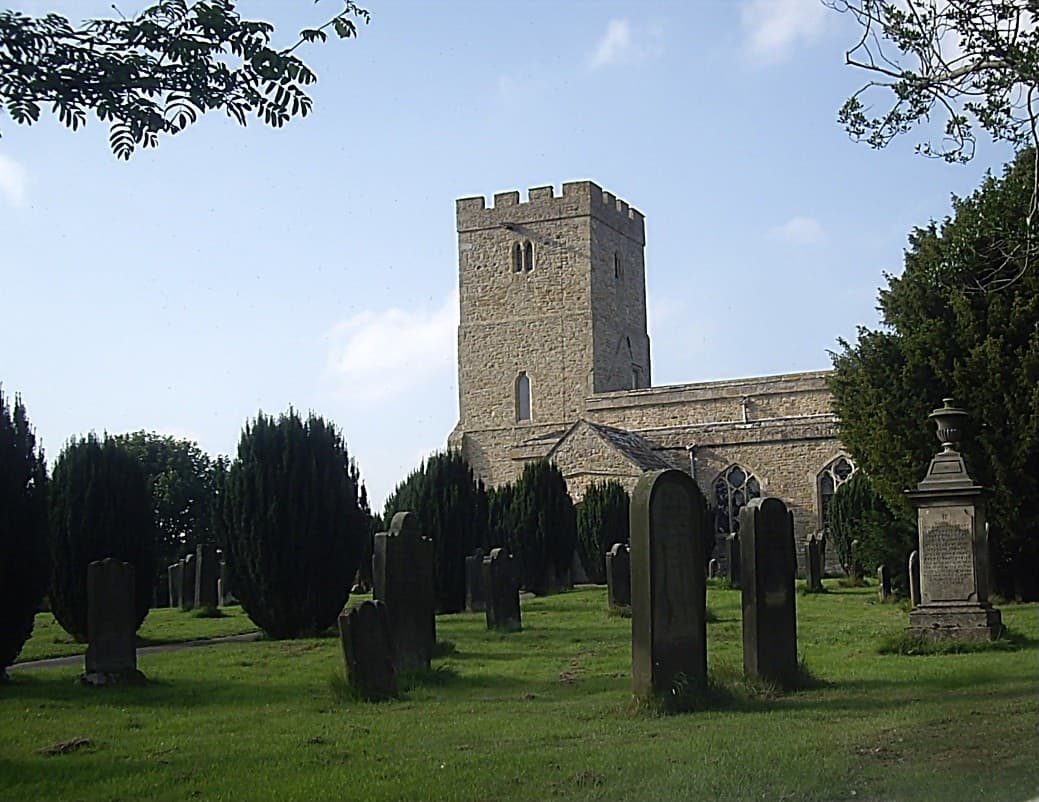
The building is of stone rubble under roofs of stone slate, artificial stone slate and lead, on a plan of a four-bay nave with south aisle and south porch, a three-bay chancel with a 19th-century north vestry, and a west tower. The tower rises in three stages with quoins and stepped diagonal buttresses: a lancet window above a central buttress on the west face of the lowest stage, similar lancets on each face of the middle stage, two-light bell openings in the top stage, and a battlemented parapet at the summit. A five-sided stair turret on the north side is a 19th-century addition, and lying on its side on the ground to the west is a medieval stone coffin. The porch, with its own stepped diagonal buttresses, carries a sundial over its arched doorway and shelters an inner door of the 13th century. The south aisle has a 19th-century single-light west window, two 19th-century three-light windows in its south wall and a three-light 13th-century east window; the north wall of the church holds three two-light windows with Decorated and Perpendicular tracery, and the chancel a priest's doorway and a three-light east window with Decorated tracery.
Inside are a four-bay south arcade, a tower arch and a chancel arch. A recumbent effigy lies in the north wall of the chancel, faced by a 19th-century piscina and a stepped triple sedilia in the south wall, with another piscina and an aumbry in the south aisle. The font is 19th-century but carries a carved canopy of the 17th century. The church holds a number of tombs and monuments to the Smithson family — the family of Stanwick Park whose descendants became Dukes of Northumberland, and from whom James Smithson, founder of the Smithsonian Institution, sprang. On the east wall of the chancel are boards painted with the Lord's Prayer, the Creeds and the Commandments; over the chancel arch hang the royal arms of George III, and hatchments line the church. The organ was built in 1866 by John Fincham of London, and the tower carries a ring of three bells, all cast by Samuel I. Smith — two in 1677 and the third in 1685.
The churchyard and its surroundings amount to a small landscape of listed heritage. South of the south aisle stand four sandstone tombstones of the 18th century, with another group of four of the same period east of the porch; south of the porch are memorials to William Newcomb, who died in 1752, and to Richard Slater, of the early 18th century. To the north-north-east of the church are two wells built in the late 19th century for the Duke of Northumberland and possibly designed by Salvin himself — the smaller, about 150 metres from the church, gathers a spring and feeds the larger well some 100 metres away.
Redundant since 1990 but lovingly maintained, St John the Baptist's remains open to visitors through the Churches Conservation Trust — a 13th-century church with a 9th-century cross, Smithson monuments and Restoration bells, standing alone among the grass-grown ramparts where the Brigantes once made their stand against Rome.
Plan a visit
Visiting hours & services.
Visitor information
St John the Baptist's is a redundant Grade I church in the care of the Churches Conservation Trust, standing within the Iron Age earthworks of Stanwick Camp — the site itself is a Scheduled Monument. Visitors can see the 9th-century Anglo-Saxon cross shaft south of the chancel, Saxon carved stones in the south aisle, the Smithson family monuments, the 17th-century font canopy and three Restoration-era bells, with Salvin's 1868 restoration throughout.
Where to find it
Location & contact.
In the neighbourhood
Nearby attractions.
Gallery
Sources
Where this record comes from.
This entry is reconciled from open data. Follow the sources to verify the details or suggest a correction.
Nearby