London, United Kingdom№ 000062212
St John the Divine, Kennington
- Founded
- 1888
- Tradition
- Anglican / Episcopal
- Architect
- George Edmund Street
- Style
- Gothic Revival
About this place
History & significance.
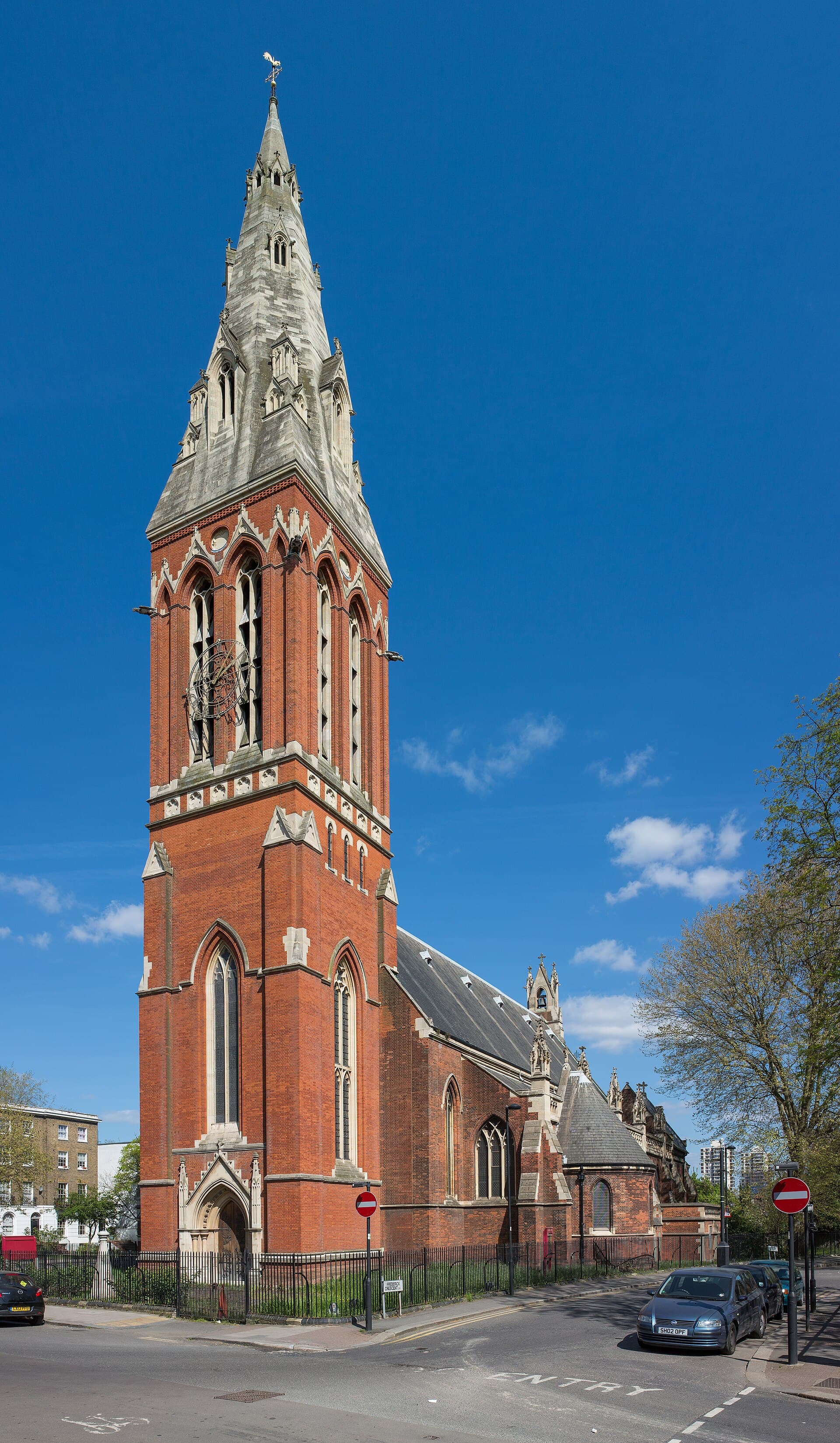
St John the Divine, Kennington, rises above Vassall Road in the London Borough of Lambeth — its 200-foot spire, the tallest in south London, visible for miles around the Oval cricket ground. Designed by George Edmund Street, architect of the Royal Courts of Justice on the Strand, and built between 1871 and 1874 in the Decorated Gothic style, this Grade I listed Anglican church in the Diocese of Southwark drew from John Betjeman the verdict that it was "the most magnificent church in South London."
The church is regarded as a masterpiece of Victorian Gothic: red brick throughout, with all parapets, window openings and doorways dressed in stone, and the upper part of the spire entirely of stone. The original interior was designed by George Frederick Bodley, founder of Watts & Co., and fitted out in the highly ornate style typical of the Victorian era and of Anglo-Catholic churches — stone carvings by Thomas Earp, wrought iron altar rails, stained glass, and a carved reredos painted by Clayton and Bell, with a new organ by J. W. Walker & Sons installed in 1875.
From its foundation in 1871 the church belonged to the Anglican high church movement. The second vicar, the Revd Charles Edward Brooke, was associated with the Oxford Movement and its mission to impoverished city parishes — at a time when ritualistic practices in the Church of England were limited by the Public Worship Regulation Act of 1874, making the church's incense and ceremony quietly defiant. The Sisterhood of St John the Divine, the Anglican religious order founded in Canada by Hannah Grier Coome, takes its name indirectly from this church, where its foundress found spiritual comfort during her residence in Britain. Notable clergy have included Cyril Easthaugh, curate and vicar, later Bishop of Kensington and then Peterborough; Cathrew Fisher, later Bishop of Nyasaland; and John Hall, curate, later Dean of Westminster.
The Blitz nearly destroyed it all. In 1941 the church suffered severe bomb damage and most of Bodley's original interior was lost. Years of restoration under H. S. Goodhart-Rendel followed, and St John the Divine reopened in September 1958. The post-war refitting brought new treasures. Between about 1958 and 1959, W. T. Carter Shapland provided three new stained glass windows for the eastern apse in a modern idiom of bold colour and line: the central window, above the high altar, shows the enthroned Christ presiding over the Last Judgement, with the Four Horsemen of the Apocalypse and a seated John the Divine writing the Book of Revelation below, and the Archangel Michael casting the fallen angels into hell; flanking windows trace the life of Christ from the Annunciation through the Baptism and the Calling of the Fishermen to the Entry into Jerusalem, the Last Supper, the Crucifixion and the Three Marys at the empty tomb. Shapland added a second window around 1962 in the All Souls chapel — the risen Christ crowned in glory above the text from Hebrews, "unto them that look for him shall he appear the second time" — close in style to his great west window at Chester Cathedral of the same years. Of the original glass, some by Charles Eamer Kempe survived the bombs, including the west window beneath the tower and two windows in the south aisle chapel; Goodhart-Rendel glazed the aisles plainly. Behind the altar, murals painted by Brian Thomas in 1966 show the Virgin and Child in a floral garden, a central panel of lilies and roses — the traditional Marian symbols — and a pietà framed not with flowers but with thorns.
Two other works give the church its particular character. Above the north door hangs the "Korean Icon," designed in the style of a Greek Orthodox iconostasis with figures from the Gospels, dedicated as a memorial to Bishop Charles John Corfe, who founded the Anglican Church of Korea in 1890. And on the south side of the nave stands the Kelham Rood — a life-size bronze of Christ on the Cross with free-standing figures of St John and the Virgin Mary, completed in 1929 by Charles Sargeant Jagger, the sculptor of the Royal Artillery Memorial at Hyde Park Corner. Commissioned by the Society of the Sacred Mission for the Great Chapel at Kelham Hall in Nottinghamshire, and later at the society's priory at Willen in Milton Keynes, the rood came finally to Kennington — where the original plan to suspend it above the high altar was abandoned in favour of placing it at floor level, in full and close view of the congregation: Jagger's soldiers'-memorial realism at eye level among the worshippers.
The tower and spire were extensively restored in 1994, when a new set of carved grotesques and gargoyles was added — many of them caricatures of members of the congregation, the clergy and the royal family: the Queen, Prince Charles, Prince William and Archbishop Michael Ramsey are among the better-known faces peering down from Street's stonework.
The high church traditions continue unbroken. Services are in the Anglo-Catholic style, with an emphasis on sacraments, liturgy and ceremony: on Sundays and holy days the clergy wear decorated robes, a choir sings the Mass and incense is used, while Mass is said daily through the week, the liturgy usually drawn from Common Worship. Devotional statues, icons, sanctuary lamps and the Reserved Sacrament fill the building that Street raised and Bodley adorned — bombed, rebuilt and re-glazed, still the most magnificent church in south London, with the tallest spire to prove it.
Plan a visit
Visiting hours & services.
Visitor information
St John the Divine stands on Vassall Road in Kennington, a few minutes' walk from Oval tube station (Northern line) and the Oval cricket ground, with buses along Brixton and Camberwell New Roads. It is an active Anglo-Catholic parish church in the Diocese of Southwark: sung Mass with choir and incense on Sundays and holy days, and Mass said daily through the week. Visitors should seek out Jagger's bronze Kelham Rood at floor level in the nave, Shapland's apocalyptic apse windows, the surviving Kempe glass, Brian Thomas's thorn-framed pietà murals, the Korean Icon over the north door — and the 1994 gargoyles caricaturing the Queen, Prince Charles and Archbishop Ramsey.
Where to find it
Location & contact.
In the neighbourhood
Nearby attractions.
Gallery
Sources
Where this record comes from.
This entry is reconciled from open data. Follow the sources to verify the details or suggest a correction.
Nearby