Church Stretton, United Kingdom№ 000062447
St Laurence's Church, Church Stretton
- Founded
- 1150
- Tradition
- Anglican / Episcopal
- Architect
- Samuel Pountney Smith
- Style
- Norman & Early English Gothic
About this place
History & significance.
St Laurence's Church stands at the heart of Church Stretton, the small town in the Shropshire Hills sometimes called "Little Switzerland" for the beauty of its surrounding country. A Grade I listed building of medieval origins, with a Norman nave, Early English transepts and a battlemented Perpendicular tower, it is one of the finest churches in this part of Shropshire — and it gives the town its very name, for "Church Stretton" means the settlement on the Roman road (the street, or strœt) that has a church. From the Norman carvings of its doorways to its Victorian memorial to one of England's greatest painters, St Laurence's gathers many centuries of history into one cruciform building beneath the hills.
The church grew over several centuries. Its nave dates from the twelfth century and is Norman in style, while the transepts were added in the following century, in the Early English Gothic manner; the chancel and the upper stage of the tower belong to the fifteenth century. The building has a cruciform plan, with the nave and chancel crossed by north and south transepts, each of which gained a west aisle during a restoration by the local architect Samuel Pountney Smith in 1867–68, and a central tower rising over the crossing. The south vestry was added in 1831, and there were further restorations in 1882 and 1932; in 2010 the interior was modernised, the old pews replaced by movable chairs and new heating, lighting and sound systems installed, adapting the ancient church for contemporary use.
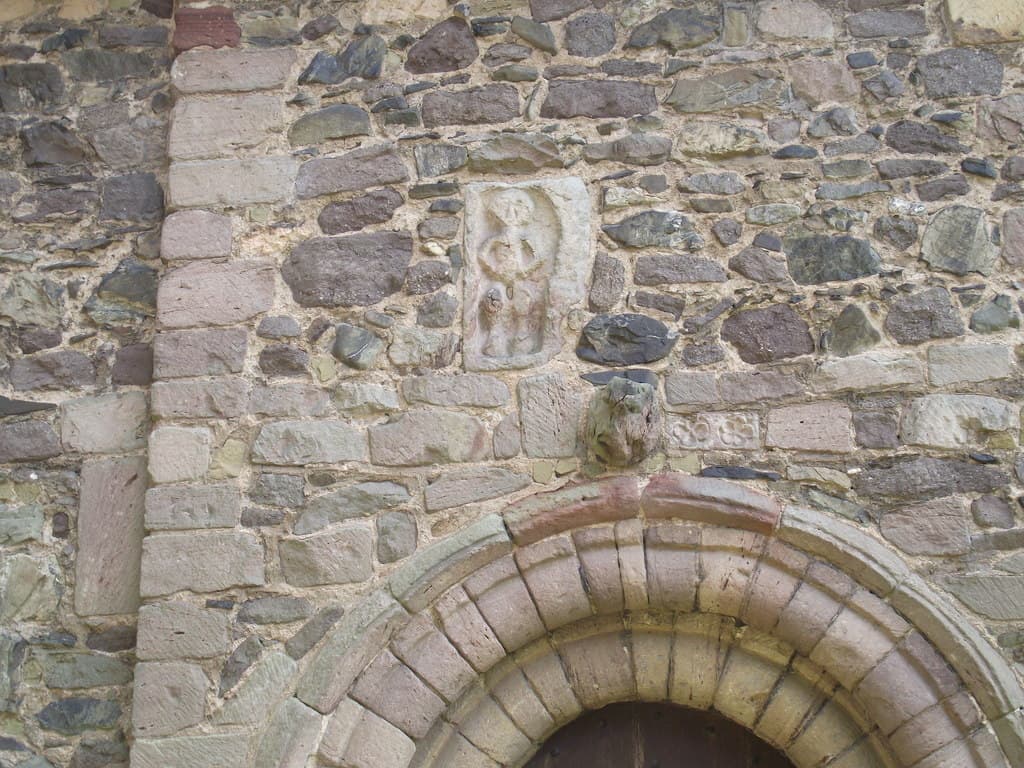
The exterior preserves many fine medieval features. The three-stage tower has gargoyles at its corners and centre, lancet windows in its lower stages, a clock, and two-light bell openings beneath a battlemented parapet with elaborate corner finials; its diagonal buttresses include, at the south-east angle, one carved with the figure of St Laurence, the church's patron, the early Christian deacon and martyr who was, by tradition, roasted to death on a gridiron. The Norman nave retains its original buttresses and two Norman doorways, one on the north and one on the south. Above the north doorway is one of the church's most intriguing features: a re-set sheela-na-gig, a carved figure of the kind found at a number of medieval churches, whose meaning has long been debated — variously interpreted as a pagan survival, a fertility symbol, or a warning against sin. Its presence over a church doorway is a reminder of the strange and earthy world of medieval popular belief.
Inside, the church is rich in medieval and later furnishings. All the roofs are medieval, a remarkable survival, and in the south-west corner of the chancel is a window with a piscina set into its sill, used for washing the sacred vessels. The reredos behind the altar was constructed around 1820, reusing seventeenth-century panelling, and the octagonal font is Perpendicular in style; the pulpit of 1880, made of stone and different coloured marbles, was designed by Samuel Pountney Smith. In the ceiling of the tower is a modern sculpture, dating from about 1970, depicting St Laurence with his gridiron. The church is also notable for its glass: some of the windows in the chancel contain medieval glass and Flemish roundels, the east window is by Betton and Evans of Shrewsbury, and there is an early window in the nave by the celebrated firm of Burlison and Grylls.
One window holds a special association with the wider world of art. In the south transept is a memorial window to Lord Leighton of Stretton — Frederic Leighton, the great Victorian painter and President of the Royal Academy, the only British artist ever to be raised to the peerage, who took his title from the town of Stretton. The window commemorates this connection between the small Shropshire town and one of the most celebrated figures of Victorian art, a reminder of how even a country church can be linked to the great names of national life.
St Laurence's remains an active Anglican parish church, the principal church of the united parish of Church Stretton, which also includes St Michael and All Angels at All Stretton and All Saints at Little Stretton, within the Diocese of Hereford. It continues to serve the town and its visitors, its medieval tower a familiar landmark beneath the surrounding hills.
The church stands in the centre of Church Stretton, a town that became a popular health resort in the Victorian and Edwardian periods, set amid the dramatic scenery of the Shropshire Hills Area of Outstanding Natural Beauty. The great whaleback ridge of the Long Mynd rises immediately above the town, with the beautiful Carding Mill Valley — cared for by the National Trust — cutting into its flank; the volcanic crags of the Stretton Hills, the limestone escarpment of Wenlock Edge, and the wider walking country immortalised by the poet A. E. Housman in A Shropshire Lad are all within easy reach.
From a Norman nave and Early English transepts, through the Perpendicular tower with its carved figure of St Laurence, the enigmatic sheela-na-gig over the north door, and the medieval roofs and glass within, to the memorial window to the painter Lord Leighton, St Laurence's Church gathers some nine centuries of Shropshire history into one building. A Grade I listed church that gives the town its name, it remains the living parish church of Church Stretton — a treasure of the Shropshire Hills beneath the slopes of the Long Mynd.
Plan a visit
Visiting hours & services.
Visitor information
St Laurence's is an active Church of England parish church in the Diocese of Hereford, open to visitors at the heart of Church Stretton. A Grade I listed cruciform church with a Norman nave, Early English transepts and a battlemented Perpendicular tower, it is celebrated for its medieval roofs and glass, the enigmatic sheela-na-gig carving over its north door, and a memorial window to the painter Lord Leighton, who took his title from the town.
Where to find it
Location & contact.
In the neighbourhood
Nearby attractions.
Gallery
Sources
Where this record comes from.
This entry is reconciled from open data. Follow the sources to verify the details or suggest a correction.
Nearby