Frodsham, United Kingdom№ 000062448
St Laurence's Church, Frodsham
- Founded
- 1086
- Tradition
- Anglican / Episcopal
- Architect
- George Frederick Bodley
- Style
- Norman
About this place
History & significance.
St Laurence's Church stands not in the centre of Frodsham but above it, in the elevated district of Overton overlooking the Cheshire market town — a Grade I listed church whose nave interior is considered one of the finest examples of Norman architecture in Cheshire, in an active parish whose recorded history begins in the Domesday Book.
Domesday records a church with a priest on this spot, and in 1093 Hugh Lupus, the great Norman Earl of Chester, gave the tithes to the abbot of St Werburgh's Abbey in Chester. In the 1270s they passed to the monastery of Vale Royal on its foundation by Edward I, and after the Dissolution of the Monasteries the tithes and advowson came to the dean and chapter of Christ Church, Oxford. Frodsham was one of the ancient parishes of Cheshire, embracing the villages of Kingsley, Norley, Manley, Alvanley and Helsby until the nineteenth century peeled them away — Norley becoming a separate parish in 1836, Kingsley in 1851, Alvanley in 1861 and Helsby in 1875.
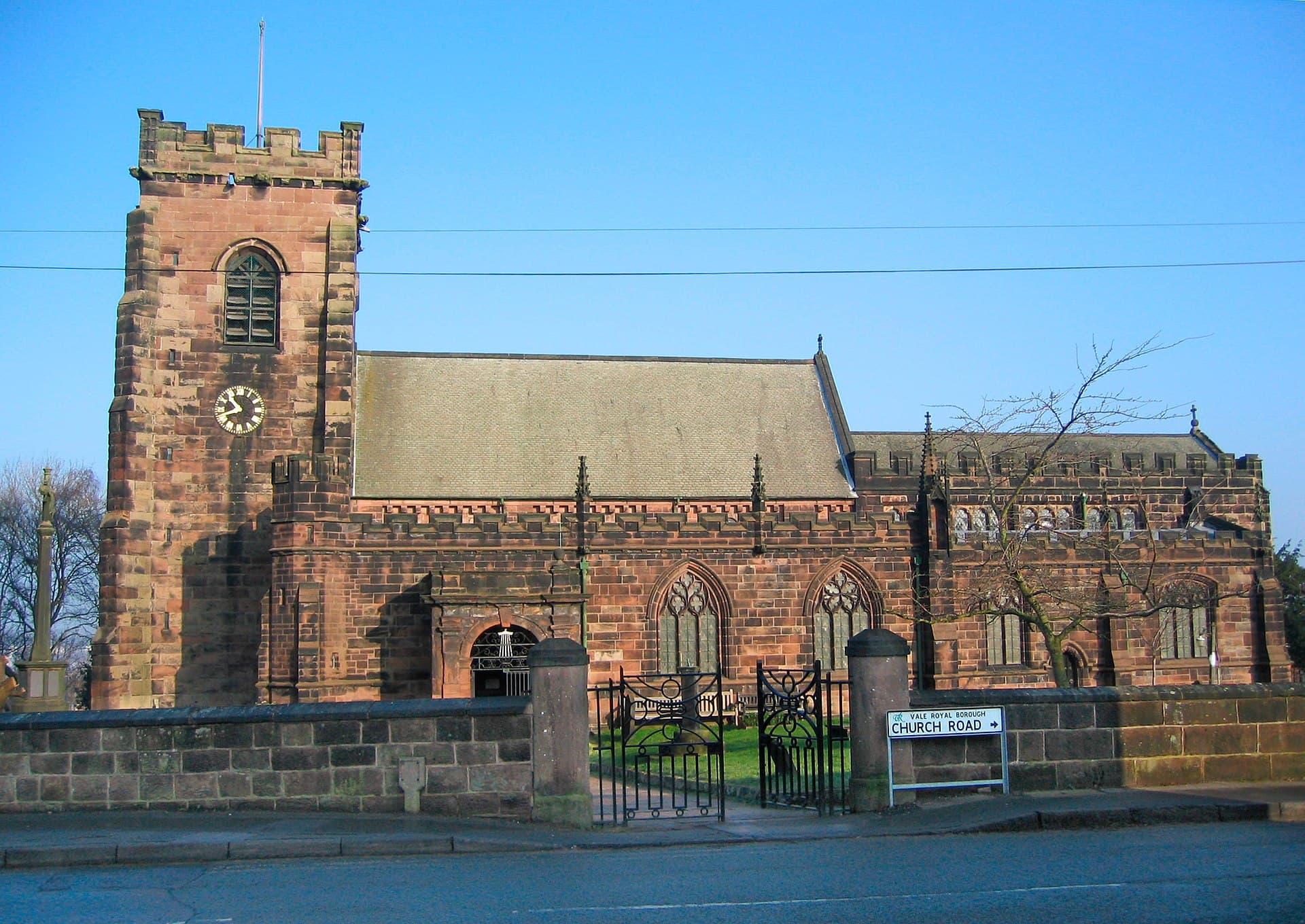
The present church dates from around 1180, built of local red sandstone. The fourteenth century lengthened the chancel and raised the tower; the fifteenth lengthened and heightened the chancel again; and the sixteenth added the north chapel and probably the south. The plan is symmetrical: west tower, nave of three and a half bays, north and south aisles, two-bay chapels on each side, and a three-bay chancel with sanctuary. The north porch is dated 1715 and the south 1724. The three-stage tower carries clocks on its north and south faces beneath two-light belfry windows and a crenellated parapet — the aisles and chancel crenellated to match — and in its south wall are re-set carved stones of Saxon and Norman date, precious fragments of the church's earliest fabric. The north chapel is the Blessed Sacrament Chapel (formerly the Helsby Chapel), the south the Lady Chapel (formerly the Kingsley Chapel). Considerable rebuilding was carried out between 1880 and 1883 by Bodley and Garner, who removed the galleries and plaster ceilings inserted around 1740 and gave the church its font of 1880.
The Norman nave arcades, much restored but still containing original material, are the church's chief glory. Around them gathers a rich accumulation of furnishings: seventeenth-century altar rails with twisted balusters; an altar table of 1678 and parish chest of 1679, both made by Robert Harper; a reredos of about 1700 in the north chapel with Corinthian columns and pilasters; a three-tier brass candelabra made in Birmingham in 1805; and church plate mostly given around 1760 by the vicar Francis Gastrell. The Victorian pulpit replaced a three-decker whose sounding board now hangs on the north wall of the nave, beside a memorial to the Rev William Charles Cotton, vicar from 1857 to 1879 — the eccentric missionary and pioneer apiarist. The sanctuary keeps a piscina adapted from a fourteenth-century corbel, and a sedilia; the chancel holds monuments mainly to the Ashley family of Park Place. The stained glass includes a Good Shepherd of 1917 by Shrigley and Hunt in the baptistry and three windows of the 1930s by A. K. Nicholson. The organ, built by Binns in 1882–83 in a case by John Oldrid Scott, was rebuilt by Binns in 1923 and by Sixsmith in 1982, and the tower carries a ring of eight bells — six cast by Rudhall of Gloucester in 1734, two by John Taylor and Company in 1911. The parish registers begin in 1558, with a Civil War gap from 1642 to 1661, and the churchwardens' accounts run from 1609.
The churchyard has three Grade II listed structures: a war memorial of 1921 sculpted by the Arts and Crafts designer Alec Miller; a sundial of 1790 with copper dial and gnomon on a sandstone stem; and the Wright family tomb of about 1806, a truncated grey stone obelisk near the western gate. Here too lie the war graves of twenty-one Commonwealth service personnel — fifteen of the First World War, six of the Second — and one of the churchyard's most poignant residents: Prince Warabo, teenage son of King Jaja of Opobo in Nigeria, sent to school at the former Manor House School in Frodsham, where he died in 1882, an ocean from home. St Laurence's remains the active parish church of Frodsham, in the deanery that bears the town's name, looking down from its sandstone hill as it has for more than eight centuries.
Plan a visit
Visiting hours & services.
Visitor information
St Laurence's is the active Church of England parish church of Frodsham, Cheshire (Diocese of Chester), standing at Overton above the town with regular Sunday services. The Grade I church offers one of Cheshire's finest Norman nave interiors, re-set Saxon and Norman carved stones in the tower, 17th-century furnishings by Robert Harper, Rudhall bells of 1734 and the touching grave of Prince Warabo of Opobo in the churchyard.
Where to find it
Location & contact.
In the neighbourhood
Nearby attractions.
Gallery
Sources
Where this record comes from.
This entry is reconciled from open data. Follow the sources to verify the details or suggest a correction.
Nearby