Leeds, United Kingdom№ 000062334
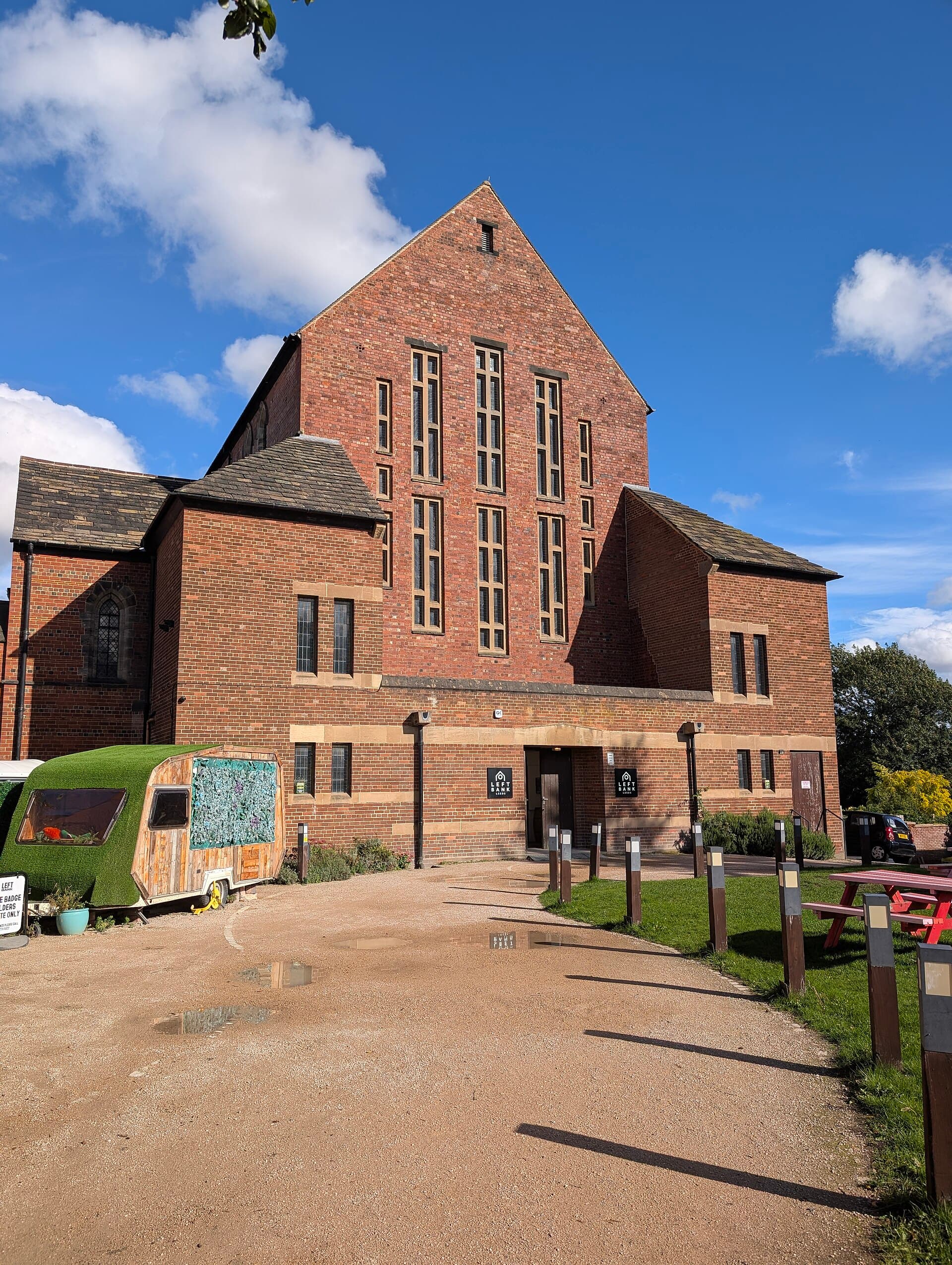
St Margaret of Antioch Church, Leeds
- Founded
- 1909
- Tradition
- Anglican / Episcopal
- Architect
- Temple Moore
- Style
- Gothic Revival
About this place
History & significance.
St Margaret of Antioch's Church on Cardigan Road in Headingley, Leeds — near Burley Park railway station — is a Grade II* listed masterpiece of the Late Gothic Revival by Temple Moore, once introduced to visiting clergy as "the finest Church in Leeds", and now reborn as Left Bank Leeds, one of the city's best-loved arts venues.
The church was built in the Parish of Burley to serve the red-brick terraces spreading across this corner of late Victorian Leeds. The first church on the site was a temporary iron building, dedicated in March 1898 by Archdeacon Kilner, which served as church, Sunday school and social venue — and was notoriously hot in summer. The first vicar, the Rev Arthur Hastings Kelk (previously Anglican chaplain in Beirut), took possession of the parsonage in 1897, and from the start the parish set about raising funds for a permanent building: a monthly parish magazine launched in January 1899 with some 800 subscriptions, a separate Sunday school finished by Easter 1900, bazaars in Leeds Town Hall, door-to-door canvassing, and appeals to neighbouring businesses, parishes and the diocese itself.
Temple Moore — among the most refined church architects of his generation — was commissioned from 1901. The foundation stone was laid on 26 October 1907, the first phase completed in 1908 with an unfinished west end, and the church consecrated in 1909, its first wedding celebrated on Easter Monday that year. Moore's design, widely regarded as a particularly fine example of his work and of the Late Gothic Revival, earned the building its Grade II* listing; his planned vicarage and First World War memorial were never built, and neither was the huge west tower of his original design. The west end waited half a century: a Jubilee Building Fund launched in 1959 found Moore's plans too ornate and expensive, and George Pace of York — a great admirer of Moore — designed the present west end, completed in 1963. Sir John Betjeman knew and admired the building, especially its interior. The vicar Robert Combe caught the parish's feeling in 1920: "every week shews me new beauties in the building... Its stern grandeur in Lent, followed by its glory on Easter Day, was almost over-powering."
St Margaret's became a separate parish in 1911, and for most of the century lived the full life of an Anglo-Catholic parish: Sunday services, Whitsun parades, the Mothers' Union, musical and men's societies, and the annual parochial excursion around St Margaret's feast day of 20 July. Its hospitality was wide: a house was rented for Belgian refugees in the First World War, and from the 1940s to the 1960s the church hosted the Orthodox liturgy in Slovak, the Polish Orthodox Church and the Russian Orthodox Church in Exile. But Headingley's demographics shifted toward a transient population, mooted amalgamations with All Hallows and St Michael's came to nothing, and by the mid-1990s the congregation had dwindled to a handful. The Church Commissioners declared the building redundant in March 1995, the congregation joining All Hallows nearby, renamed St Margaret's and All Hallows.
The building's rescue came from local Christians who bought it in 2001, determined that it should not fall into ruin. Used occasionally for special events, it nonetheless deteriorated — roof damage and a pigeon infestation made it a health hazard — until English Heritage funded essential repairs from the Buildings at Risk Register, and a steering group shaped a new vision. That vision is Left Bank Leeds: a multidisciplinary arts venue whose mission is to preserve the building while inspiring and empowering the community through a sustainable programme promoting creativity, connection and wellbeing — exhibitions, gigs, festivals, cinema, talks, afternoon teas and a public co-working space, cited by The Guardian in its alternative city guide to Leeds, and open for public events and private hire.
Temple Moore's interior still keeps its treasures: the First World War memorial dedicated in 1923 (now moved to the south-west corner), the east end stained glass, the choir stalls designed and installed by his son-in-law Leslie Moore, and the high altar dedicated in its present form in 1950 — the furnishings of "the finest Church in Leeds", presiding now over concerts and canvases instead of congregations, but cared for as devotedly as ever.
Plan a visit
Visiting hours & services.
Visitor information
St Margaret of Antioch's is a FORMER church: redundant since 1995, the Grade II* Temple Moore building on Cardigan Road, Headingley, is now Left Bank Leeds, a multidisciplinary arts venue open to the public for exhibitions, gigs, festivals, cinema, talks and co-working, and available for event hire. The Leslie Moore choir stalls, east window and 1923 war memorial survive inside.
Where to find it
Location & contact.
In the neighbourhood
Nearby attractions.
Gallery
Sources
Where this record comes from.
This entry is reconciled from open data. Follow the sources to verify the details or suggest a correction.
Nearby