Bowness-on-Windermere, United Kingdom№ 000062542
St Martin's Church, Bowness-on-Windermere
- Founded
- 1203
- Tradition
- Anglican / Episcopal
- Architect
- Sharpe, Paley and Austin
- Style
- Gothic
About this place
History & significance.
St Martin's Church stands at the centre of Bowness-on-Windermere in Cumbria, the parish church of the busy little lakeside town and a Grade I listed building whose east window holds glass seven and a half centuries old. An active Anglican church in the deanery of Windermere and the Diocese of Carlisle, it shares a united benefice with St Anne's at Ings, St Cuthbert's at Kentmere, St James' at Staveley, Jesus Church at Troutbeck and St Mary's at Windermere.
A church has stood on the site since at least 1203, originally a chapel of ease to the great mother church at Kendal; it became a parish in its own right in 1348, when the churchyard was consecrated. Disaster struck in 1480, when the church burnt down, leaving only the font, the base of the tower and one door. A new church rose quickly and was consecrated in 1483 — among its benefactors a local carrier named Bellman, who is said to have provided the lead for the roof, an act of generosity still commemorated in glass. The medieval church had a simple plan of aisled nave and west tower, furnished in time with box pews, a rood loft, a three-decker pulpit and, by 1812, a west gallery, its walls and roof beams covered with murals and painted biblical texts.
In 1870 the church was restored by the great Lancaster architects Paley and Austin, with the industrialist and politician Henry Schneider among the benefactors. They extended the chancel, raised the tower and gave it its distinctive saddleback roof, and replaced the seating; during the work, painted inscriptions hidden under whitewash were rediscovered. Around the same time Henry Hughes of London painted murals in tempera and oil in the chancel and nave and restored the east window. A vestry by W. L. Dolman was added at the north-east in 1911 and converted by him in 1922 into a memorial chapel — its fund-raising led by Sir William Forwood — commemorating the seventy-one men of the parish who died in the First World War and giving thanks for those who returned. Later in the twentieth century pews were cleared from the back of the church for a social area, the choir vestry became a children's wing, and at the millennium a glass screen by Sally Scott, etched with angels and music, was set in the tower arch to create the Tower Room.
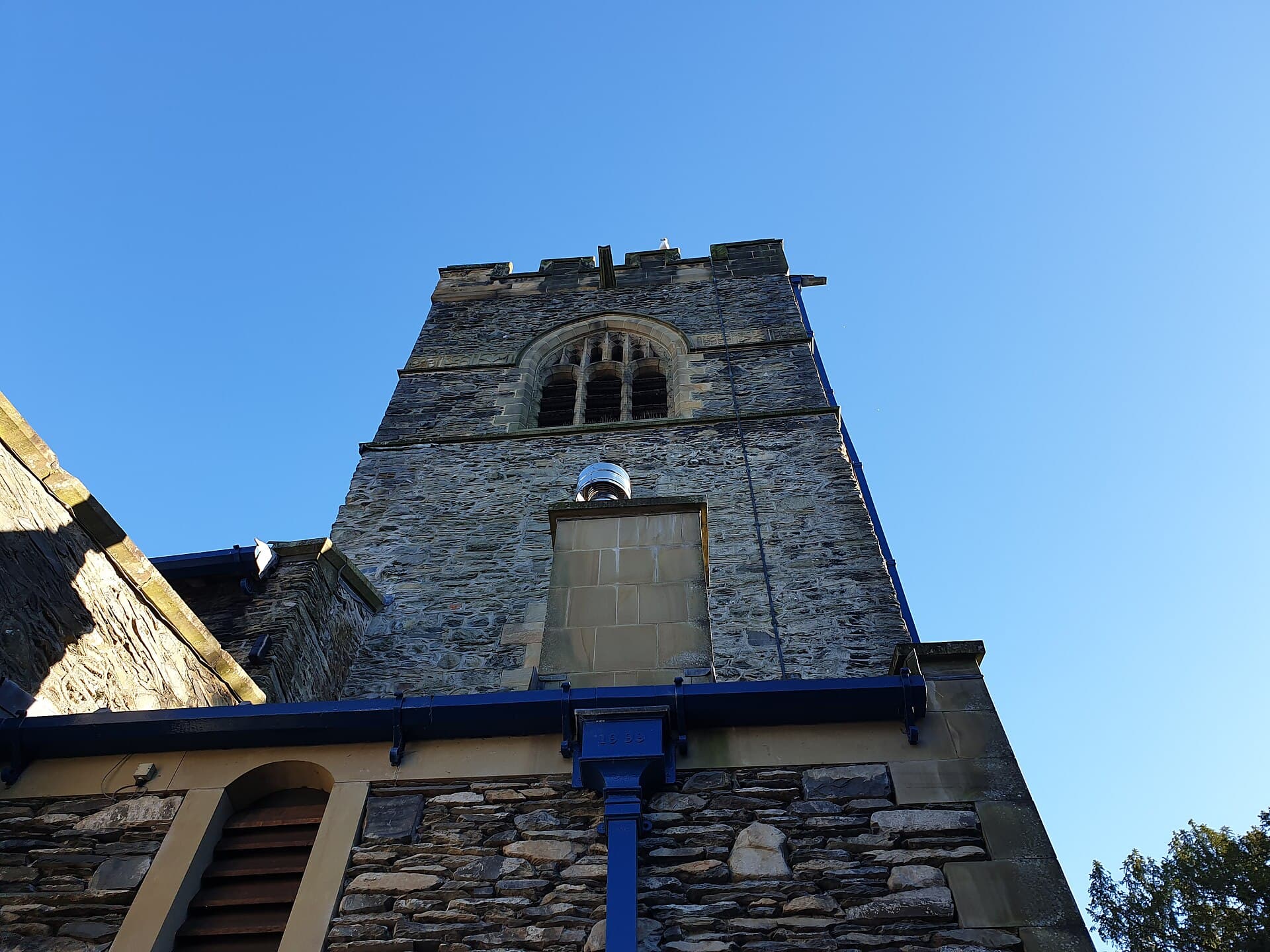
The church is built of slate rubble with sandstone dressings under lead roofs, with nave and chancel under a clerestory, aisles running the building's full length, south porch, north-east chapel and west tower. Hyde and Pevsner found the interior "a strange sight" — constructed entirely of thickly plastered, white-painted rubble, its square, chamfered piers "markedly tapered". The sandstone font that survived the 1480 fire may date from the twelfth century, a small octagonal bowl with heads carved at its corners on a later stem. At the tower's base stands a seventeenth-century wooden statue of St Martin dividing his cloak with the beggar. The marble reredos of 1870, by Bell and Almond, carries mosaics of the symbols of the Four Evangelists and the Passion, and before the lectern is a display case made by Arthur Simpson in 1907 in memory of the artist Dan Gibson, containing historic books including a Breeches Bible and two sixteenth-century chained Bibles. The memorials include a monument by the great sculptor John Flaxman to Richard Watson, Bishop of Llandaff (died 1816), a wall memorial of 1631, and others to the Fleming family. The Arts and Crafts screen to the south-east vestry, designed by Dan Gibson and carved by the vicar and parishioners of St John's, Windermere, came here when that church closed in 1995.
The east window is the treasure: stained glass of many periods, the oldest piece believed to date from 1260, much of the rest from the 1460s. The central three lights depict the Crucifixion flanked by saints, with kneeling figures below — benefactors, Augustinian canons and the prior of Cartmel Priory, from which the glass is thought to have been transferred. At the top are the arms of George Washington, whose ancestor John Wessington owned land at nearby Warton. Henry Hughes's restoration pieces of 1870 are each signed with the initials "HH". In the north aisle, the Carriers Arms window incorporates ancient glass with a carrier's emblems, commemorating Bellman of the leaden roof; elsewhere is glass by Ward and Hughes (1881), Powell's and A. K. Nicholson (both 1915), and Shrigley and Hunt in the memorial chapel (1920s). The painted texts on walls and beams include catechetical passages from Robert Openshawe's book of 1590 and, on an arch facing the lectern, a thanksgiving poem of 1629 for deliverance from the Gunpowder Plot. The three-manual organ of 1922 by Jardine and Company was rebuilt in 1964 by J. H. Cowan of Liverpool and restored in 1999, and the tower carries a ring of eight bells, all cast in 1872 by John Warner and Sons.
The churchyard tells its own stories of the age of empire. A Grade II listed tomb of 1822 commemorates Rasselas Belfield, a freed slave described on his headstone as "A Native of Abyssinia", thought to have been valet to Peter Taylor of Belfield house — while against the south aisle wall, in pointed historical counterpoint, lies a white veined marble slab to John Bolton, slave trader and plantation owner, who died in 1837. A South African War memorial of 1903 also stands in the churchyard of this lakeside church, where the centuries lie close together.
Plan a visit
Visiting hours & services.
Visitor information
St Martin's is the active Church of England parish church of Bowness-on-Windermere, Cumbria (Diocese of Carlisle), in the town centre near the lake. The Grade I church is open to visitors, who come for the medieval east window with glass from 1260 and the 1460s (including the Washington arms), the 12th-century font that survived the 1480 fire, chained Tudor Bibles, the Gunpowder Plot thanksgiving poem of 1629, and the freed slave Rasselas Belfield's tomb in the churchyard.
Where to find it
Location & contact.
In the neighbourhood
Nearby attractions.
Gallery
Sources
Where this record comes from.
This entry is reconciled from open data. Follow the sources to verify the details or suggest a correction.
Nearby