Plymouth, United Kingdom№ 000085422
St Mary's Church, Cattedown
- Founded
- 1911
- Tradition
- Anglican / Episcopal
- Architect
- Charles Nicholson
- Style
- Gothic Revival
About this place
History & significance.
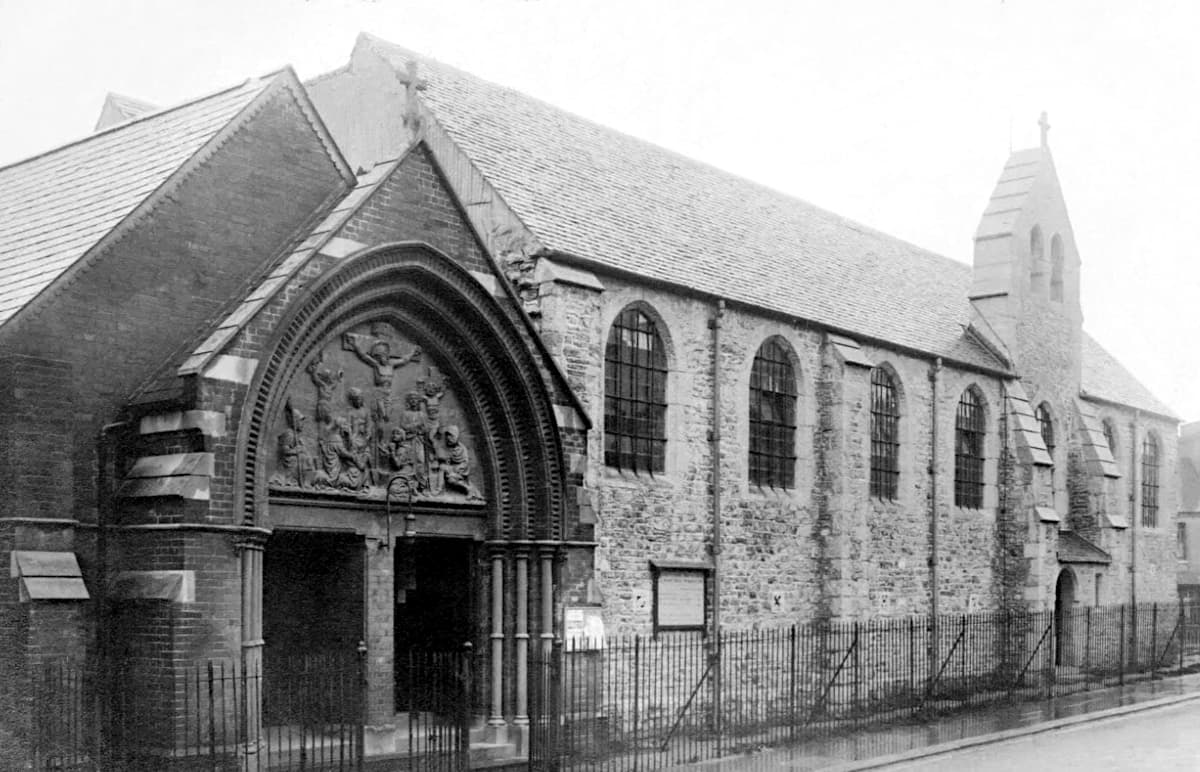
St Mary's Church, Cattedown — in full, the church of St Mary the Virgin and St Mary Magdalene — was a Church of England church in the industrial east end of Plymouth, Devon. Built in 1911–12 to designs by Sir Charles Nicholson, it served its dockside district for less than half a century, closed in 1956, spent decades as a warehouse and community hall, and was demolished in 2007–08. Its story is a compact history of twentieth-century urban church life: heroic Edwardian expansion, mid-century contraction, and slow disappearance.
The church was conceived to serve the rapidly growing industrial district of Cattedown, where late-Victorian housing had outstripped the capacity of St John's, the parish church of Sutton-on-Plym. In 1893 H. E. Tracey Elliot of James Terrace gave a site at the east end of Alvington Street, and the vicar, the Revd Wynell-Mayow, formed a building committee. His successor, the Revd C. H. Salt, carried the scheme forward, and by 1899 about £1,000 had been raised — enough for a temporary church seating 160, cleverly designed to become the west end of the eventual permanent building, with a temporary east wall built in anticipation. The Bishop of Crediton, Robert Trefusis, dedicated it on 13 February 1899, serving a new church district of some five thousand people. Its red-brick frontage carried a Doulting stone carving of the Crucifixion above the door, sculpted by Mr Trevennen and given by John Shelly, a former churchwarden of St John's.
The permanent church was designed by Sir Charles Nicholson, the prolific Edwardian church architect, with seating for 630: nave, chancel, north and south aisles, a small chapel in the south aisle, and vestries to follow. The first phase, built in 1911–12 by W. Cowlin and Sons of Bristol, cost £3,400 of an estimated £6,400 total. Mrs Trefusis cut the first sod on 1 July 1911 on behalf of the Bishop of Crediton, and the Bishop of Exeter, Archibald Robertson, laid the foundation stone on 9 September and consecrated the church on 6 May 1912 — an occasion marred by protesters outside objecting to the "alleged Ritualistic practices" of the vicar, the Revd W. Stevenson, and his curate. The new parish of St Mary's was carved from Sutton-on-Plym the following day. The church was the seventh built under Plymouth's Three Towns Church Extension Scheme, which covered a significant share of the cost, and the vestries were finally added by 1933. Architecturally it was a building of its moment: local limestone with granite buttresses and dressings under Delabole slate, a bell-cot over the south entrance — and, strikingly, no timber at all in the roof and groined ceiling, reinforced concrete being used instead, an early embrace of the new material.
The parish's life proved short. St Mary's closed for worship in 1956 and its territory was folded back into Sutton-on-Plym. From 1961 the Church Commissioners let the building for storage — to the South Western Electricity Board for many years, then from 1987 to the flooring wholesalers Christal Supplies. In 1989–90 part of the building found gentler use, converted at a cost of £35,000 into a combined church hall and community centre while the rest remained a warehouse. The end came on 12 June 2007, when the Church Commissioners approved demolition, carried out that December and January. A 2012 proposal for affordable housing on the site came to nothing, and in 2015 Western Power Distribution received permission to use the cleared ground as an overflow car park — a quiet end for a church built in the confident expansion of Edwardian Plymouth, and now remembered chiefly in photographs and parish records.
Plan a visit
Visiting hours & services.
Visitor information
St Mary's, Cattedown, no longer stands: the 1911-12 Charles Nicholson church closed for worship in 1956, served for decades as storage and a community hall, and was demolished in 2007-08. The site at the east end of Alvington Street in Plymouth is now used as an overflow car park; nothing of the church remains to visit, though its story is preserved in Plymouth's local archives.
Where to find it
Location & contact.
In the neighbourhood
Nearby attractions.
Sources
Where this record comes from.
This entry is reconciled from open data. Follow the sources to verify the details or suggest a correction.
Nearby