City of Portsmouth, United Kingdom№ 000062685
St Mary's Church
- Founded
- 1164
- Tradition
- Anglican / Episcopal
- Architect
- Arthur Blomfield
- Style
- Gothic Revival
About this place
History & significance.
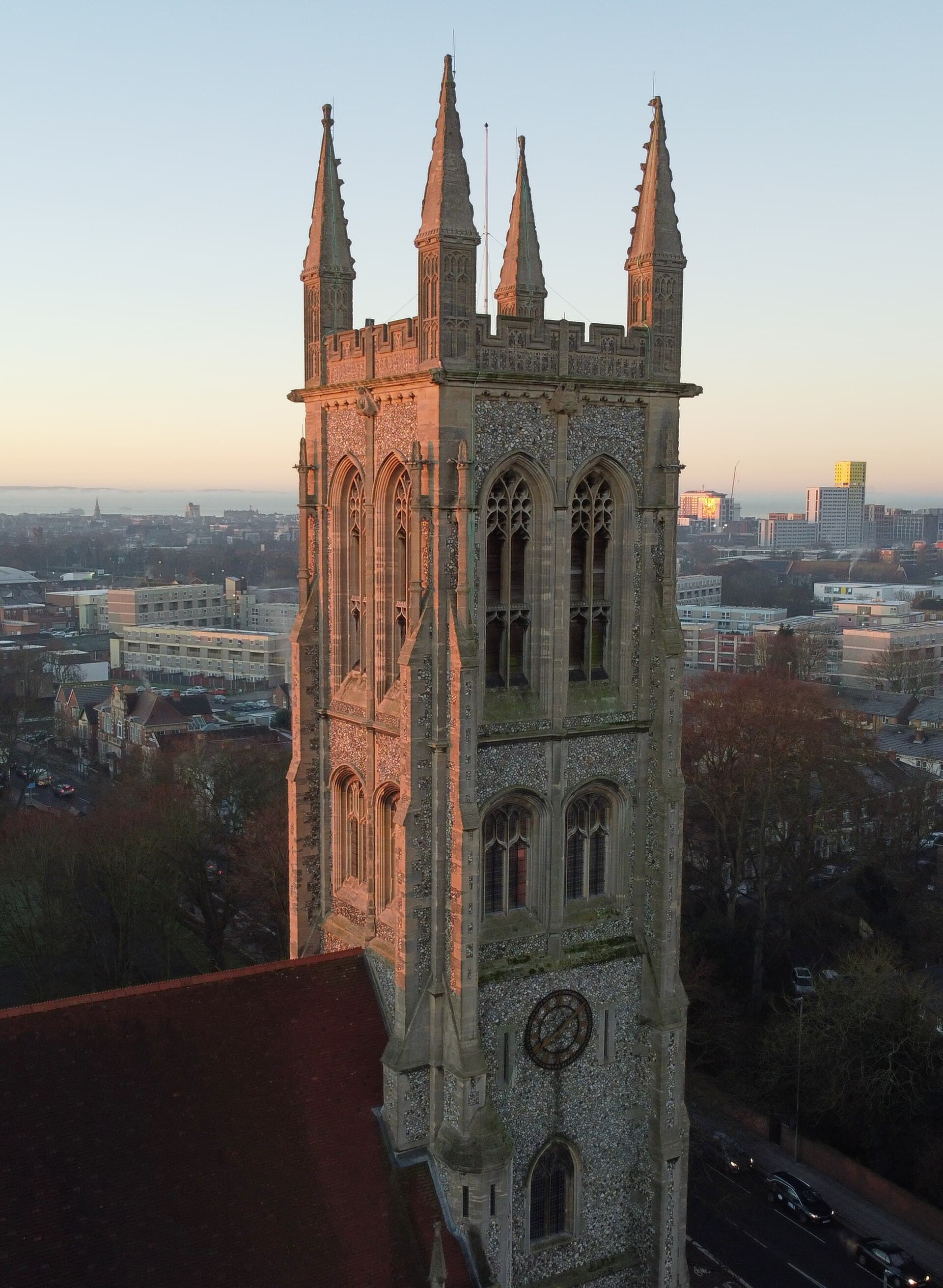
St Mary's Church, Portsea, is the main Church of England parish church for Portsea and Fratton in Portsmouth, standing on the oldest church site on Portsea Island. The present building, among the largest parish churches in the country and described as the "finest Victorian building in Hampshire", is at least the third church on the site, a Grade II* listed landmark whose 167-foot tower made it the highest building in Portsmouth on completion. Its former regular worshippers include Charles Dickens, Isambard Kingdom Brunel and Cosmo Gordon Lang — the last of whom served here as vicar before rising to the throne of Canterbury.
The site's history predates Portsmouth itself, generally reckoned founded in 1181 by Jean de Gisors: in 1164 the Norman lord of the manor, Baldwin de Portsea, informed Henry de Blois, Bishop of Winchester, that he was giving the church of St Mary, with land, cattle, sheep and hogs, to the prior and canons of Southwick Priory, proving a church already stood here, while Domesday records thirty-one families in what is now Buckland, Copnor and Fratton. Little is known of that early church beyond its low dormered roof and a tower added in Tudor times, and until the nineteenth century it stood among farms and fields. As the dockyard and population grew, a gallery with box pews was squeezed in, then in 1843 a new church in the Early English style by Thomas Ellis Owen, incorporating the Tudor west tower, was built for £5,000. It lasted barely four decades: dark, ill-ventilated and, gallingly, smaller than the newly built Roman Catholic cathedral, it was demolished in 1887.
The present church owes its grandeur to an anonymous benefactor. The vicar, Canon Edgar Jacob, had planned to raise £15,000, but an unnamed Portsmouth resident offered to double whatever the parish raised, and grander plans went to Sir Arthur Blomfield, architect to the Diocese of Winchester, who set out to build "the chief parish church of a great town". The Princess Royal laid the foundation stone on 9 August 1887, the church was consecrated by Bishop Harold Browne of Winchester on 20 October 1889 at a final cost of £44,000, and only at the donor's death in 1891 was the secret revealed: he was W. H. Smith, First Lord of the Admiralty and head of the newsagent dynasty, who had given £28,000 in all. The new church could contain the entire footprint of its predecessor within its walls. Built of flint with Bath stone dressings in the Neo-Perpendicular style, 210 feet long, it has a six-bay aisled nave under a spectacular oak hammerbeam roof with gilded bosses, a chancel vaulted in wood and then stone, an alabaster font from Staffordshire, a Hamstone pulpit of "exceptional size", and the great four-stage west tower with corner pinnacles, likely inspired by the church towers of East Anglia, that overtopped every building in Portsmouth until the Guildhall rose in 1890. The west window commemorates W. H. Smith, and a royal coat of arms of 1822 survives from the medieval church.
The church has survived arson and bombs. On 25 August 1894 intruders crumpled the altar cloth, poured spirits and turned on the gas, but the fire burnt out before taking hold. When the Diocese of Portsmouth was created in 1927, St Mary's was proposed as pro-cathedral, but its commitment to the area's many mission churches told against it, and St Thomas's became the cathedral, needing to be doubled in size before it matched St Mary's. In the Portsmouth Blitz, on 24 August 1940, two bombs narrowly missed the church, falling on Woodland Street immediately behind; the shockwave shattered most of the great seven-light east window, boarded with wood until new glass came in 1952. A £700,000 restoration of the tower in 2008-09, supported by English Heritage, required one of the largest suspended scaffolds in the world at the time.
The roll of vicars is extraordinary for a parish church: Edgar Jacob became Bishop of Newcastle and then St Albans; Cosmo Gordon Lang, vicar from 1896 to 1901, became Archbishop of York and then of Canterbury, crowning George VI; Cyril Garbett, vicar from 1909 to 1919, became Archbishop of York in his turn; and Freddy Temple, of the great clerical dynasty, later Bishop of Malmesbury, served in the 1960s. The organ, by J. W. Walker and Sons from 1888, was designed from the outset to cathedral proportions and, with 2,622 pipes, is among the largest and finest in any parish church on the South Coast, completed in 1892 by a gift from W. H. Smith's widow; its solid oak case and screen of 1901, carved with images of the church itself, is a memorial to the dead of the Boer War, dedicated to the strains of Chopin's funeral march. After a make-do overhaul in 1965, for which the vicar enlisted John Betjeman among his fundraising allies, the organ finally received the most comprehensive restoration in its history from 2020 to 2023, backed by a £764,000 National Lottery Heritage grant, the pipework sent to Nicholson and Company of Malvern to be returned to its original Victorian condition, with a replica of the original console.
The bells tell their own tale of triumph over difficulty. A peal of six was cast by Lester and Pack of Whitechapel in 1764 for the old Tudor tower; four came across in 1889 to join four new Whitechapel bells in a ring of eight hung seventy feet above the ringing chamber, of "remarkable depth of tone" but so hard to ring, with elastic ropes, swaying tower and a staircase crossing the rope paths, that the consecration-day band gave up their peal attempt through "sheer exhaustion". By 1932 the bells were unringable, and the parish too poor to mend them, until Mr F. Hopkins of the Barron Bell Trust gave the entire cost of recasting: John Taylor of Loughborough recast all eight, rehung them twenty-five feet lower in a new cast-iron frame behind soundproofed windows, so that the sound travels up and out rather than down onto the street, and the result, dedicated on 8 April 1933, was hailed in The Ringing World as "nothing short of excellent" and "amongst the finest peals of eight in existence". More than two hundred full peals have been rung since, by visiting bands and the Portsmouth District ringers. The church even has a namesake on the far side of the world: St Mary's Anglican Church at Busselton in Western Australia is named after it. Amid the dense terraced streets of Fratton, the great flint church that Smith's fortune built remains exactly what Canon Jacob and Blomfield intended: the chief parish church of a great town.
Plan a visit
Visiting hours & services.
Visitor information
St Mary's is an active parish church with regular Sunday and midweek services; visitors are welcome and entry is free. The hammerbeam roof, the W. H. Smith memorial west window, the Boer War organ screen and the celebrated 1933 Taylor bells — rung by the Portsmouth District ringers — are the highlights of what's been called the finest Victorian building in Hampshire, with the restored Walker organ back in voice after its 2020-23 restoration.
Where to find it
Location & contact.
In the neighbourhood
Nearby attractions.
Gallery
Sources
Where this record comes from.
This entry is reconciled from open data. Follow the sources to verify the details or suggest a correction.
Nearby