City of Southampton, United Kingdom№ 000061381
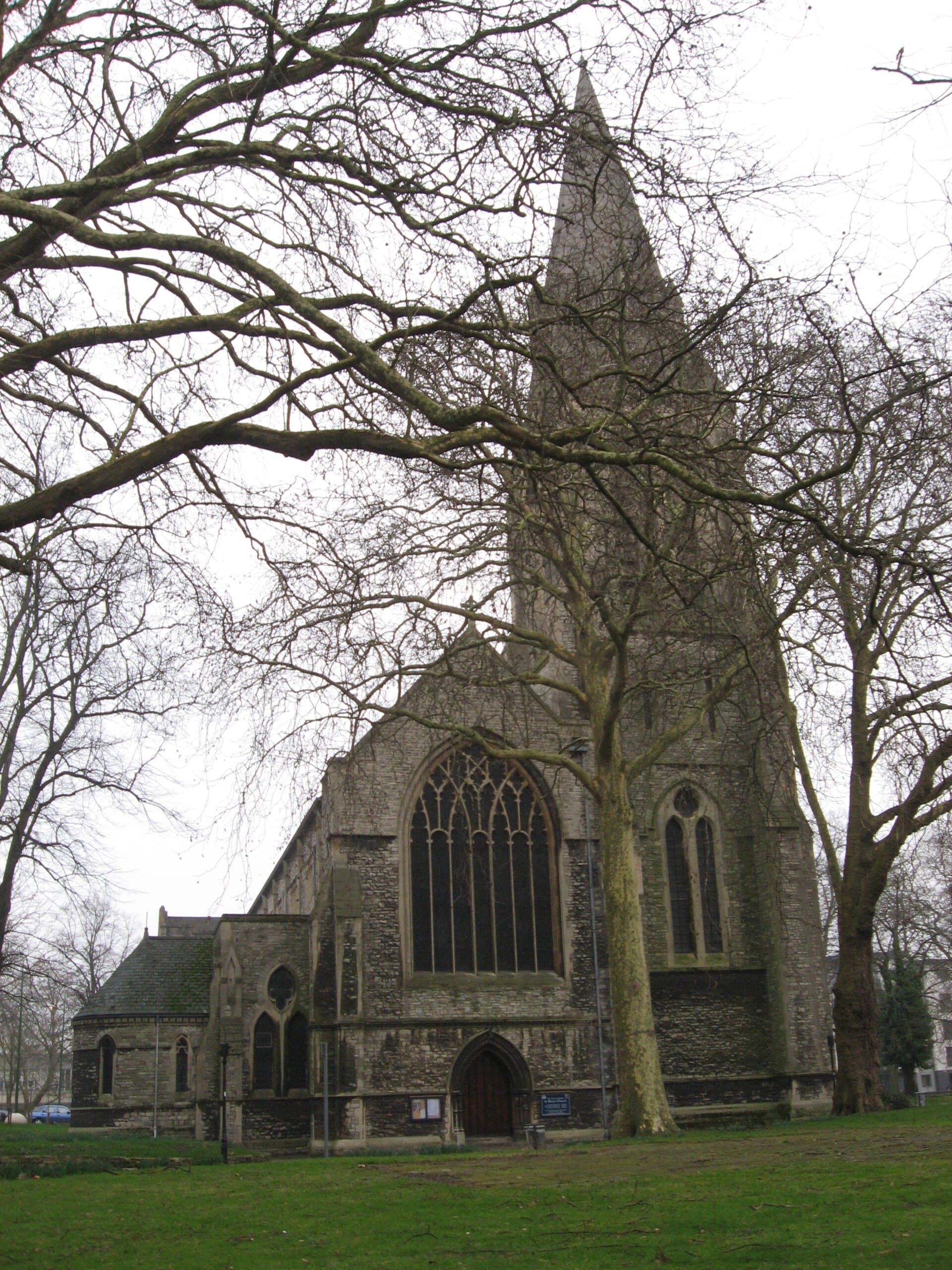
St. Mary's Church, Southampton
- Founded
- 1884
- Tradition
- Anglican / Episcopal
- Architect
- George Edmund Street
- Style
- English Gothic
About this place
History & significance.
St Mary's Church is the civic and mother church of Southampton, the tallest and largest church in the city, whose 200-foot tower and spire make it the loftiest church in all Hampshire and the landmark after which St Mary's Stadium, home of Southampton Football Club, is named. The present building is the sixth church to stand on this ancient site: founded around 634, destroyed in the Southampton Blitz of 1940, and rebuilt between 1954 and 1956 around the surviving Grade II listed tower and spire of 1912-14. Its bells are world-famous in their own right, having inspired the song "The Bells of St. Mary's", recorded by Frances Alda in 1919 and immortalised by Bing Crosby; and its football team, founded by a curate, grew into "The Saints" themselves.
The first church is believed to have been founded around 634, coinciding with the visit of St Birinus to the Saxon port town of Hamwic on his mission to reconvert England to Christianity. This small Saxon building controlled a great swathe of the town from the River Itchen to present-day Northam, but during the reign of King Canute the settlement shifted to the site of modern Southampton near the confluence of the Test and Itchen, and the old port and its church were abandoned. The second church rose in the twelfth century: according to Leland's chronicle of 1546, its reconstruction was ordered by Queen Matilda, wife of Henry I, the old building having decayed except for a small chapel of St Nicholas kept in use. Dedicated to Our Lady Blessed Virgin Mary and known as the "great church", it stood outside the city walls yet claimed precedence over every church within them, a claim disputed in the thirteenth century until the Bishop of Winchester sent his representative Adam de Hales to hold an enquiry, after which the priests of St Michael, Lawrence, John, Andrew, All Saints and Holy Trinity swore an oath that St Mary's was the mother church. In 1549 much of the church was destroyed by order of the government commissioners, most likely to punish the rector, William Capon, for resisting the confiscation of church lands; the Court Leet directed that the rubble be used to build a new road from Bargate, and only the chancel survived, leased with the estates in 1551 to Robert Reniger, a former Sheriff of Southampton, on condition that the rector receive £18 a year.
The third and fourth churches were Georgian works of necessity. After years of failed efforts by Doctor Clutterbuck, his successor Ralph Brideoake built a new nave in 1711 for £920 and rebuilt the chancel in 1723 for £400. As Southampton's population passed ten thousand by the census of 1801, the rector Francis North remodelled and expanded the building, adding external aisles and internal galleries, and the church was reconsecrated in 1833 by Charles Sumner, Bishop of Winchester. But the docks opened in 1838, the population nearly tripled to over sixty thousand by 1861, and the cheaply built church aged badly; Bishop Samuel Wilberforce, whose son was the rector, campaigned strongly for replacement. When the bishop died unexpectedly in 1871 the rebuilding became his memorial. His son William commissioned the eminent George Edmund Street, who condemned the entire structure and designed its successor. The Prince and Princess of Wales, the future Edward VII and Queen Alexandra, laid the foundation stone with their children on 12 August 1878, and the partially completed church was consecrated on 21 June 1879 with sermons from the Archbishop of Canterbury in the morning and the Archbishop of York in the evening, believed to be the only occasion in the history of the Church of England that both archbishops have preached in the same church on the same day. Street died in 1881, but the church was completed to his plan by 1884, all except the upper tower and spire, which waited thirty years until Canon Lovett saw them built to Street's design in 1912-14, the rector himself placing the weathervane on the spire on 5 January 1914.
The tower had hardly been finished when it gained its bells, thanks to a donation of nearly £1,000 from Mary Ann Wingrove in memory of her husband Robert: a fine-toned ring of eight from John Taylor and Company of Loughborough, cast in 1914, whose first full peal of 5,040 changes of Grandsire Triples in January 1916 commemorated the fallen of the First World War. It was these bells, ringing across the Itchen, that Douglas Furber and the Australian composer A. Emmett Adams heard while waiting for their ocean liner, inspiring "The Bells of St. Mary's", which crossed to America in 1917 and achieved international fame when Bing Crosby recorded it in 1946 for the film of the same name. The ring was augmented to ten in 1933 by the Barron Bell Trust.
On the night of 30 November 1940 the Luftwaffe's most severe raid on the port city struck St Mary's with incendiaries, and despite the efforts of the rector and his team, fire consumed most of the structure; morning found the church ruinous except for the tower, spire and conical baptistery, gutted internally, with the treasures, stained glass, roofs and fittings destroyed. The fire, fanned into the tower, wrecked the bells, one falling through two floors into the ringing chamber. The council's offer of a new site was declined, and under Canon Spencer Leeson the parish restored the tower and spire between 1945 and 1948 as a sign of hope, the recast bells, the first ring in the country destroyed by enemy bombing to be restored, ringing again at a service held in the ruins on 20 June 1948. The body of the church was rebuilt from February 1954 to June 1956 by the architect Romilly Craze, keeping Street's ground plan, lower walls and window designs but with modern influences, and rededicated on 12 June 1956 before fourteen hundred worshippers. The result is an exterior best described as Neo-Cistercian, the work of three hands: Street's lower walls, Craze's upper walls, and the tower and spire executed by Street's son Arthur to his father's design. Pevsner, critical of the rebuilt body, called the tower and broach spire a splendid composition and one of the finest Victorian steeples in England.
Inside, the church is lofty, spacious and deliberately plain, seven bays long under a roof open to the rafters on great arches. The conical baptistery, with its blue and gold quadripartite vault, is the only interior space besides the tower to survive unaltered from before the bombing, and keeps all five of its original Clayton and Bell windows depicting Moses, Christ, Noah and Philip. The principal modern windows include Gerald Smith's seven-light west window of Christ in Majesty and his east window lancets of post-Resurrection scenes, the south transept's lancets and rose by James Clark and Eaton, and Christopher Webb's St Barnabas in the north transept. The Seafarers' Chapel in the north chancel aisle honours the port's seafaring history, hung with the house flags of the shipping companies that used Southampton, with a ship's binnacle for a lectern and Smith's window of Christ above modern ships; and in May 2018 a memorial window for the centenary of the Titanic disaster, created by Louise Hemmings, was installed, an angel rising from the waters above 669 coloured orbs, one for each Southampton life lost, over the words from the Song of Solomon, "many waters cannot quench love". The organ in the south chancel aisle, a substantial Henry Willis instrument of 1956 incorporating pipework from 1883, has 3,383 pipes and 61 speaking stops over three manuals and pedals, among the largest and finest of any church on the South Coast, replacing the Willis of 1878-84 lost in the fire.
The church's most famous offspring wears red and white. In 1880 the curate, Reverend Arthur Baron Sole, founded a church football team on the Deanery field; refounded in 1885 by the St Mary's Church of England Young Men's Association, it became St Mary's F.C., then Southampton St Mary's on joining the Southern League in 1894, and finally, after winning the league title in 1896-97, Southampton F.C., keeping its ecclesiastical roots alive in the nickname "The Saints"; from 1887 to 1896 the church was even the club's landlord at the Antelope Ground. The church itself was renewed once more in 2018 with an £800,000 renovation and a church plant from Holy Trinity Brompton, its worship now in the charismatic evangelical tradition, the sixth church on Birinus's ancient site still gathering the city it has mothered for nearly fourteen centuries.
Plan a visit
Visiting hours & services.
Visitor information
St Mary's is Southampton's civic church, now a lively charismatic evangelical congregation following its 2018 renewal with Holy Trinity Brompton, with Sunday services and midweek activities open to all. Visitors can see the 200-foot tower and spire — the tallest in Hampshire — the Titanic memorial window with its 669 orbs for the Southampton lives lost, the Seafarers' Chapel hung with shipping-line flags, and hear the famous bells that inspired 'The Bells of St. Mary's'. Entry is free.
Where to find it
Location & contact.
In the neighbourhood
Nearby attractions.
Gallery
Sources
Where this record comes from.
This entry is reconciled from open data. Follow the sources to verify the details or suggest a correction.
Nearby