West Chiltington, United Kingdom№ 000062714
St Mary's Church, West Chiltington
- Founded
- 1101
- Tradition
- Anglican / Episcopal
- Style
- Norman
About this place
History & significance.
St Mary's Church is the Grade I listed Anglican parish church of West Chiltington, a village in the Horsham district of West Sussex, and the acknowledged "showpiece" and "most attractive part" of its Wealden village. Built in the first half of the twelfth century, it keeps an exceptional collection of medieval features — among them what may be Sussex's oldest porch, a "fantastically long" hagioscope or squint, and one of the county's most extensive schemes of medieval wall paintings. In the Sussex volume of The Buildings of England, Ian Nairn wrote that the church's appearance gives "a very happy, unexpected effect, like a French village church", and the first Lord Ponsonby of Shulbrede went further: "if it was in Italy, people would make pilgrimages to it".
The Domesday Book of 1086 records a church in the village, then called Cilletone, and though it is uncertain whether anything of that building survives in the present church, Nairn suggested the nave and chancel walls are "probably 11th-century", and the Saxon building almost certainly stood on the same site. The present church is of the "Transitional Norman" period of 1100–1150, when Norman architecture was giving way to Early English Gothic. The three-bay south aisle was added around 1200, the chancel arch being of similar age; a chantry chapel followed in the early thirteenth century, set in the angle of the chancel and south aisle, and another chapel was built on the chancel's south side a century later. The oak-shingled spire of 1602 rests partly on the masonry of the old bell turret and partly on the east wall of the nave. The church was restored between 1880 and 1882 by the Steyning architect Charles Dalby. Curiously, the dedication to St Mary was unknown until the discovery of a will of 1541, in which John Sayrle asked to be "buried in the churchyard of Our Lady of Chiltington" — a churchyard that documents record as holding more than 3,700 burials.
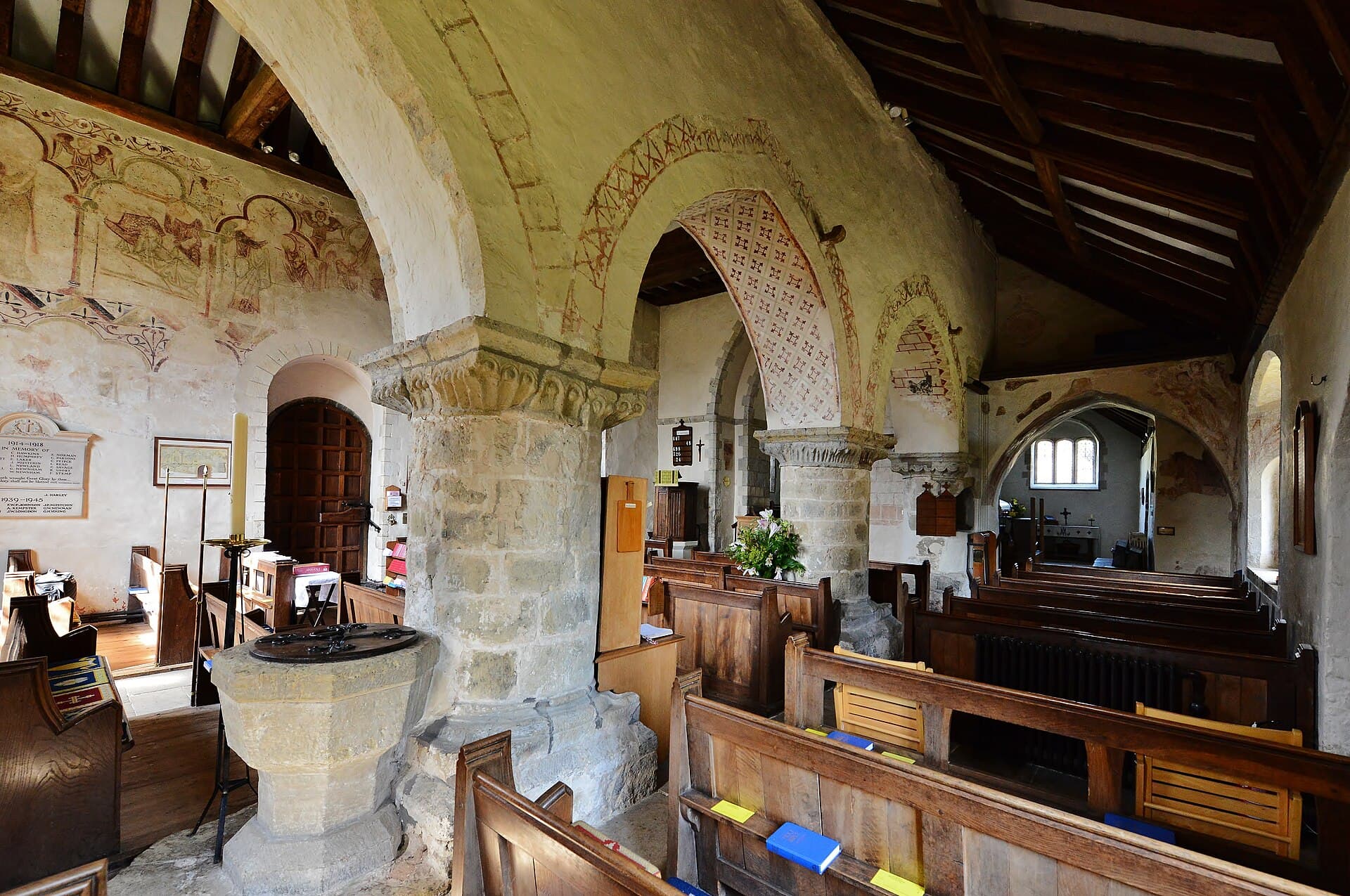
The architecture is full of incident. The chancel arch takes the form of two arches, one inside the other, contrived to carry the five-foot-thick east wall that supports the belfry. The pointed arches of the south arcade rest on round piers with varying capitals, and two round-headed Norman windows survive — the west window of the south aisle and the centre window in the chancel's north wall — while the chancel east window holds the church's only stained glass. The most famous feature is the hagioscope: about nine feet long and resembling a tunnel, it runs from the south aisle into the chancel through one of the arcade pillars and the chancel arch, allowing worshippers in the aisle to see the bread and wine consecrated at the Eucharist — exceptionally long even among England's many medieval squints. The roof is laid with Horsham slabs, the local stone slates common to churches in the district.
The wall paintings are the church's greatest treasure. Uncovered in 1882, treated by Professor Tristram in 1931 and later preserved by Mrs Eve Baker, they date from the twelfth to fourteenth centuries — and Nairn observed that "the ensemble can still give a ghostly echo of the original effect". The oldest significant painting, uncovered as recently as 1967, is a medallion at the east end of the south aisle with a central cross formed of an endless knot of rope, and the aisle also keeps twelfth-century angels and Apostles. The nave carries two thirteenth-century biblical cycles: Passion scenes along the south wall — the Entry into Jerusalem, the Last Supper, Christ washing the disciples' feet, the Betrayal, the Flagellation, Christ carrying his cross, the Crucifixion and the angel at the tomb — and Nativity scenes on the north, with the Annunciation, the Visitation, the Nativity itself, and an angel and shepherd. Fourteenth-century decorative designs adorn the easternmost pillar of the south arcade and the soffits of its arches. Most intriguing of all, in the splay of the north nave window, is a fourteenth-century painting of Christ standing on a wheel, arms raised to display his wounds, surrounded by the tools of different trades — tailor's shears, a butcher's cleaver, a carpenter's square, a weaver's shuttle, even two dice above his right shoulder. Found in many medieval English churches and long debated, the subject has been conclusively identified as a warning against Sabbath-breaking: to work on Sunday is to inflict new wounds on Christ.
The bells carry the parish's history in bronze. A survey of 1864 recorded four bells, each thirty-four and a half inches across: the first inscribed Iohannes Xpi Care with an armorial shield; the second reading "our hope is in the lord" over the initials and date "r e 1602"; the third naming two seventeenth-century churchwardens in their old spellings — "Iohn Broker Edward Ivpp Chvrch Wardens 1665"; and the fourth inscribed "Roger Tapsel" with the date 1626 — a name that echoes the Tapsel gates unique to Sussex churchyards. A 1960s survey recorded that the 1602 bell had been recast by Mears & Stainbank, who also supplied a new bell of 1950 inscribed "hear my prayer o god", commemorating — as a brass plate confirms — the late John Junius Morgan, formerly of Spod Shitterton Nyetimber.
St Mary's was listed at Grade I on 15 March 1955, one of just thirty-eight buildings of exceptional interest in the Horsham district as of 2001. Its extensive parish covers the rural area around West Chiltington village together with the larger suburban village of West Chiltington Common and the hamlets of Gay Street, Broadford Bridge and Coneyhurst. Worship stands in the traditional catholic stream of the Church of England: Sunday brings a 1662 Book of Common Prayer Holy Communion at 8 am and a Sung Parish Mass at 10; Wednesday has Exposition of the Blessed Sacrament and a BCP Communion; Thursday the Rosary and a said Mass. The church is open daily for visitors, and on the first Thursday of each month the church hall hosts "The Village Cafe – Refresh!", offering free tea, coffee and cake and "a time to talk and be refreshed" — hospitality as much a part of this church's nine centuries as its painted walls.
Plan a visit
Visiting hours & services.
Visitor information
St Mary's is open daily for visitors, with Sunday worship at 8 am (BCP Holy Communion) and 10 am (Sung Parish Mass), plus Wednesday and Thursday services. The medieval wall paintings — including the rare Christ of the Trades — and the nine-foot squint are the great sights, and the free Village Cafe runs in the church hall on first Thursdays.
Where to find it
Location & contact.
In the neighbourhood
Nearby attractions.
Gallery
Sources
Where this record comes from.
This entry is reconciled from open data. Follow the sources to verify the details or suggest a correction.
Nearby