Portslade, United Kingdom№ 000062855
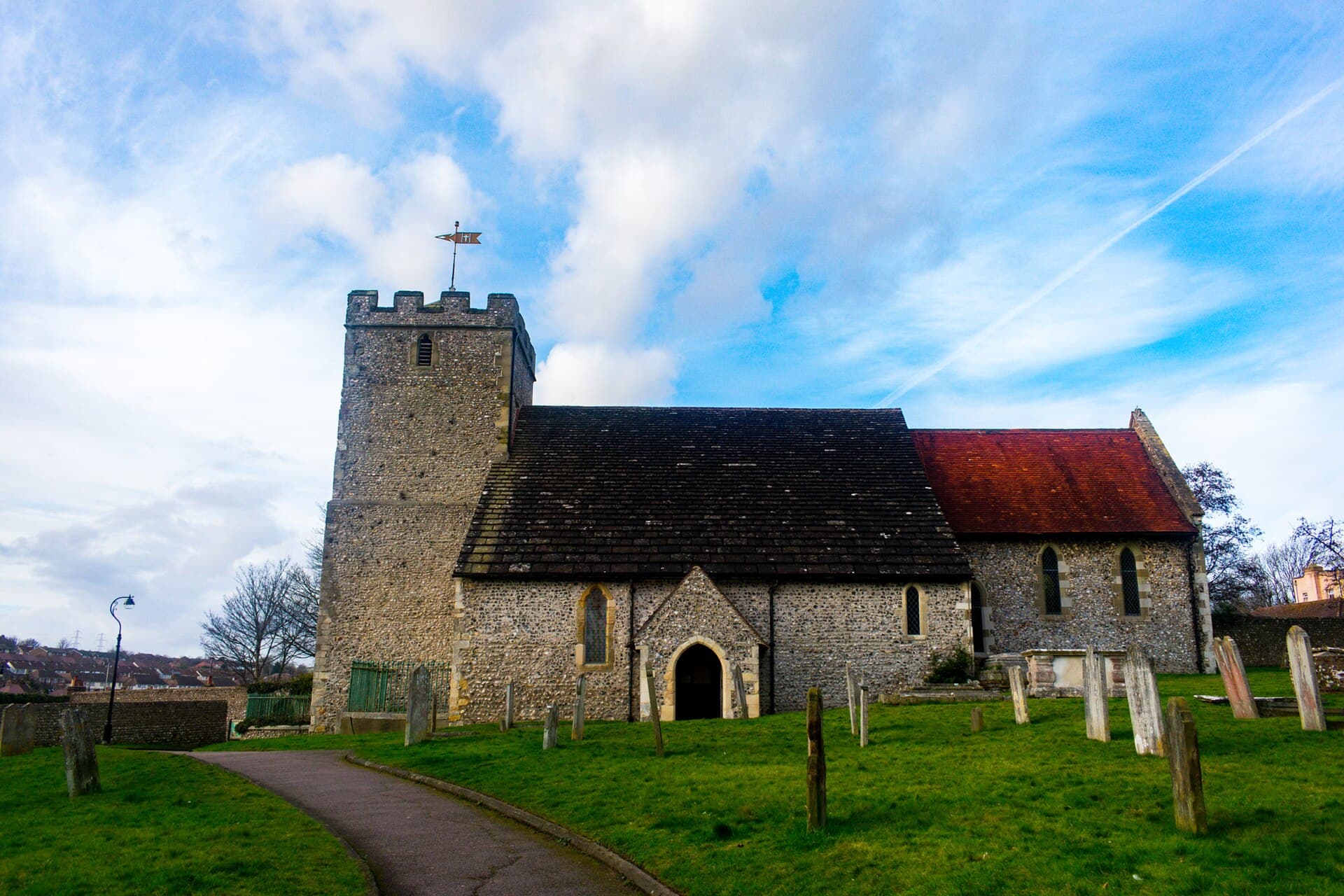
St Nicolas Church, Portslade
- Founded
- 1150
- Tradition
- Anglican / Episcopal
- Style
- Norman
About this place
History & significance.
St Nicolas Church serves the old village of Portslade, the historic inland settlement now absorbed into the city of Brighton and Hove, set apart from the Victorian streets of Portslade-by-Sea below. With twelfth-century origins, it is one of southern England's hall churches, and it holds a quiet distinction among the ancient churches west of Brighton: while St Andrew's at Hove, St Leonard's at Aldrington, St Helen's at Hangleton and St Peter's at West Blatchington all fell at some point into ruin, St Nicolas has never ceased to stand and serve. Portslade was originally the most populous and important of these villages, and its church's unbroken history reflects that early consequence.
A Roman road once ran north–south through the area — Samian ware has been found nearby, and neighbouring Southwick had a Roman villa — but the village itself is a medieval creation, its manor house and church built close together in the twelfth century. The first church comprised a chancel, a nave with a south aisle, and a square west tower; the nave, aisle and lower tower came first, with characteristically Norman twin pillars of Caen stone, their capitals carved with scallop designs. The chancel, with its chamfered Norman arch, and the tower's upper stage followed in the early thirteenth century; the battlemented bell tower was added in the fourteenth, and the south porch probably by the sixteenth. The turreted tower, built of coursed stone rubble unlike the random rubble of the main walls, rises in its three historical layers without a single buttress.
The Victorians both rescued and inadvertently destroyed parts of the church's heritage. In 1847 medieval wall paintings of the Last Judgement were uncovered in the nave — the vicar wrote an illustrated article for an archaeological journal attributing them to about 1440 — but they were then whitewashed over and lost. A north aisle was added in 1849, wider than but similar to its medieval counterpart. The thirteenth-century sedilia and piscina on the chancel's south wall survive in restored form, joined by a stone pulpit, a modern altar, and a reredos and panelling of 1921. Most windows are lancets, some thirteenth-century, with the east end formed of two tall narrow lancets beneath a sexfoil; stained glass depicts St Francis of Assisi and St Nicolas, and a small 1946 window in the tower by the local designers Cox & Barnard commemorates the former verger A. C. Wheatland.
The church's most flamboyant element is the Brackenbury Chapel at the west end, built between 1869 and 1874 by Hannah Brackenbury over her family's vault. In deliberate contrast to the plain old church, the chapel is built of knapped flint and finished with elaborately carved wood, stonework and black and green marble, with a three-light lancet window bearing the family arms and a marble tomb at its centre. Hannah Brackenbury, who was buried there on her death in 1873, was a formidable philanthropist: a benefactor of local causes — she gave the land and money for Portslade's Gothic primary school of 1872 — and of Balliol College, Oxford, where a debating society and a building at the college entrance still carry her name.
The church faced a peculiar structural crisis in 1959. Its roof of heavy stone slabs had not only sagged but had shifted a full foot out of position under its own weight, despite substantial wooden king posts. For most of that year a jack anchored beneath the chancel arch slowly winched the roof back into place — patient engineering for a patient building — while a vestry and organ gallery were added.
St Nicolas was listed Grade II* on 19 July 1950. Its parish has grown around it: St Andrew's Church on Church Road in Portslade-by-Sea, designed by the Brighton architect Edmund Scott and built in 1863–64, gained its own parish in 1898 but was reunited with St Nicolas and reduced to a chapel of ease in 2013, when the two were joined with the Good Shepherd, Mile Oak, to form the Parish of Portslade and Mile Oak — covering the seaside streets, the old village and a stretch of the South Downs. Services are held daily, with two or three each Sunday, in a church that has watched over Portslade for nearly nine hundred years.
Plan a visit
Visiting hours & services.
Visitor information
St Nicolas is an active Church of England parish church in Portslade Old Village, Brighton and Hove, at the heart of the Parish of Portslade and Mile Oak. Grade II* listed with 12th-century Caen-stone arcades, a three-layer medieval tower and the ornate Victorian Brackenbury Chapel, it holds daily services with two or three on Sundays, and visitors are welcome.
Where to find it
Location & contact.
In the neighbourhood
Nearby attractions.
Gallery
Sources
Where this record comes from.
This entry is reconciled from open data. Follow the sources to verify the details or suggest a correction.
Nearby