City of London, United Kingdom№ 000060133
St Olave Hart Street
- Founded
- 1250
- Tradition
- Anglican / Episcopal
- Style
- Perpendicular Gothic
About this place
History & significance.
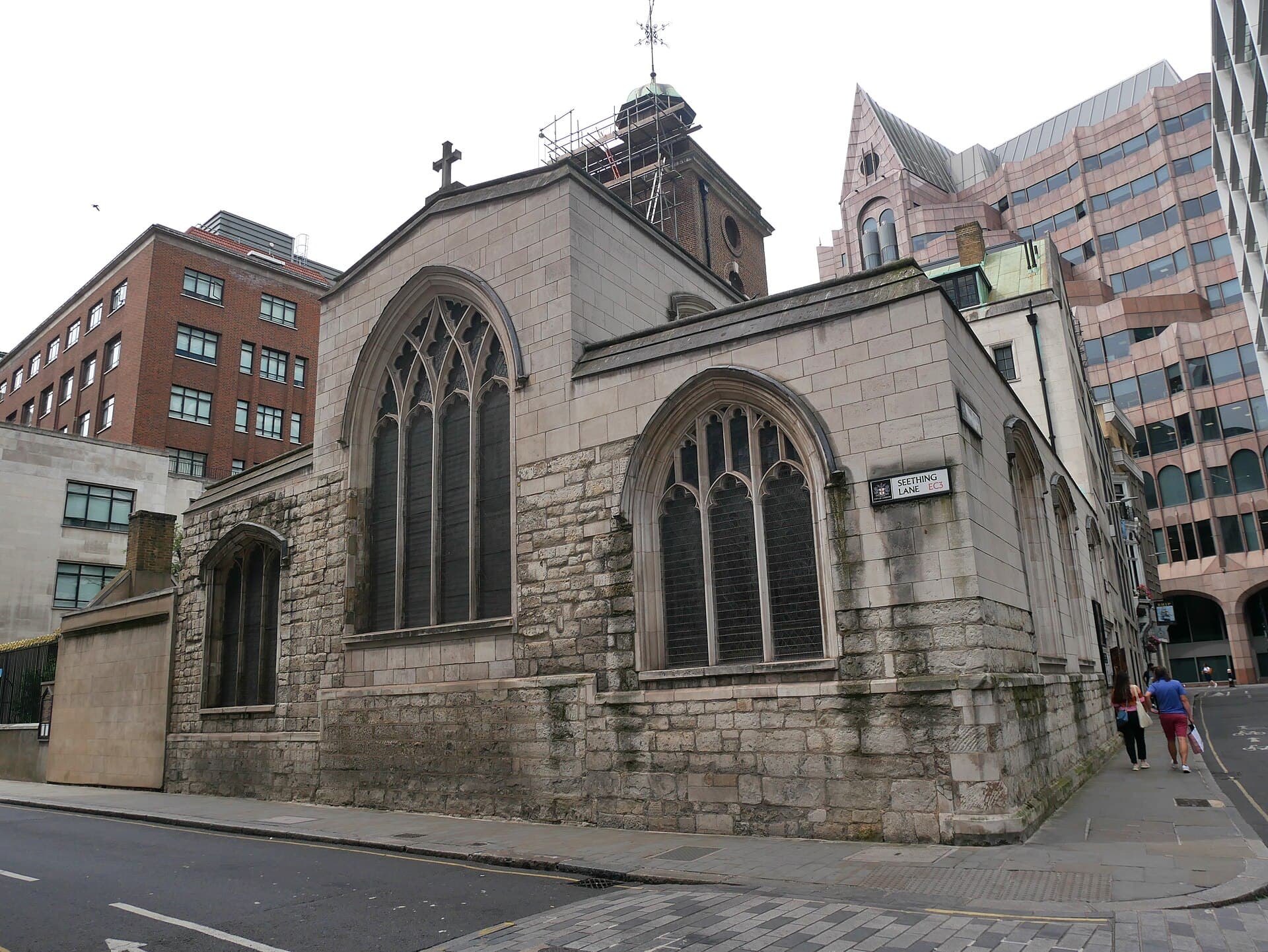
St Olave Hart Street is one of the great survivors among the churches of the City of London: a small medieval parish church on the corner of Hart Street and Seething Lane, near Fenchurch Street station, that escaped the Great Fire of 1666, sheltered a king in exile, and keeps within its walls the graves of Samuel Pepys and his wife. The poet John Betjeman called it "a country church in the world of Seething Lane", and it remains one of the smallest churches in the City — and one of only a handful of medieval City churches to have come through the Great Fire. Besides serving its parish, St Olave's is the Ward Church of the Tower Ward of the City of London, and it has long and historic ties to Trinity House and the Clothworkers' Company.
The church is first recorded in the thirteenth century as St Olave-towards-the-Tower, a stone building replacing what was presumably a wooden predecessor. The dedication is to King Olaf II, patron saint of Norway, who fought beside the Anglo-Saxon King Æthelred the Unready against the Danes at the Battle of London Bridge in 1014 and was canonised after his death in 1028; the church is said to stand on the site of the battle itself. Nine centuries later the Norwegian connection came full circle: King Haakon VII of Norway worshipped at St Olave's from 1940 to 1945, while his country lay under Nazi occupation. The church was rebuilt in the thirteenth century and again in the fifteenth, and the present building dates from around 1450. According to John Stow's Survey of London, a major benefactor in the late fifteenth century was the wool merchant Richard Cely the elder, who held the advowson of the church and at his death in 1482 left money for the steeple and an altar; the merchant mark of the Cely family — famous for the Cely Letters of 1472–88, one of the great archives of medieval English trade — was carved into two corbels of the nave and survived until the bombs of the Second World War.
The Great Fire of 1666 stopped just short of the church, and the salvation was no accident. Sir William Penn — father of the William Penn who founded Pennsylvania — brought men from the nearby naval yards and ordered the houses around the church blown up to make a firebreak. The flames came within a hundred yards or so before the wind changed, sparing St Olave's and a cluster of churches on the eastern edge of the City.
It is Samuel Pepys, though, who gives St Olave's its most beloved associations. The diarist's house and his Navy Office both stood on Seething Lane, and he worshipped here so faithfully that his diary calls it simply "our own church". In 1660 he had a gallery built on the south wall with an outside staircase from the Navy Office, so that he could come to church without getting wet in the rain; the gallery is gone, but a memorial to Pepys marks where its door once opened. When his wife Elisabeth died of fever in 1669, Pepys commissioned a marble bust of her from John Bushnell and set it on the north wall of the sanctuary, where he could see her from his pew during services. In 1703 he was buried beside her in the nave — diarist and wife reunited beneath the church they had known so well.
The church's most famous external feature is pure theatre: the entrance arch to the churchyard of 1658, carved with grinning skulls and crossbones in its tympanum. Charles Dickens was delighted by it, writing in The Uncommercial Traveller of "one of my best beloved churchyards, I call the churchyard of Saint Ghastly Grim", and confessing that he had once visited it after midnight in a thunderstorm, when the skulls had "the air of a public execution". The parish registers hold stranger residents still. On 14 September 1586 they record the burial of "Mother Goose" — commemorated by a plaque outside — and on 24 July 1665 that of Mary Ramsay, popularly said to be the woman who brought the plague to London; for the rest of that terrible year, plague victims were marked in the registers with a "p" after their names.
The registers and monuments read like an index of Tudor and Stuart England. Princess Elizabeth — the future Queen Elizabeth I — held a thanksgiving service at St Olave's on Trinity Sunday 1554 to celebrate her release from the Tower of London, and a stained-glass window on the east side shows her standing with two tall bells at her feet: she had given silk bell-ropes to All Hallows Staining, whose bells rang loudest on the day of her freedom, and when that parish merged with St Olave's in 1870 the bell-ropes came too. Sir Francis Walsingham, Elizabeth's spymaster, lived across the street, and his house appears repeatedly in the registers as a venue for baptisms, marriages and funerals; his grandson Robert Devereux, 3rd Earl of Essex, the Civil War general, was baptised from it in 1590. The poet Sir Philip Sidney had his daughter Elizabeth christened here in 1585. Anthony Bacon, diplomat and brother of Francis Bacon, was buried here in 1601. The memoirist Ann, Lady Fanshawe was born in the parish and baptised here in 1625. And in two of the most poignant entries, an Inuk man — the first Inuk brought to England, captured during Martin Frobisher's 1576 voyage in search of the Northwest Passage — was buried here that October, followed in November 1577 by an Inuk child known as Nutaaq, captured on Frobisher's second expedition. A memorial in the tower honoured Monkhouse Davison and Abraham Newman, the Fenchurch Street grocers whose crates of tea, shipped to Boston late in 1773, were hurled into the harbour at the Boston Tea Party.
What the Great Fire spared, the Luftwaffe nearly destroyed. The church was gutted by German bombs in 1941 during the Blitz; an incendiary dropped on the tower on 11 May burned out the tower, baptistry and surrounding buildings, and the heat was so intense that the peal of eight bells melted "back into bell metal". While the ruin awaited restoration, the parish worshipped from 1948 in a prefabricated church on the site of All Hallows Staining, known as St Olave Mark Lane, with the old tower of All Hallows Staining serving as its chancel. The restored St Olave's reopened in 1954, and King Haakon returned to preside over the rededication, laying a stone from Trondheim Cathedral before the sanctuary. In the early 1950s the melted bell metal was recast into new bells by the very foundry that had cast the originals in 1662 and 1694 — the Whitechapel Bell Foundry — and hung in the rebuilt tower. There are now nine bells, a Sanctus bell and a ring of eight hung for full-circle ringing, rung by the University of London Society of Change Ringers at Thursday-evening practices in term time and before the Sunday service. The church had been designated a Grade I listed building in 1950.
Architecturally, St Olave's wears its history modestly: a Perpendicular Gothic exterior with a squat square tower of stone and brick, the brick top added in 1732. The interior, partly a creation of the 1950s restoration, is nearly square, its three bays divided by columns of Purbeck limestone carrying pointed arches beneath a simple oak roof with bosses. Among the precious survivals are Elisabeth Pepys's monument and a pulpit said to be the work of Grinling Gibbons. The organ of 1781 by Samuel Green — whose first organists, Mary Hudson, William Shrubsole and John Turene, were all appointed on a single day that December — perished in the Blitz; the John Compton Organ Company built its successor in the west gallery in 1954, extended in 1957 and now controlling forty-three stops from behind a great wooden grille. One monument has a story all its own: the bust of Peter Turner, the Paracelsian physician buried here in 1614 beside his father, the naturalist William Turner, vanished when the church was gutted in 1941 — and resurfaced at a UK art auction in April 2010. The sale was frozen, the Art Loss Register negotiated its return, and in 2011, after an absence of seventy years, the bust went back to its corner of the church.
Today St Olave Hart Street remains an active Church of England parish church in the heart of the City, a pocket of medieval stone among the glass towers — Betjeman's country church, with Pepys in the nave, skulls over the gate, and bells recast from their own wartime ruin still ringing over Seething Lane.
Plan a visit
Visiting hours & services.
Mass schedule
Sunday service held weekly (the bells are rung 12:20pm-1:00pm every Sunday) Bell-ringing practice: Thursday evenings 7:00pm-8:30pm in term time See the parish website for the current schedule of services and lunchtime events
Visitor information
St Olave Hart Street is an active Church of England parish church and the Ward Church of Tower Ward, and it welcomes visitors. Highlights include the 1658 churchyard gateway carved with skulls - Dickens's 'St Ghastly Grim' - the memorials to Samuel and Elisabeth Pepys, the recovered bust of physician Peter Turner, the pulpit attributed to Grinling Gibbons, and the Mother Goose burial plaque. The church stands at the corner of Hart Street and Seething Lane, two minutes from Fenchurch Street station and a short walk from Tower Hill. It is a Grade I listed building.
Where to find it
Location & contact.
In the neighbourhood
Nearby attractions.
Gallery
Sources
Where this record comes from.
This entry is reconciled from open data. Follow the sources to verify the details or suggest a correction.
Nearby