Nottingham, United Kingdom№ 000061927
St. Stephen's Church, Sneinton
- Founded
- 1837
- Tradition
- Anglican / Episcopal
- Style
- Gothic Revival
About this place
History & significance.
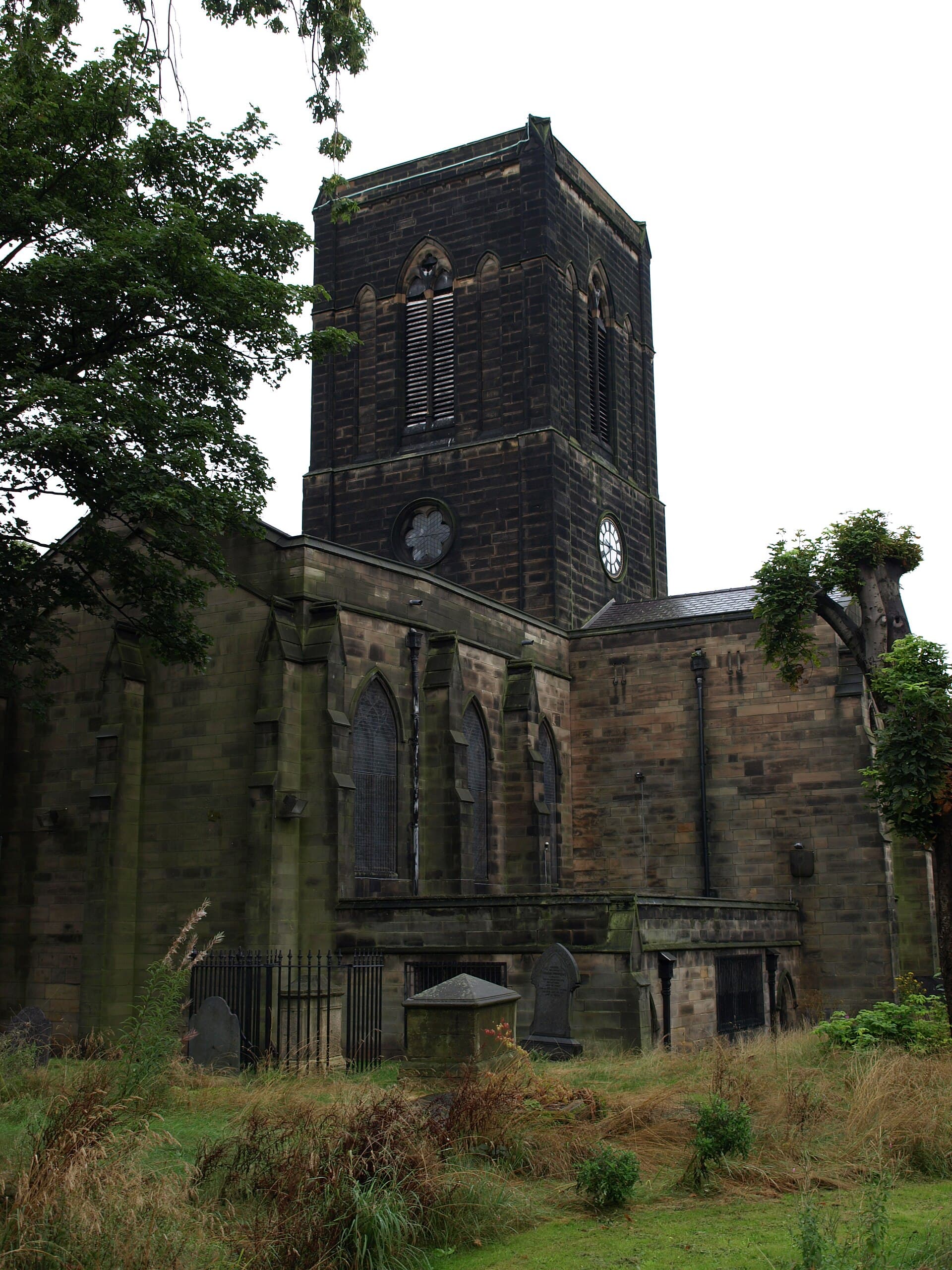
St Stephen's Church, Sneinton, is the Church of England parish church of the Sneinton suburb of Nottingham, a Grade II listed building of special architectural and historic interest with a history that runs from a medieval priory chapel to rock 'n' roll in the vicarage. It also holds a small but cherished place in English literary history: the parents of D. H. Lawrence — the miner Arthur Lawrence and Lydia Beardsall, whose marriage the novelist would anatomise in Sons and Lovers — were married in the church on 27 December 1875.
A church has stood at Sneinton since medieval times, when it was served from Lenton Priory, the great Cluniac house on the other side of Nottingham. After the Dissolution of the Monasteries the church was served mostly by clergy from St Mary's, Nottingham, the town's principal parish church, and Sneinton did not become a parish in its own right until 1866, by which time the village had been absorbed into the expanding industrial town.
The present building dates from 1837 and was designed by Thomas Rickman — the architect-scholar who first classified the phases of English medieval architecture into Norman, Early English, Decorated and Perpendicular — and built by W. Surplice of Nottingham. It was one of the earliest Gothic Revival buildings in Nottinghamshire. St Stephen's is a Commissioners' church: the Church Building Commission granted £1,303 towards its construction, against a full cost of £4,511, equivalent to roughly £400,000 today.
From early in its life the church stood out for the advanced character of its worship. Its catholic liturgy was noted by Wylie as early as 1853, and it was the first church in Nottingham to introduce a surpliced choir — a contemporary account records a male choir dressed in surplices, and observes that this was the only Protestant place of worship in the neighbourhood where such practices as intoning the prayers prevailed. The innovation was well ahead of its neighbours: St Mary's, Nottingham did not put its choir into surplices until 1868. This high-church character later left its architectural mark, for between 1909 and 1912 the church was extended by Cecil Greenwood Hare to designs by George Frederick Bodley, the greatest Anglo-Catholic church architect of the late Victorian age. Bodley also designed the reredos to the high altar, which was carved at Oberammergau — the Bavarian village famous for its Passion Play and its woodcarvers — and depicts scenes from the life of Christ.
The church's most remarkable furnishings are far older than the building itself. The choir stalls date from the fourteenth or fifteenth century and came originally from St Mary's, Nottingham; they were acquired by the organist of St Stephen's in 1848, and they contain fine medieval misericords carved with figures — a rare medieval survival in a Victorian suburban church.
The tower clock has its own civic history. A new clock with four dials, made by Reuben Bosworth, was started on Tuesday 26 December 1865; it was the gift of William Tomlin Esq and cost over £120. In 1967 Nottingham Corporation designated it a public clock and took over responsibility for its maintenance.
The organ history begins with a small pipe organ obtained in 1840, which was sold in 1871 to St Giles' Church, West Bridgford. It was replaced in 1872, at a cost of £450, by an instrument from Brindley & Foster, dedicated at the Harvest Festival on 19 September 1872, when it was played by Herbert Stephen Irons, Rector Chori and Organist of Southwell Minster. The organ was enlarged in 1888, moved from the chancel and rebuilt by Cousans and Sons in 1901, and later worked on by Ernest Wragg and Sons. The known organists run from William Henry Willcockson, who served until 1848, through Thomas Smith (1848–64), W. F. Horners (around 1881), Charles F. C. Hole (from 1882), H. G. Hamilton (from 1903) to Jabez Hack, who presided from about 1920 to 1941.
One of the most engaging episodes in the church's modern history was captured on film. In 1959 St Stephen's featured in a British Pathé newsreel showing the vicar, the Reverend John Tyson, encouraging young people back to church: they helped with the cleaning and attended evening service, and in return were allowed to build a café and rock 'n' roll club in the vicarage — a glimpse of post-war parish life meeting the new youth culture head-on.
The parish's boundaries have shifted with the city around it. Following the closure of St Matthias' Church, Nottingham in 2003, the parish became known as St Stephen and St Matthias, and the church continues to serve Sneinton today — a Rickman shell with a Bodley heart, medieval misericords in its stalls, and the wedding register entry that links it forever to D. H. Lawrence.
Plan a visit
Visiting hours & services.
Visitor information
St Stephen's (now St Stephen and St Matthias) is the active Grade II Anglican parish church of Sneinton in Nottingham. Visitors can see Thomas Rickman's 1837 Gothic Revival building with its Bodley extension and Oberammergau-carved reredos, medieval choir stalls with carved misericords from St Mary's Nottingham, and the 1865 four-dial public clock — and stand where D.H. Lawrence's parents married in 1875.
Where to find it
Location & contact.
In the neighbourhood
Nearby attractions.
Gallery
Sources
Where this record comes from.
This entry is reconciled from open data. Follow the sources to verify the details or suggest a correction.
Nearby