Oldham, United Kingdom№ 000063301
Westwood Moravian Church
- Founded
- 1865
- Tradition
- Non-denominational
- Style
- Victorian Nonconformist Gothic
About this place
History & significance.
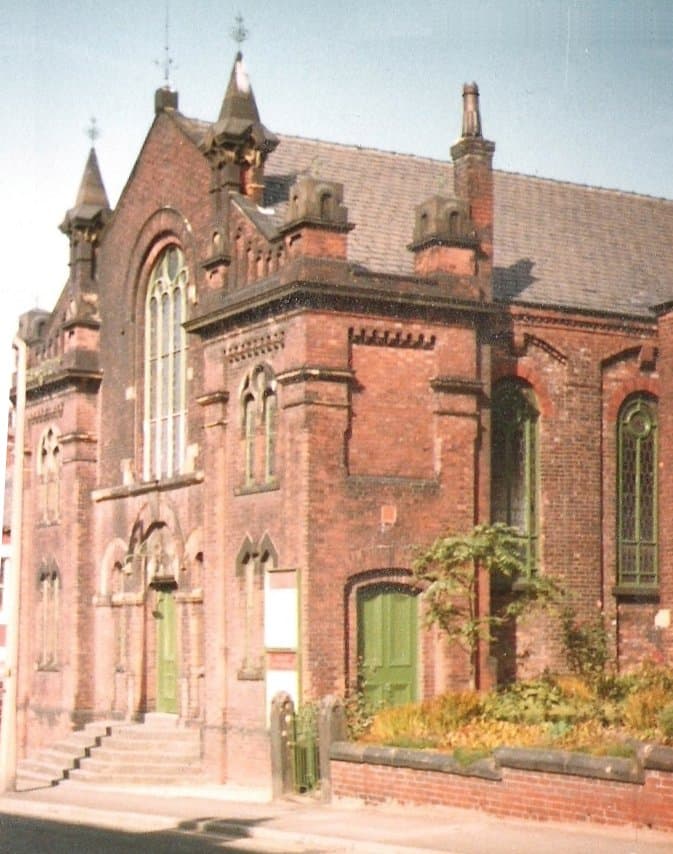
Westwood Moravian Church was founded in 1865 in the Westwood district of Oldham, Greater Manchester, and for 140 years its building on the corner of Middleton Road and Neville Street stood at the heart of community life in one of the town's densest industrial neighbourhoods. The Moravian congregation worshipped there until July 2005, when it moved to new premises in Royton; the Victorian church still stands, and is today home to Firwood Church, a free evangelical congregation.
The mission began with house-based work over 1864 by the Reverend Bennett Harvey, Minister of the Fairfield Moravian Settlement in Droylsden, and the Reverend Frederic La Trobe. It was organised by the leaders of Salem Moravian Church in eastern Oldham, with the support of the British Provincial Board, to serve members who had moved to work in Westwood — then a new industrial district of cotton mills and packed terraced housing, dominated by Westwood Mill and Anchor Mill — joined by settlers from the Dukinfield Moravian Church. The foundation stone of the first chapel on Main Road was laid on 5 August 1865, and the first public services were held in the new building on 12 November 1865, with forty adults in the morning and seventy in the evening. Within a year the chapel could not hold the anniversary crowds, and work began in 1868 on a larger church on Middleton Road, opened on 12 May 1869. Its façade was all show to the road: "pinnacled piers frame a gabled entrance bay with round-headed arches to the door and windows. On each side bays with stairs to the galleries, with cornices and pinnacles at the angles."
The interior evolved with the congregation. A drawing of 1882 shows the organ in an apse at the north end, the pulpit centrally placed before it with stairs on both sides, the communion table in front, and pews facing from right, left and centre. A substantial remodelling in 1924 — costing over £3,000 — added vestries for the minister and choir beyond the old north wall and fitted the front of the church with beautiful oak furniture: choir stalls to right and left, a communion table, chairs, a memorial screen for the war dead, and a new pulpit. In 1932 a baptismal font was given in memory of Brother J. J. Lees. The first organ, bought in 1873 for £100 and first played on Palm Sunday, was replaced in 1903 by an instrument designed by George Benson of Manchester, with great and swell manuals and pedals, installed by Robert Jackson, organist of St Peter's, Oldham — its bellows initially powered by a hydraulic engine running on mains water pressure, the exhaust water going to the nearby Neville Mill, until an electric blower arrived in 1923. Jackson composed the celebrated four-voice setting of "While Shepherds Watched Their Flocks", which became the traditional climax of Westwood's Christingle service just before Christmas; the BBC broadcast the Christingle Service from Westwood in December 1953. A manse was built next door in August 1872, and the original Main Road chapel became the Sunday School — lengthened with a three-storey extension in 1896 to hold 500 scholars, then replaced in 1906 by a new Sunday School Hall whose foundation stones were laid on 7 April by Bishop C. E. Sutcliffe, designed by the architect C. T. Taylor ARIBA at a cost of £1,850, with a fine Edwardian façade to Main Road.
The numbers tell the story of a thriving industrial congregation. In 1900 the Sunday School had thirty-one officers and teachers and 537 enrolled scholars, with average attendances of 197 in the morning and 377 in the afternoon; in 1906 the church counted 173 communicants and 83 adherents. The church's educational work mattered enormously in a town where children could legally work twelve-hour days in the mills and state education did not arrive until 1870 — and even then, of Oldham's 18,085 school-age children, only about half attended school. From the outset the minister taught reading, writing and arithmetic in evening classes, day school teachers hired the Sunday School building for private tuition, and from 1922 to 1957 the School Hall served as an Employment Exchange. The church was a centre of community life far beyond its membership: the Band of Hope, the 7th Oldham Company of the Boys' Brigade, the Women's Guild and a Men's Institute with two full-size billiard tables; a cricket club from 1883, a recreation club for football, cricket and tennis from 1922, Girl Guides from 1932 under Sister Emily Shaw, Boy Scouts begun by the minister Brother Edward Barker during the Second World War, youth clubs from at least 1943, and a Wakes Club from 1953 continuing an older tradition of saving for holidays. A drama society dating back to 1897 merged with the Westwood Glee Club in 1934 and was still staging pantomimes and J. B. Priestley comedies in the 1970s. Even dancing has its history here: after much vexed debate it was permitted from 1921 — no more than six dances a night, except on Christmas Eve and New Year's Eve — a decision that prompted the Sunday School superintendent and a church committee member to resign in protest, before the rules were relaxed in 1931 to allow ninety minutes of dancing at any social event. The neighbours could be less harmonious: the Oldham Corporation Tram Depot stood behind the church, and in 1912 the committee wrote to the Tramways Manager complaining that the grinding of trams disturbed worship, asking that drivers pass slowly and stop ringing the terminus bell during services.
Westwood gave four men to the Moravian ministry. Brother Harry Lloyd, a Platt Brothers employee accepted for missionary training in 1904, served in the West Indies and died in Antigua in 1941 — his son Ronald returning as Westwood's minister from 1945 to 1954. Brother Handel Hassell trained at Fairfield College, graduated from the Victoria University of Manchester, won the Military Cross and Bar in the First World War, and died in 1953 as Principal of Fairfield College. Brother George Harp, once a minder at the Manor Mill in Chadderton, was ordained at Westwood by Bishop Arthur Ward on 21 June 1925 and sailed the following month to serve as a missionary in Labrador. Brother Fred Linyard, ordained at Westwood by Bishop G. W. M. MacLeavy in 1953 after study at Fairfield and Manchester and a year in the United States, served in England and the West Indies, joined the Provincial Board, edited The Moravian Messenger in retirement, and was elected to the distinguished honorary position of Advocatus Fratrum in Anglia. The church also hosted the British Provincial Synod in June 1939, including its opening session, missions session, ordinations and communion services.
By the early twenty-first century, demographic change in Westwood and the growing difficulty of maintaining the buildings forced a decision. In 2005 the congregation left — moving first to St Luke's Anglican Church in Chadderton and then to smaller premises in Royton, six miles away, fulfilling a recommendation made as far back as 1881, when Westwood's then minister Brother H. Reichel had suggested Royton to the Lancashire District Conference as a place for a new congregation. The oak communion table, war memorial plaque, the Lamb and Flag symbol from the pulpit and the 1932 font went with them; the Benson organ, valued at £3,000 in 1965, was left to be broken up. The building on Middleton Road found new life with Firwood Church, which continues Christian worship where the Moravians' mission to Oldham's mill workers began a century and a half ago.
Plan a visit
Visiting hours & services.
Visitor information
The building is now home to Firwood Church, a free evangelical congregation, with Sunday services and weekday community activities; visitors are welcome at service times. The Moravian congregation that built the church now worships in Royton.
Where to find it
Location & contact.
In the neighbourhood
Nearby attractions.
Sources
Where this record comes from.
This entry is reconciled from open data. Follow the sources to verify the details or suggest a correction.
Nearby