Bristol, United Kingdom№ 000061457
John Wesley's New Room
- Founded
- 1739
- Tradition
- Methodist
- Style
- Georgian (18th-century)
About this place
History & significance.
John Wesley's New Room in Bristol is one of the most important buildings in the history of Protestant Christianity, for it is the oldest Methodist building in the world — the cradle of the Methodist movement. Standing between The Horsefair and Broadmead in the heart of the city, opened in 1739, it was the first purpose-built Methodist preaching house ever constructed, and within its walls John Wesley and his brother Charles, the founders of Methodism, organised the earliest Methodist societies. A Grade I listed building, now home to a Methodist museum and still a place of worship, the New Room is a place of pilgrimage for Methodists from across the world, and a monument to a movement that would grow to encompass millions.
The New Room owes its existence to the dramatic events of 1739, when John Wesley, the Anglican clergyman whose open-air preaching was sweeping the country, came to Bristol. On 2 April 1739 he began preaching in the open fields to the working people of the city — colliers, labourers and the poor who rarely entered a church — and founded religious societies among them. Just two months later the New Room was built to house these growing societies; Wesley called it "our New Room in the Horsefair", and it became the oldest purpose-built Methodist chapel in the world. From 3 June 1739 the Methodist societies of Bristol met here as the "United Society", the model on which Methodism would be organised everywhere.
The building reflects the practical, frugal character of early Methodism. It was built with a double-decker pulpit, from which the preacher could be seen and heard by all, and was lit by an octagonal lantern window in the roof — partly, it is said, to reduce the amount paid in the hated window tax. The pews and benches were made from old ship timber, a thrifty use of materials in a great port city. But the New Room was far more than a place of worship: it served as a dispensary, providing medicine to the poor of the area, and as a schoolroom, reflecting Wesley's deep concern for the welfare, education and health of ordinary people. Wesley even published a popular medical handbook, Primitive Physick, and the New Room housed one of the first medical dispensaries in Bristol. He also sold his many published works from a bookstore here — and so prolific were the Methodists that, of all the printed output of Bristol between 1695 and 1775, more than half was written by them.
Wesley was careful, in these early years, that Methodism should complement rather than compete with the Church of England, to which he remained loyal: he insisted that meetings at the New Room be held only outside the hours of Anglican church services. In 1748 the building was enlarged, possibly by the Quaker architect George Tully, and rooms were built above the chapel in which Wesley and the other itinerant preachers could stay. John Wesley himself lived at the New Room from 1748 to 1771, making it in effect the headquarters of the early movement, and he administered Holy Communion here when his brother Charles — the great hymn-writer, author of so many of the best-loved hymns in the English language, who lived in Bristol — was away. Only reluctantly did Wesley allow the enlarged New Room to be registered under the Toleration Act as a formal place of worship, for he believed that the sacraments should properly be celebrated in the parish churches; but the logic of the movement was carrying Methodism towards becoming a church in its own right.
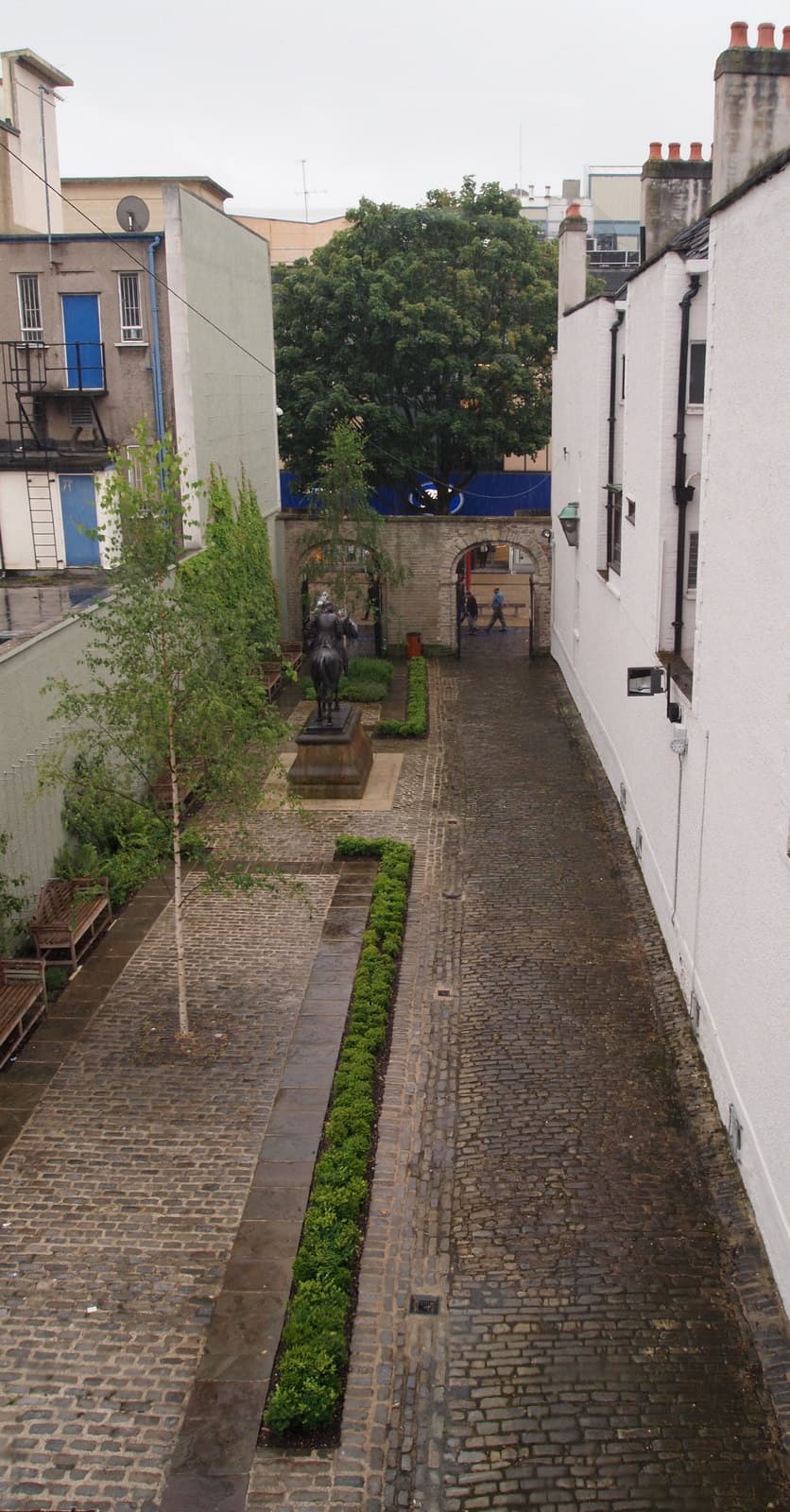
The building has been carefully preserved. After Wesley's death the property passed in 1808 to the Welsh Calvinistic Methodists, but in 1929 it was bought back by the Wesleyan Methodist Church and restored by the architect Sir George Oatley, who returned it to something like its eighteenth-century appearance; a fine chamber organ by John Snetzler, made in 1761, was installed at this time. The courtyards around the building hold statues of John and Charles Wesley, and a garden was created in the Broadmead courtyard in 2011. Today the preachers' rooms above the chapel house a museum telling the story of the Wesleys and the rise of Methodism, while the chapel below remains in use for worship — a living link to the very origins of the movement.
The New Room stands in the centre of Bristol, surrounded by the modern shops of the Broadmead and Cabot Circus shopping districts, yet preserving within them an oasis of eighteenth-century calm. The historic harbourside of Bristol, with Brunel's pioneering steamship the SS Great Britain and the M Shed museum, the medieval Bristol Cathedral and St Mary Redcliffe, the elegant streets and the famous Clifton Suspension Bridge are all within easy reach in one of England's most vibrant and historic cities.
From John Wesley's open-air preaching in 1739, through the building of the New Room as the first Methodist chapel in the world, its use as chapel, dispensary, school and bookshop, and Wesley's years living and working here at the heart of the early movement, to its restoration and its life today as a museum and place of worship, John Wesley's New Room gathers the very birth of Methodism into one building. A Grade I listed treasure in the heart of Bristol, it remains the oldest Methodist building in the world — the cradle of a movement that spread from this small Bristol chapel across the globe.
Plan a visit
Visiting hours & services.
Visitor information
John Wesley's New Room is the oldest Methodist building in the world - the first purpose-built Methodist chapel, opened in 1739 - and is both an active place of worship and a museum. A Grade I listed building between The Horsefair and Broadmead in central Bristol, it preserves its 18th-century chapel with double-decker pulpit, the preachers' rooms where John Wesley lived (now a Methodist museum), and courtyards with statues of John and Charles Wesley. It welcomes visitors and pilgrims.
Where to find it
Location & contact.
In the neighbourhood
Nearby attractions.
Gallery
Sources
Where this record comes from.
This entry is reconciled from open data. Follow the sources to verify the details or suggest a correction.
Nearby