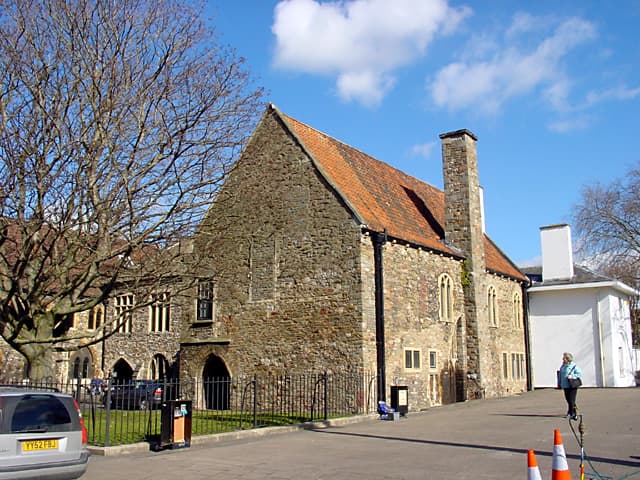
Bristol, United Kingdom№ 000062086
Quakers Friars
- Founded
- 1227
- Architect
- George Tully
- Style
- Georgian
About this place
History & significance.
Quakers Friars, in the Broadmead quarter of central Bristol, carries two great religious histories in a single name. The "Friars" were the Dominicans — the Black Friars whose priory was founded here by Maurice de Gaunt around 1227, a mere twelve years after St Dominic founded the order and six after it first reached England. The "Quakers" came four centuries later, worshipping on the site for nearly three hundred years. Today the Grade I listed building, having served as a register office, theatre and a succession of restaurants amid the Cabot Circus shopping development, no longer hosts worship — but few buildings in Bristol hold so much layered devotion.
The medieval priory has one striking royal association: in 1287 Llywelyn ap Dafydd, eldest son and heir of Dafydd ap Gruffudd, the last native Prince of Wales, was buried here. He had died in captivity at nearby Bristol Castle, where he had been confined since his father's execution in 1283 — a child prisoner of Edward I's conquest of Wales. The priory was dissolved in 1538 and partitioned: parts went to the Smiths and Cutlers Company and the Bakers Company as guildhalls, the rest to private owners, with much of the land eventually passing to Dennis Hollister, a prominent Bristol businessman and Member of Parliament for Somerset.
Hollister proved the hinge of the site's second religious life. Quakerism arrived in Bristol in 1654 with John Audland and John Camm, two Cumbrian members of the "Valiant Sixty" — the travelling ministers fired by George Fox's early preaching journeys. Hollister, then a Baptist already stirred by the Quaker message, housed them and hosted the city's first meetings for worship in his Broadmead orchard — ground originally planted by the Dominicans themselves. The mission caused scandal among Bristol's establishment and extraordinary excitement among its people; as Audland and Camm reported in 1654, "Every day we have a meeting… the house was all filled so the street: so the voice went forth." George Fox first visited Bristol Friends in 1656, and in October 1669 Fox married Margaret Fell — Quakerism's co-founder and "nursing mother" — at the Broadmead Great Meeting House nearby.
It was during the couple's wedding stay that Bristol Friends completed the purchase of the old Blackfriars site from Hollister, in 1669. The priory's east range was demolished and a purpose-built meeting house erected in 1670 at a recorded cost of £655, with ground for a burial place. Persecution followed quickly: in 1681, during the crackdowns under the Conventicle Act, a mob led by John Hellier attacked the meeting house. The community nonetheless grew until, by 1746, the old building — by then incorporating much of the surviving priory, including the Cutlers' and Bakers' Halls — was too small. It was demolished in 1747, and more property purchased, including the "Old Orchard" where Camm and Audland had held those first meetings ninety years before.
The present building rose in 1747–49 to designs by the Quaker architect George Tully, who around the same time had worked on John Wesley's New Room nearby; the fine moulding and detail work was by Thomas Paty, Bristol's leading carver. The result was a landmark in Quaker architecture: a grand galleried space arranged around a central ministers' gallery, with eight Doric columns and a square lantern light overhead. Pevsner observed that Quakers Friars must be "the first building of the Quakers to accept this degree of monumentality or display" — and indeed some conservative Friends grumbled that it was too ornate, the money better spent relieving poverty. The works cost £1,830, with £261 more in land and legal fees. In 1828 the meeting bought the rest of the surviving Blackfriars cloister to house a school and charitable work.
The Quaker centuries ended quietly. In 1954 the meeting resolved to sell the entire site to Bristol City Council and build smaller; the last meeting for worship on the site was held in 1956, and Bristol Central Friends Meeting continues today at the Central Quaker Meeting House on Champion Square, opened in 1962. The old building became Bristol's register office — generations of Bristolians were married within its Doric hall — and after renovation as part of the Cabot Circus development it now houses restaurants, its medieval cloister fragments and Georgian meeting hall improbably preserved at the heart of a twenty-first-century shopping quarter. It remains one of the most important sites in England for the early history of both the Dominican Order and the Religious Society of Friends.
Plan a visit
Visiting hours & services.
Visitor information
Quakers Friars is a Grade I listed former Dominican priory and Quaker meeting house in Broadmead, central Bristol, now home to restaurants within the Cabot Circus development - it no longer hosts worship (Bristol's Quakers meet at the Central Meeting House on Champion Square). Visitors can freely view the exterior, the surviving priory cloister fragments and George Tully's 1747-49 Georgian meeting hall while exploring the shopping quarter.
Where to find it
Location & contact.
In the neighbourhood
Nearby attractions.
Sources
Where this record comes from.
This entry is reconciled from open data. Follow the sources to verify the details or suggest a correction.
Nearby