London, United Kingdom№ 000094579
Roman Catholic Church of St Peter
- Founded
- 1843
- Tradition
- Roman Catholic
- Architect
- Augustus Pugin
- Style
- Gothic Revival
About this place
History & significance.
St Peter's Roman Catholic Church stands between Woolwich New Road and Brookhill Road in Woolwich, south-east London, its main entrance on Woolwich New Road — one of only three churches in London designed by Augustus Pugin, the great evangelist of the Gothic Revival. Designed in 1841–42, it remains unfinished to this day: the projected tower and spire were never built. The parish of St Peter the Apostle serves the Catholic community of central Woolwich and the surrounding areas within the Archdiocese of Southwark.
The Catholic story of Woolwich begins in hardship. In the late eighteenth and early nineteenth centuries, as Catholic emancipation gradually gave Catholics in Britain and Ireland freedom to worship and establish schools and churches, the Catholic mission in Woolwich mainly served Catholic prisoners held on the prison hulks moored in the Thames near the Royal Arsenal. By 1793 the mission consisted largely of poor families, some employed at the Arsenal, together with Irish soldiers stationed at the Royal Artillery Barracks and the town's other barracks. The mission first used a small chapel in Greenwich, then from 1816 an unauthorized chapel in Sun Alley — now Sunbury Street — by which time the congregation had its own priest, Father James Delaney. In 1818 a former Methodist chapel opposite the present Woolwich Arsenal station was rededicated, seating four hundred, and ten years later a Catholic school was established. In 1838 a young London-born priest named Cornelius Coles, probably of Irish or Belgian origin, was stationed in Woolwich; his principal tasks became the building of a new church for a congregation estimated at three thousand by 1841, and a school for children who, Coles reported even in 1855, suffered persecution in the barrack schools.
In February 1841 the Board of Ordnance made a plot on Woolwich New Road, next to The Gun public house, available to the Woolwich Catholics free of charge, and in September the commission for the design went to the twenty-nine-year-old Augustus Welby Northmore Pugin. Coles may have known Pugin from his previous post at Holy Trinity, Bermondsey, where the architect had built a monastery in 1838. Few of Pugin's letters mention St Peter's — he was simultaneously at work on the far more prestigious St George's Cathedral, Southwark — but his published correspondence includes extracts from Father Coles's letters showing the architect's keen interest in the furnishings.
The laying of the foundation stone on 26 October 1842 was itself historic: the first time in London such a Catholic ceremony had been performed openly since the Reformation. Only a year earlier, the foundation stone of St George's Cathedral had been laid in secrecy at seven in the morning for fear of a Protestant backlash; in Woolwich, perhaps the knowledge that a large number of Irish soldiers would be in attendance gave priest and congregation their confidence. The church was built in 1842–43 by the local builder George Myers — Pugin's favourite contractor — in yellow London stock brick with Bath stone dressings and slate roofs. The limited budget forced a sober design built in phases: no transept, no clerestory, restrained dressings. The nave and aisles cost £4,000, of which Thomas Griffiths, Vicar Apostolic of London, gave £1,000.
Pugin added the sacristy and presbytery in 1845–46 — the small presbytery is praised by the Survey of London as "one of Pugin's best small brick secular buildings, plain but fetchingly proportioned" — and the Lady Chapel, smaller than his original design, followed in 1850. After Pugin's death his son Edward Welby Pugin built the school to the south in 1858, and the chancel and south chapel, in keeping with Pugin's plans and manner, were added in 1887–89 by the Scottish architect Frederick Walters, who also worked on St George's Cathedral. A much larger presbytery by John Crawley was added in 1870, coarser than the older house and rather overshadowing it.
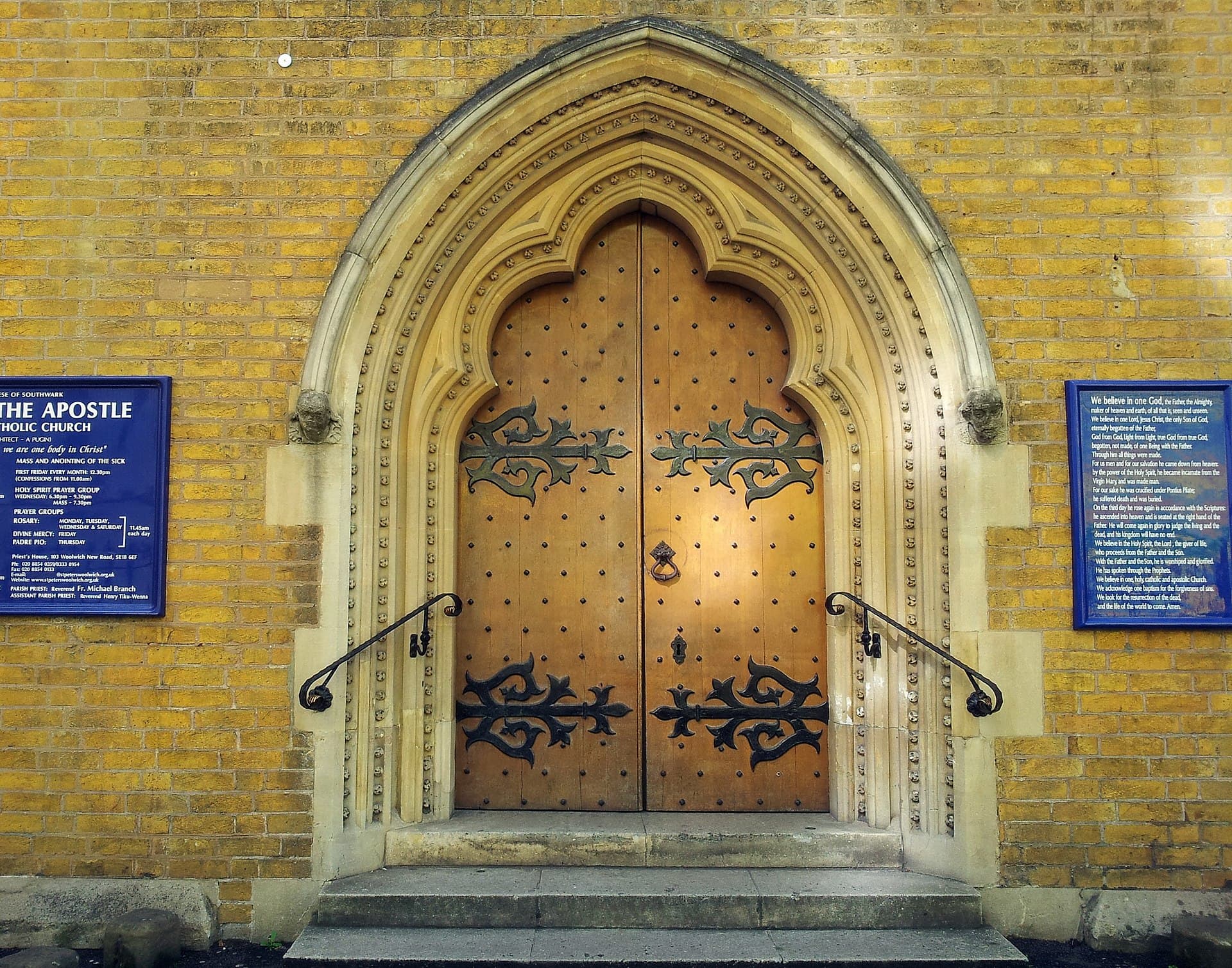
The exterior's most striking feature is, paradoxically, an absence: the planned south-west tower, never built, leaves the church looking unbalanced. Pugin believed Gothic architecture celebrated asymmetry, and so placed his tower at a corner rather than at the centre of the west front. Stepped buttresses support the aisles, angled buttresses the east end; the south aisle portal carries the richest decoration, with crockets and ball flowers, while the smaller west portal is now the main entrance. Inside, the six-bay nave revives the Decorated Gothic of around 1300 — the style Pugin preferred to call that of Edward I. The roof ridges rise at a sharp angle; with no galleries and no clerestory the church is rather dark, and the white and mint-green repainting intended to counter this is described by the Survey of London as "gaudy" and "alien to Pugin's aesthetic." Pointed arches rest on quatrefoil piers between nave and aisles, and the plainness of the nave sets off the richness of the chancel, with its original 1840s altar and traceried stone reredos, possibly in part original. The choir screen Pugin intended was never built. The Lady Chapel preserves an original ensemble of altar, reredos, Minton tiles and a Hardman & Co. stained glass window; the east window was designed by Pugin himself and initially set in a temporary wall closing off the nave, its glass made by Lavers, Barraud and Westlake in 1909. After the Second Vatican Council the pulpit and altar rails were removed and a forward altar added.
E. W. Pugin's school building survives, much altered front and back, as the parish hall — St Peter's Centre — while the separate infant school of 1871 behind it stands empty. In May 2019 the church became part of the Woolwich Conservation Area, which embraces Woolwich New Road, the Bathway Quarter, General Gordon Square, Beresford Square, Powis Street and St Mary's Church and Gardens. Pugin's tower may never have risen, but his brick Gothic church — begun with the first open Catholic foundation ceremony London had seen in three centuries — still anchors the Catholic life of Woolwich, between the barracks and the Arsenal that first gathered its people.
Plan a visit
Visiting hours & services.
Visitor information
St Peter's is on Woolwich New Road in central Woolwich, two minutes' walk from Woolwich Arsenal station (Elizabeth line, DLR and Southeastern) and the town's bus interchange. It is an active Roman Catholic parish church in the Archdiocese of Southwark, with daily Mass, weekend Masses serving Woolwich's diverse Catholic community, and confessions; the church is generally open around service times. Notice the deliberately asymmetrical west front with its never-built corner tower, the crocketed south portal, the 1840s altar and reredos, the Minton-tiled Lady Chapel with Hardman glass, and Pugin's east window.
Where to find it
Location & contact.
In the neighbourhood
Nearby attractions.
Gallery
Sources
Where this record comes from.
This entry is reconciled from open data. Follow the sources to verify the details or suggest a correction.
Nearby