London, United Kingdom№ 000058690
St George's Garrison Church
- Founded
- 1863
- Tradition
- Anglican / Episcopal
- Architect
- T. H. Wyatt
- Style
- Romanesque Revival
About this place
History & significance.
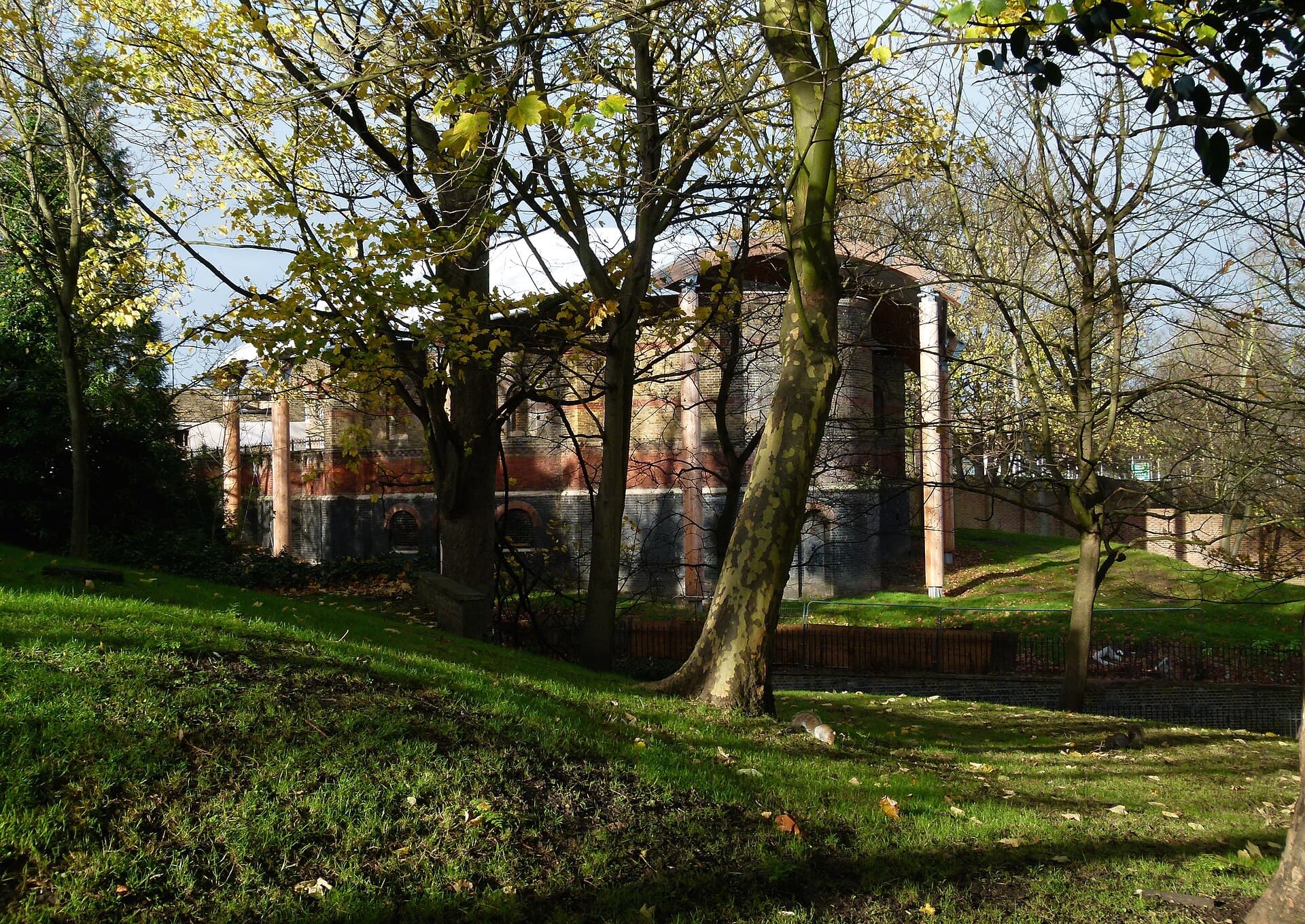
St George's Garrison Church is a ruined church in Woolwich, in the Royal Borough of Greenwich, South East London — built in 1862–63 as the Church of England place of worship for the Royal Artillery garrison, largely destroyed by a V-1 flying bomb in 1944, and now preserved as one of London's most poignant memorial sites: a restored ruin with a canopied roof, walls of blue, red and yellow brick, Venetian mosaics, and a memorial garden where the nave once stood, open to the public on Sundays.
The church was built on a triangular plot between Grand Depot Road — part of the South Circular — and Woolwich New Road, its entrance facing the parade ground of the Royal Artillery Barracks, the heart of military Woolwich. The Royal Artillery's first chapel, built in 1808 as part of the barracks complex at the north end of Woolwich Common, was converted into a theatre when St George's opened. The idea for the new garrison church came from Lord Sidney Herbert, the Secretary of State for War — the great army reformer and ally of Florence Nightingale — and his influence shows in the design, which closely resembles T. H. Wyatt's parish church at Wilton, near the Herbert family seat at Wilton House. Wyatt, assisted by his younger brother Matthew, designed for Woolwich a church in the Early Christian and Lombardic Romanesque style with Byzantine influences in the interior; the choice of the Wyatt brothers may also have owed something to family history, for both the Royal Artillery Barracks and the Royal Military Academy nearby had been designed by their great-great-grandfather James Wyatt. The church was built by George Smith and Co of Pimlico. Soon after completion the seating was increased from 1,550 to 1,700; Royal Artillery officers raised money for stained glass windows and an organ, mosaics followed in 1902–03, and memorials to deceased artillerymen accumulated, with an obelisk to the fallen of the Second Boer War erected south of the church, where the two roads converge.
The exterior follows the Romanesque Revival, its polychromatic brick typical of the mid-Victorian decades. The narthex at the west end, inspired by the Romanesque churches of northern Italy, consists of three porches with Bath stone columns and carved capitals, the two western columns of the central porch quatrefoil-shaped and of Aberdeen granite. The original west façade carried a rose window and stood about four times higher than what remains of the narthex today. The church was a large basilica with a wide nave and narrow aisles — of which almost nothing now survives — and it never had a tower, only a small belfry perched slightly incongruously on the roof of the south aisle. The interior combined neo-Romanesque and neo-Byzantine: most was lost to fire and neglect, but the lower chancel remains impressive, with architectural details, commemorative plaques, the original altar and the lower part of the pulpit, while of the once-striking galleried ironwork only two damaged corbels survive.
The chancel mosaics were made in the Salviati workshop in Venice and installed by Burke & Co in 1902–03. The best-preserved panels show ancient Christian symbols — vines with grapes, a peacock, and a phoenix rising from the flames, an image that would prove prophetic. A small mosaic of the Lamb of God, saved from the rubble, survives — improbably — in one of the toilets of the north-west porch. The largest mosaic, St George and the Dragon in the apse, was added in 1919–20 as part of a memorial to the Royal Artillery men who had won the Victoria Cross.
On 13 July 1944 a V-1 flying bomb struck the church, and the resulting fire destroyed the interior. The walls survived more or less intact and a temporary roof was erected, but the church was no longer needed — the smaller chapel of St Michael and All Angels at the Royal Military Academy proved a sufficient replacement — and the burned-out shell suffered years of neglect and vandalism. A rebuilding scheme proposed by the architect Kenneth Lindy in 1952 failed to win support. In 1970 the upper walls were demolished and a corrugated canopy roof was raised over the remains of the apse; photographs from the 1960s show the apse windows then still in place, along with the upper parts of the chancel-arch columns and parts of the pulpit. A memorial garden was laid out in the roofless nave and aisles the same year. In 1973 the building was listed — for its polychromatic Victorian brickwork, as part of the historic military ensemble of Woolwich, and, remarkably, for demonstrating the impact of aerial assault, reflected in its very ruination.
Salvation came in the twenty-first century. In 2011 ownership passed from the Defence Infrastructure Organisation to Heritage of London Trust Operations, and the Heritage Lottery Fund awarded nearly £400,000 toward an £800,000 conservation programme, including a larger canopy roof over the east end. Since 2016 the church has been run by the Woolwich Garrison Church Trust, a local group, with further plans to restore the pulpit and reinstall the alabaster panels of the apse, currently in storage.
St George's has been a memorial church for more than a century, and its garden of remembrance keeps gathering names. Marble plaques to artillerymen survive in the apse beside the Victoria Cross memorial; a column of the chancel arch bears the names of men killed in conflicts up to the Second World War; copper plaques on the aisle walls record Royal Artillery men who died in action or of natural causes after 1945. On 11 November 2015 the Royal Borough of Greenwich added a memorial marking Woolwich's history as a barracks town, commemorating all who served or lived in Woolwich and gave their lives in the service of their country — including the victims of the IRA bombing of the King's Arms pub in 1974, and Fusilier Lee Rigby, murdered by Islamist terrorists in Woolwich in 2013. The phoenix in the Salviati mosaic still rises from its flames above the altar — the garrison church that was bombed, burned, abandoned and finally embraced, keeping faith with the gunners of Woolwich under its open sky.
Plan a visit
Visiting hours & services.
Visitor information
St George's Garrison Church is a preserved ruined church on Woolwich New Road in Woolwich, south-east London — the former Church of England garrison church of the Royal Artillery, built in 1862–63 and destroyed by a V-1 flying bomb in 1944. Now a memorial garden with surviving Venetian mosaics under a canopy roof, cared for by the Woolwich Garrison Church Trust, it is open to the public on Sundays.
Where to find it
Location & contact.
In the neighbourhood
Nearby attractions.
Gallery
Sources
Where this record comes from.
This entry is reconciled from open data. Follow the sources to verify the details or suggest a correction.
Nearby